 Movie
Movie Controller

[English] 日本語
 Yorodumi
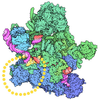
- EMDB-43735: Structure of a LGR dimer from Caenorhabditis elegans in apo state -
+ Open data

- Basic information
| Entry |  | |||||||||
|---|---|---|---|---|---|---|---|---|---|---|
| Title | Structure of a LGR dimer from Caenorhabditis elegans in apo state | |||||||||
 Map data Map data | ||||||||||
 Sample Sample |
| |||||||||
 Keywords Keywords | glycoprotein hormones / glycoprotein hormone receptors / leucine-rich-repeat-containing GPCRs (LGRs) / Caenorhabditis elegans / dimer / cryo-EM. / MEMBRANE PROTEIN | |||||||||
| Function / homology |  Function and homology information Function and homology informationprotein-hormone receptor activity / G protein-coupled receptor activity / plasma membrane Similarity search - Function | |||||||||
| Biological species |   Caenorhabditis elegans (invertebrata) Caenorhabditis elegans (invertebrata) | |||||||||
| Method | single particle reconstruction / cryo EM / Resolution: 3.79 Å | |||||||||
 Authors Authors | Gong Z / Hendrickson WA | |||||||||
| Funding support |  United States, 1 items United States, 1 items
| |||||||||
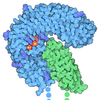
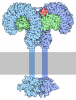
 Citation Citation | Journal: Nat Commun / Year: 2025 Title: Structure of an LGR dimer, an evolutionary predecessor of glycoprotein hormone receptors. Authors: Zhen Gong / Shuobing Chen / Ziao Fu / Brian Kloss / Chi Wang / Jonathan Kim / Oliver B Clarke / Qing R Fan / Wayne A Hendrickson /  Abstract: Glycoprotein hormones (GpHs) produced in the human pituitary act through receptors (GpHRs) in the gonads to support reproduction and in the thyroid for metabolism. GpHs are heterodimeric cystine-knot ...Glycoprotein hormones (GpHs) produced in the human pituitary act through receptors (GpHRs) in the gonads to support reproduction and in the thyroid for metabolism. GpHs are heterodimeric cystine-knot proteins; their receptors bind cognate hormones at an extracellular domain and signal through a transmembrane domain to heterotrimeric G proteins. GpHs and GpHRs have co-evolved from invertebrate counterparts. Structures of the human receptors as isolated for cryogenic electron microscopy (cryo-EM) are all monomeric despite compelling evidence for their functioning as dimers. Here we characterize the homologous receptor from Caenorhabditis elegans. Its biochemical properties are notably similar to those of the thyroid stimulating hormone receptor (TSHR) of humans. Structurally, it is an asymmetric dimer (protomers screw-transformed by 142°/4.1 Å), composed such that only one hormone could bind. This is compatible with the 1:2 asymmetry of negatively cooperative TSH:TSHR complexes and for the transactivation evident from functional complementation of binding-deficient and signaling-deficient GpHRs. By modeling, a symmetrized dimer can bind two hormones as in the 2:2 complexes that support TSHR switches in G-protein usage. | |||||||||
| History |
|
- Structure visualization
| Supplemental images |
|---|

- Downloads & links
-EMDB archive
| Map data | emd_43735.map.gz | 56.8 MB | EMDB map data format | |
|---|---|---|---|---|
| Header (meta data) | emd-43735-v30.xmlemd-43735.xml | 18 KB 18 KB | Display Display | EMDB header |
| Images |  emd_43735.png emd_43735.png | 140.9 KB | ||
| Filedesc metadata | emd-43735.cif.gz | 6.3 KB | ||
| Others | emd_43735_half_map_1.map.gzemd_43735_half_map_2.map.gz | 59.3 MB 59.4 MB | ||
| Archive directory |  https://data.pdbj.org/pub/emdb/structures/EMD-43735ftp://data.pdbj.org/pub/emdb/structures/EMD-43735 https://data.pdbj.org/pub/emdb/structures/EMD-43735ftp://data.pdbj.org/pub/emdb/structures/EMD-43735 | HTTPS FTP |
-Related structure data
| Related structure data |  8w1zMC M: atomic model generated by this map C: citing same article ( |
|---|---|
| Similar structure data |
-Links
| EMDB pages | EMDB (EBI/PDBe) / EMDataResource |
|---|---|
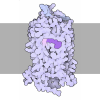
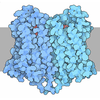
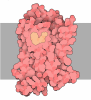
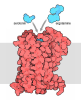
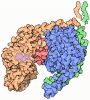
| Related items in Molecule of the Month |
-Map
| File | Download / File: emd_43735.map.gz / Format: CCP4 / Size: 64 MB / Type: IMAGE STORED AS FLOATING POINT NUMBER (4 BYTES) | ||||||||||||||||||||||||||||||||||||
|---|---|---|---|---|---|---|---|---|---|---|---|---|---|---|---|---|---|---|---|---|---|---|---|---|---|---|---|---|---|---|---|---|---|---|---|---|---|
| Projections & slices | Image control
Images are generated by Spider. | ||||||||||||||||||||||||||||||||||||
| Voxel size | X=Y=Z: 1.06 Å | ||||||||||||||||||||||||||||||||||||
| Density |
| ||||||||||||||||||||||||||||||||||||
| Symmetry | Space group: 1 | ||||||||||||||||||||||||||||||||||||
| Details | EMDB XML:
|
 Z (Sec.)
 Y (Row.)
 X (Col.)


-Supplemental data
-Half map: #1
| File | emd_43735_half_map_1.map | ||||||||||||
|---|---|---|---|---|---|---|---|---|---|---|---|---|---|
| Projections & Slices |
| ||||||||||||
| Density Histograms |


-Half map: #2
| File | emd_43735_half_map_2.map | ||||||||||||
|---|---|---|---|---|---|---|---|---|---|---|---|---|---|
| Projections & Slices |
| ||||||||||||
| Density Histograms |


- Sample components
-Entire : CeLGR
| Entire | Name: CeLGR |
|---|---|
| Components |
|
-Supramolecule #1: CeLGR
| Supramolecule | Name: CeLGR / type: organelle_or_cellular_component / ID: 1 / Parent: 0 / Macromolecule list: #1 |
|---|---|
| Source (natural) | Organism: Caenorhabditis elegans (invertebrata) |
| Molecular weight | Theoretical: 79.3 kDa/nm |
-Macromolecule #1: G-protein coupled receptors family 1 profile domain-containing protein
| Macromolecule | Name: G-protein coupled receptors family 1 profile domain-containing protein type: protein_or_peptide / ID: 1 / Number of copies: 2 / Enantiomer: LEVO |
|---|---|
| Source (natural) | Organism: Caenorhabditis elegans (invertebrata) |
| Molecular weight | Theoretical: 79.362734 KDa |
| Recombinant expression | Organism:  Homo sapiens (human) Homo sapiens (human) |
| Sequence | String: DYKDDDDKQN ALSLAQTKHS CMALKAEDGE GCTCKQTKRY GQPECCCMGL IVSQLPTNLT ADVGYLYLHN TSISVITPNF FDKFPSIRE LEIDNSAHLE HIDGSSLSVL SKLRKLSVVK CPNLREISGK LLVNNTRIQN VILKNNGLAT MPSLRMTDAH H VLLDRIDL ...String: DYKDDDDKQN ALSLAQTKHS CMALKAEDGE GCTCKQTKRY GQPECCCMGL IVSQLPTNLT ADVGYLYLHN TSISVITPNF FDKFPSIRE LEIDNSAHLE HIDGSSLSVL SKLRKLSVVK CPNLREISGK LLVNNTRIQN VILKNNGLAT MPSLRMTDAH H VLLDRIDL SGNKIKFISD SKVRNVKART VVLSENKLIE ISGYAFTESQ FLKLKLNNNP DLRSLSVDAF KNMAGLQTLD LS HTSIDTL PINGLKKLKT LILNDVPTLK SLPSVLSFTD LETAHFTYPH HCCLFKYVDD VTMNDNGKYQ RNAKEIHKRI CDK REQQKV ARRRKRETSG IDFLDMLLKE WTDNSTYTGP DDADDDELPP FVEIGAEPCQ SIGEEVQKYY SNITCYPQPD ALNP CENIV GYPFLRIAVW VVCLAAIVGN IIVWALLGIV YEKRMRMHYL YMINMSVADM VTGIYLAVLA IADAKMSDEY YRHAV WWQT GWGCRAAGFL AVFASELGII SMFLIAFEMS YNTRQSFRGR RLSPKVGVLL MIGGWLFAII MAILPWFDVS SYSESS VCL PLRAATIFDK SYLIFGLSFN FLAFAAMALS YGFIVKMLKE NETREEDRAL ITKMTVLVVT DLICWFPTLF FGFTATI GF PLLSLSSAKF VLVFFFPINA FANPFLYVFF TEVIQHRVRS KTLPVIRRAA ADYKDDDDK UniProtKB: G-protein coupled receptors family 1 profile domain-containing protein |
-Macromolecule #2: 2-acetamido-2-deoxy-beta-D-glucopyranose
| Macromolecule | Name: 2-acetamido-2-deoxy-beta-D-glucopyranose / type: ligand / ID: 2 / Number of copies: 6 / Formula: NAG |
|---|---|
| Molecular weight | Theoretical: 221.208 Da |
| Chemical component information | 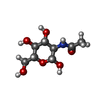 ChemComp-NAG: |
-Macromolecule #3: CHOLESTEROL
| Macromolecule | Name: CHOLESTEROL / type: ligand / ID: 3 / Number of copies: 1 / Formula: CLR |
|---|---|
| Molecular weight | Theoretical: 386.654 Da |
| Chemical component information | 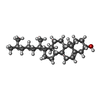 ChemComp-CLR: |
-Experimental details
-Structure determination
| Method | cryo EM |
|---|---|
 Processing Processing | single particle reconstruction |
| Aggregation state | particle |
-Sample preparation
| Buffer | pH: 7.5 |
|---|---|
| Vitrification | Cryogen name: ETHANE |
- Electron microscopy
| Microscope | FEI TITAN KRIOS |
|---|---|
| Image recording | Film or detector model: GATAN K2 SUMMIT (4k x 4k) / Average electron dose: 71.01 e/Å2 |
| Electron beam | Acceleration voltage: 300 kV / Electron source:  FIELD EMISSION GUN FIELD EMISSION GUN |
| Electron optics | Illumination mode: FLOOD BEAM / Imaging mode: BRIGHT FIELD / Nominal defocus max: 2.0 µm / Nominal defocus min: 1.2 µm |
| Experimental equipment |  Model: Titan Krios / Image courtesy: FEI Company |
