 Movie
Movie Controller
 Structure viewers
 About Yorodumi Papers


+Search query
-Structure paper
| Title | Polymorphic Self-Assembly with Procedural Flexibility for Monodisperse Quaternary Protein Structures of DegQ Enzymes. |
|---|---|
| Journal, issue, pages | Adv Mater, Vol. 36, Issue 19, Page e2308837, Year 2024 |
| Publish date | Feb 28, 2024 |
 Authors Authors | Hanul Jeon / Ah-Reum Han / Sangmin Oh / Jin-Gyeong Park / Myeong Namkoong / Kyeong-Mi Bang / Ho Min Kim / Nak-Kyoon Kim / Kwang Yeon Hwang / Kahyun Hur / Bong-Jin Lee / Jeongyun Heo / Sehoon Kim / Hyun Kyu Song / Hyesung Cho / In-Gyun Lee /  |
| PubMed Abstract | As large molecular tertiary structures, some proteins can act as small robots that find, bind, and chaperone target protein clients, showing the potential to serve as smart building blocks in self- ...As large molecular tertiary structures, some proteins can act as small robots that find, bind, and chaperone target protein clients, showing the potential to serve as smart building blocks in self-assembly fields. Instead of using such intrinsic functions, most self-assembly methodologies for proteins aim for de novo-designed structures with accurate geometric assemblies, which can limit procedural flexibility. Here, a strategy enabling polymorphic clustering of quaternary proteins, exhibiting simplicity and flexibility of self-assembling paths for proteins in forming monodisperse quaternary cage particles is presented. It is proposed that the enzyme protomer DegQ, previously solved at low resolution, may potentially be usable as a threefold symmetric building block, which can form polyhedral cages incorporated by the chaperone action of DegQ in the presence of protein clients. To obtain highly monodisperse cage particles, soft, and hence, less resistive client proteins, which can program the inherent chaperone activity of DegQ to efficient formations of polymorphic cages, depending on the size of clients are utilized. By reconstructing the atomic resolution cryogenic electron microscopy DegQ structures using obtained 12- and 24-meric clusters, the polymorphic clustering of DegQ enzymes is validated in terms of soft and rigid domains, which will provide effective routes for protein self-assemblies with procedural flexibility. |
 External links External links | Adv Mater / PubMed:38351715 |
| Methods | EM (single particle) |
| Resolution | 2.5 - 4.17 Å |
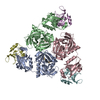
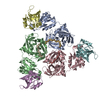
| Structure data | EMDB-37257, PDB-8kic: EMDB-37318, PDB-8w69: 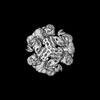 EMDB-37331: Cryo-EM structure of the DegQ dodecamer with a lysozyme  EMDB-37333: Structure of DegQ-b-casein complex |
| Source |
|
 Keywords Keywords | HYDROLASE / Seine protease / Complex |


 escherichia coli (E. coli)
 gallus gallus (chicken)
 bos taurus (domestic cattle)