 Movie
Movie Controller
 Structure viewers
 About Yorodumi Papers


+Search query
-Structure paper
| Title | Molecular structure and characterization of the Thermochromatium tepidum light-harvesting 1 photocomplex produced in a foreign host. |
|---|---|
| Journal, issue, pages | Biochim Biophys Acta Bioenerg, Vol. 1865, Issue 3, Page 149050, Year 2024 |
| Publish date | Aug 1, 2024 |
 Authors Authors | Yi-Hao Yan / Guang-Lei Wang / Xing-Yu Yue / Fei Ma / Michael T Madigan / Zheng-Yu Wang-Otomo / Mei-Juan Zou / Long-Jiang Yu /    |
| PubMed Abstract | Purple phototrophic bacteria possess light-harvesting 1 and reaction center (LH1-RC) core complexes that play a key role in converting solar energy to chemical energy. High-resolution structures of ...Purple phototrophic bacteria possess light-harvesting 1 and reaction center (LH1-RC) core complexes that play a key role in converting solar energy to chemical energy. High-resolution structures of LH1-RC and RC complexes have been intensively studied and have yielded critical insight into the architecture and interactions of their proteins, pigments, and cofactors. Nevertheless, a detailed picture of the structure and assembly of LH1-only complexes is lacking due to the intimate association between LH1 and the RC. To study the intrinsic properties and structure of an LH1-only complex, a genetic system was constructed to express the Thermochromatium (Tch.) tepidum LH1 complex heterologously in a modified Rhodospirillum rubrum mutant strain. The heterologously expressed Tch. tepidum LH1 complex was isolated in a pure form free of the RC and exhibited the characteristic absorption properties of Tch. tepidum. Cryo-EM structures of the LH1-only complexes revealed a closed circular ring consisting of either 14 or 15 αβ-subunits, making it the smallest completely closed LH1 complex discovered thus far. Surprisingly, the Tch. tepidum LH1-only complex displayed even higher thermostability than that of the native LH1-RC complex. These results reveal previously unsuspected plasticity of the LH1 complex, provide new insights into the structure and assembly of the LH1-RC complex, and show how molecular genetics can be exploited to study membrane proteins from phototrophic organisms whose genetic manipulation is not yet possible. |
 External links External links | Biochim Biophys Acta Bioenerg / PubMed:38806091 |
| Methods | EM (single particle) |
| Resolution | 3.11 - 3.32 Å |
| Structure data | EMDB-36151, PDB-8jc8: EMDB-36154, PDB-8jc9: |
| Chemicals | 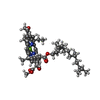 ChemComp-BCL:  ChemComp-8K6:  ChemComp-CA: 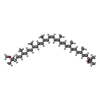 ChemComp-CRT:  ChemComp-D12: |
| Source |
|
 Keywords Keywords | PHOTOSYNTHESIS / LH1 COMPLEX |



 thermochromatium tepidum (bacteria)