[English] 日本語
Yorodumi Papers
- Database of articles cited by EMDB/PDB/SASBDB data -

+
Search query

Keywords
Structure methods
Author
Journal
IF

-
Structure paper

TitleSubunit and chlorophyll organization of the plant photosystem II supercomplex.
Journal, issue, pagesNat Plants, Vol. 3, Page 17080, Year 2017
Publish dateJun 12, 2017
AuthorsLaura S van Bezouwen / Stefano Caffarri / Ravindra S Kale / Roman Kouřil / Andy-Mark W H Thunnissen / Gert T Oostergetel / Egbert J Boekema /
PubMed AbstractPhotosystem II (PSII) is a light-driven protein, involved in the primary reactions of photosynthesis. In plant photosynthetic membranes PSII forms large multisubunit supercomplexes, containing a ...Photosystem II (PSII) is a light-driven protein, involved in the primary reactions of photosynthesis. In plant photosynthetic membranes PSII forms large multisubunit supercomplexes, containing a dimeric core and up to four light-harvesting complexes (LHCs), which act as antenna proteins. Here we solved a three-dimensional (3D) structure of the CSM supercomplex from Arabidopsis thaliana using cryo-transmission electron microscopy (cryo-EM) and single-particle analysis at an overall resolution of 5.3 Å. Using a combination of homology modelling and restrained refinement against the cryo-EM map, it was possible to model atomic structures for all antenna complexes and almost all core subunits. We located all 35 chlorophylls of the core region based on the cyanobacterial PSII structure, whose positioning is highly conserved, as well as all the chlorophylls of the LHCII S and M trimers. A total of 13 and 9 chlorophylls were identified in CP26 and CP24, respectively. Energy flow from LHC complexes to the PSII reaction centre is proposed to follow preferential pathways: CP26 and CP29 directly transfer to the core using several routes for efficient transfer; the S trimer is directly connected to CP43 and the M trimer can efficiently transfer energy to the core through CP29 and the S trimer.
External linksNat Plants / PubMed:28604725
MethodsEM (single particle)
Resolution5.3 Å
Structure data

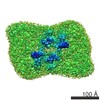
EMDB-3491, PDB-5mdx:
Cryo-EM structure of the PSII supercomplex from Arabidopsis thaliana
Method: EM (single particle) / Resolution: 5.3 Å

Chemicals

ChemComp-FE2:
Unknown entry

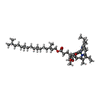
ChemComp-CLA:
CHLOROPHYLL A

ChemComp-PHO:
PHEOPHYTIN A

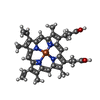
ChemComp-HEM:
PROTOPORPHYRIN IX CONTAINING FE

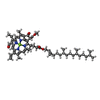
ChemComp-CHL:
CHLOROPHYLL B

Source
  • arabidopsis thaliana (thale cress)
KeywordsPHOTOSYNTHESIS / photosystem II supercomplex / single particle analysis

+
About Yorodumi Papers

-
News

-
Feb 9, 2022. New format data for meta-information of EMDB entries

New format data for meta-information of EMDB entries

  • Version 3 of the EMDB header file is now the official format.
  • The previous official version 1.9 will be removed from the archive.

Related info.:EMDB header

External links:wwPDB to switch to version 3 of the EMDB data model

-
Aug 12, 2020. Covid-19 info

Covid-19 info

URL: https://pdbj.org/emnavi/covid19.php

New page: Covid-19 featured information page in EM Navigator.

Related info.:Covid-19 info / Mar 5, 2020. Novel coronavirus structure data

+
Mar 5, 2020. Novel coronavirus structure data

Novel coronavirus structure data

Related info.:Yorodumi Speices / Aug 12, 2020. Covid-19 info

External links:COVID-19 featured content - PDBj / Molecule of the Month (242):Coronavirus Proteases

+
Jan 31, 2019. EMDB accession codes are about to change! (news from PDBe EMDB page)

EMDB accession codes are about to change! (news from PDBe EMDB page)

  • The allocation of 4 digits for EMDB accession codes will soon come to an end. Whilst these codes will remain in use, new EMDB accession codes will include an additional digit and will expand incrementally as the available range of codes is exhausted. The current 4-digit format prefixed with “EMD-” (i.e. EMD-XXXX) will advance to a 5-digit format (i.e. EMD-XXXXX), and so on. It is currently estimated that the 4-digit codes will be depleted around Spring 2019, at which point the 5-digit format will come into force.
  • The EM Navigator/Yorodumi systems omit the EMD- prefix.

Related info.:Q: What is EMD? / ID/Accession-code notation in Yorodumi/EM Navigator

External links:EMDB Accession Codes are Changing Soon! / Contact to PDBj

+
Jul 12, 2017. Major update of PDB

Major update of PDB

  • wwPDB released updated PDB data conforming to the new PDBx/mmCIF dictionary.
  • This is a major update changing the version number from 4 to 5, and with Remediation, in which all the entries are updated.
  • In this update, many items about electron microscopy experimental information are reorganized (e.g. em_software).
  • Now, EM Navigator and Yorodumi are based on the updated data.

External links:wwPDB Remediation / Enriched Model Files Conforming to OneDep Data Standards Now Available in the PDB FTP Archive

-
Yorodumi Papers

Database of articles cited by EMDB/PDB/SASBDB data

  • Database of articles cited by EMDB, PDB, and SASBDB entries
  • Using PubMed data

Related info.:EMDB / PDB / SASBDB / Yorodumi / EMN Papers / Changes in new EM Navigator and Yorodumi

Read more