 ムービー
ムービー コントローラー
 構造ビューア
 万見文献について


+検索条件
-Structure paper
| タイトル | Structural Basis for High-Affinity Trapping of the Na1.7 Channel in Its Resting State by Tarantula Toxin. |
|---|---|
| ジャーナル・号・ページ | Mol Cell, Vol. 81, Issue 1, Page 38-48.e4, Year 2021 |
| 掲載日 | 2021年1月7日 |
 著者 著者 | Goragot Wisedchaisri / Lige Tonggu / Tamer M Gamal El-Din / Eedann McCord / Ning Zheng / William A Catterall /  |
| PubMed 要旨 | Voltage-gated sodium channels initiate electrical signals and are frequently targeted by deadly gating-modifier neurotoxins, including tarantula toxins, which trap the voltage sensor in its resting ...Voltage-gated sodium channels initiate electrical signals and are frequently targeted by deadly gating-modifier neurotoxins, including tarantula toxins, which trap the voltage sensor in its resting state. The structural basis for tarantula-toxin action remains elusive because of the difficulty of capturing the functionally relevant form of the toxin-channel complex. Here, we engineered the model sodium channel NaAb with voltage-shifting mutations and the toxin-binding site of human Na1.7, an attractive pain target. This mutant chimera enabled us to determine the cryoelectron microscopy (cryo-EM) structure of the channel functionally arrested by tarantula toxin. Our structure reveals a high-affinity resting-state-specific toxin-channel interaction between a key lysine residue that serves as a "stinger" and penetrates a triad of carboxyl groups in the S3-S4 linker of the voltage sensor. By unveiling this high-affinity binding mode, our studies establish a high-resolution channel-docking and resting-state locking mechanism for huwentoxin-IV and provide guidance for developing future resting-state-targeted analgesic drugs. |
 リンク リンク | Mol Cell / PubMed:33232657 / PubMed Central |
| 手法 | EM (単粒子) |
| 解像度 | 3.6 Å |
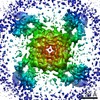
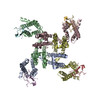
| 構造データ | EMDB-22661, PDB-7k48: |
| 由来 |
|
 キーワード キーワード | MEMBRANE PROTEIN / Ion channel / Voltage-gated sodium channel / Gating-modifier toxin |

 Escherichia coli (大腸菌)
 haplopelma schmidti (クモ)
 homo sapiens (ヒト)