[English] 日本語
Yorodumi Papers
- Database of articles cited by EMDB/PDB/SASBDB data -

+
Search query

Keywords
Structure methods
Author
Journal
IF

-
Structure paper

TitleRecognition of phylogenetically diverse pathogens through enzymatically amplified recruitment of RNF213.
Journal, issue, pagesEMBO Rep, Vol. 25, Issue 11, Page 4979-5005, Year 2024
Publish dateOct 7, 2024
AuthorsAna Crespillo-Casado / Prathyush Pothukuchi / Katerina Naydenova / Matthew C J Yip / Janet M Young / Jerome Boulanger / Vimisha Dharamdasani / Ceara Harper / Pierre-Mehdi Hammoudi / Elsje G Otten / Keith Boyle / Mayuri Gogoi / Harmit S Malik / Felix Randow /
PubMed AbstractInnate immunity senses microbial ligands known as pathogen-associated molecular patterns (PAMPs). Except for nucleic acids, PAMPs are exceedingly taxa-specific, thus enabling pattern recognition ...Innate immunity senses microbial ligands known as pathogen-associated molecular patterns (PAMPs). Except for nucleic acids, PAMPs are exceedingly taxa-specific, thus enabling pattern recognition receptors to detect cognate pathogens while ignoring others. How the E3 ubiquitin ligase RNF213 can respond to phylogenetically distant pathogens, including Gram-negative Salmonella, Gram-positive Listeria, and eukaryotic Toxoplasma, remains unknown. Here we report that the evolutionary history of RNF213 is indicative of repeated adaptation to diverse pathogen target structures, especially in and around its newly identified CBM20 carbohydrate-binding domain, which we have resolved by cryo-EM. We find that RNF213 forms coats on phylogenetically distant pathogens. ATP hydrolysis by RNF213's dynein-like domain is essential for coat formation on all three pathogens studied as is RZ finger-mediated E3 ligase activity for bacteria. Coat formation is not diffusion-limited but instead relies on rate-limiting initiation events and subsequent cooperative incorporation of further RNF213 molecules. We conclude that RNF213 responds to evolutionarily distant pathogens through enzymatically amplified cooperative recruitment.
External linksEMBO Rep / PubMed:39375464 / PubMed Central
MethodsEM (single particle)
Resolution2.9 - 3.2 Å
Structure data

EMDB-19653, PDB-8s24:
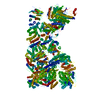
Structure of the E3 ubiquitin ligase RNF213, determined by cryoEM
Method: EM (single particle) / Resolution: 3.0 Å

EMDB-19654: Human RNF213 (consensus refinement without accounting for flexibility)
Method: EM (single particle) / Resolution: 3.0 Å

EMDB-19655: Human RNF213: focused refinement of ATPase domain
Method: EM (single particle) / Resolution: 2.9 Å

EMDB-19656: Human RNF213: focused refinement of stalk domain
Method: EM (single particle) / Resolution: 3.1 Å

EMDB-19657: Human RNF213: focused refinement of carbohydrate binding module (CBM) domain
Method: EM (single particle) / Resolution: 3.2 Å

EMDB-19658: Human RNF213: focused refinement of E3 ligase domain
Method: EM (single particle) / Resolution: 3.1 Å

EMDB-19659: Human RNF213: focused refinement of E3-RING domain
Method: EM (single particle) / Resolution: 3.1 Å

Chemicals

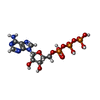
ChemComp-ATP:
ADENOSINE-5'-TRIPHOSPHATE / ATP, energy-carrying molecule*YM

ChemComp-MG:
Unknown entry

ChemComp-ZN:
Unknown entry

Source
  • homo sapiens (human)
KeywordsANTIMICROBIAL PROTEIN / E3 ubiquitin ligase / ATPase / carbohydrate-binding domain / RING domain / RZ domain

+
About Yorodumi Papers

-
News

-
Feb 9, 2022. New format data for meta-information of EMDB entries

New format data for meta-information of EMDB entries

  • Version 3 of the EMDB header file is now the official format.
  • The previous official version 1.9 will be removed from the archive.

Related info.:EMDB header

External links:wwPDB to switch to version 3 of the EMDB data model

-
Aug 12, 2020. Covid-19 info

Covid-19 info

URL: https://pdbj.org/emnavi/covid19.php

New page: Covid-19 featured information page in EM Navigator.

Related info.:Covid-19 info / Mar 5, 2020. Novel coronavirus structure data

+
Mar 5, 2020. Novel coronavirus structure data

Novel coronavirus structure data

Related info.:Yorodumi Speices / Aug 12, 2020. Covid-19 info

External links:COVID-19 featured content - PDBj / Molecule of the Month (242):Coronavirus Proteases

+
Jan 31, 2019. EMDB accession codes are about to change! (news from PDBe EMDB page)

EMDB accession codes are about to change! (news from PDBe EMDB page)

  • The allocation of 4 digits for EMDB accession codes will soon come to an end. Whilst these codes will remain in use, new EMDB accession codes will include an additional digit and will expand incrementally as the available range of codes is exhausted. The current 4-digit format prefixed with “EMD-” (i.e. EMD-XXXX) will advance to a 5-digit format (i.e. EMD-XXXXX), and so on. It is currently estimated that the 4-digit codes will be depleted around Spring 2019, at which point the 5-digit format will come into force.
  • The EM Navigator/Yorodumi systems omit the EMD- prefix.

Related info.:Q: What is EMD? / ID/Accession-code notation in Yorodumi/EM Navigator

External links:EMDB Accession Codes are Changing Soon! / Contact to PDBj

+
Jul 12, 2017. Major update of PDB

Major update of PDB

  • wwPDB released updated PDB data conforming to the new PDBx/mmCIF dictionary.
  • This is a major update changing the version number from 4 to 5, and with Remediation, in which all the entries are updated.
  • In this update, many items about electron microscopy experimental information are reorganized (e.g. em_software).
  • Now, EM Navigator and Yorodumi are based on the updated data.

External links:wwPDB Remediation / Enriched Model Files Conforming to OneDep Data Standards Now Available in the PDB FTP Archive

-
Yorodumi Papers

Database of articles cited by EMDB/PDB/SASBDB data

  • Database of articles cited by EMDB, PDB, and SASBDB entries
  • Using PubMed data

Related info.:EMDB / PDB / SASBDB / Yorodumi / EMN Papers / Changes in new EM Navigator and Yorodumi

Read more