 Movie
Movie Controller
 Structure viewers
 About Yorodumi Papers


+Search query
-Structure paper
| Title | Alphavirus nsP3 organizes into tubular scaffolds essential for infection and the cytoplasmic granule architecture. |
|---|---|
| Journal, issue, pages | Nat Commun, Vol. 15, Issue 1, Page 8106, Year 2024 |
| Publish date | Sep 16, 2024 |
 Authors Authors | Vasiliya Kril / Michael Hons / Celine Amadori / Claire Zimberger / Laurine Couture / Yara Bouery / Julien Burlaud-Gaillard / Andrei Karpov / Denis Ptchelkine / Alexandra L Thienel / Beate M Kümmerer / Ambroise Desfosses / Rhian Jones / Philippe Roingeard / Laurent Meertens / Ali Amara / Juan Reguera /   |
| PubMed Abstract | Alphaviruses, such as chikungunya virus (CHIKV), are mosquito-borne viruses that represent a significant threat to human health due to the current context of global warming. Efficient alphavirus ...Alphaviruses, such as chikungunya virus (CHIKV), are mosquito-borne viruses that represent a significant threat to human health due to the current context of global warming. Efficient alphavirus infection relies on the activity of the non-structural protein 3 (nsP3), a puzzling multifunctional molecule whose role in infection remains largely unknown. NsP3 is a component of the plasma membrane-bound viral RNA replication complex (vRC) essential for RNA amplification and is also found in large cytoplasmic aggregates of unknown function Here, we report the cryo-electron microscopy (cryo-EM) structure of the CHIKV nsP3 at 2.35 Å resolution. We show that nsP3 assembles into tubular structures made by a helical arrangement of its alphavirus unique domain (AUD). The nsP3 helical scaffolds are consistent with crown structures found on tomographic reconstructions of the mature viral RCs. In addition, nsP3 helices assemble into cytoplasmic granules organized in a network of tubular structures that contain viral genomic RNA and capsid as well as host factors required for productive infection. Structure-guided mutagenesis identified residues that prevent or disturb nsP3 assemblies, resulting in impaired viral replication or transcription. Altogether, our results reveal an unexpected nsP3-dependent molecular organization essential for different phases of alphavirus infection. |
 External links External links | Nat Commun / PubMed:39285216 / PubMed Central |
| Methods | EM (helical sym.) |
| Resolution | 2.35 - 2.98 Å |
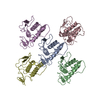
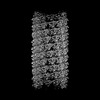
| Structure data | EMDB-17678, PDB-8phz: EMDB-17729, PDB-8pk7: 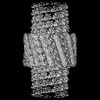 EMDB-17730: masked refinement giving rise to better defined protruding densities of the potential macrodomain outside the AUD helical assemblies. |
| Chemicals |  ChemComp-ZN: |
| Source |
|
 Keywords Keywords | VIRAL PROTEIN / Helical scaffold / Replication complex / Alpha granules / Viral factories |


 chikungunya virus strain s27-african prototype