[English] 日本語
Yorodumi Papers
- Database of articles cited by EMDB/PDB/SASBDB data -

+
Search query

Keywords
Structure methods
Author
Journal
IF

-
Structure paper

TitleNAPE-PLD is target of thiazide diuretics.
Journal, issue, pagesCell Chem Biol, Vol. 32, Issue 3, Page 449-462.e5, Year 2025
Publish dateMar 20, 2025
AuthorsSara Chiarugi / Francesco Margheriti / Valentina De Lorenzi / Elisa Martino / Eleonora Germana Margheritis / Aldo Moscardini / Roberto Marotta / Antonio Chaves-Sanjuan / Cristina Del Seppia / Giuseppe Federighi / Dominga Lapi / Tiziano Bandiera / Simona Rapposelli / Rossana Scuri / Martino Bolognesi / Gianpiero Garau /
PubMed AbstractThiazide and thiazide-like diuretics are among the most efficacious and used drugs for the treatment of hypertension, edema, and major cardiovascular outcomes. Despite more then than six decades of ...Thiazide and thiazide-like diuretics are among the most efficacious and used drugs for the treatment of hypertension, edema, and major cardiovascular outcomes. Despite more then than six decades of clinical use, the molecular target and mechanism of action by which these drugs cure hypertension after long-term use have remained mysterious. Here we report the discovery and validation of a previously unknown renal and extrarenal target of these antihypertensives, the membrane-associated phospholipase N-acylphosphatidylethanolamine-specific phospholipase D (NAPE-PLD) of the endocannabinoid system. Structural and functional insights, together with preclinical studies in hypertensive rats, disclose the molecular and physiological basis by which thiazides cause acute diuresis and, at the same time, the distinctive chronic reduction of vascular resistance. Our results shed light on the mechanism of treatment of hypertension and will be useful for developing more efficacious medications for the management of vascular risk factors, as well as associated leukoencephalopathies and myelin disorders.
External linksCell Chem Biol / PubMed:39999832
MethodsEM (single particle) / X-ray diffraction
Resolution2.8 - 15.0 Å
Structure data

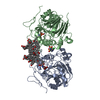
EMDB-16931: NAPE-PLD dimer bound to a nanodisc
Method: EM (single particle) / Resolution: 13.0 Å

EMDB-16932: NAPE-PLD bound to a nanodisc
Method: EM (single particle) / Resolution: 15.0 Å

PDB-8p90:
TARGET COMPLEX 2
Method: X-RAY DIFFRACTION / Resolution: 2.8 Å

PDB-8p96:
TARGET COMPLEX 3
Method: X-RAY DIFFRACTION / Resolution: 2.86 Å

PDB-8pc4:
MEMBRANE TARGET COMPLEX 1
Method: X-RAY DIFFRACTION / Resolution: 2.85 Å

Chemicals

ChemComp-ZN:
Unknown entry

ChemComp-3PE:
1,2-Distearoyl-sn-glycerophosphoethanolamine / phospholipid*YM

ChemComp-DXC:
(3ALPHA,5BETA,12ALPHA)-3,12-DIHYDROXYCHOLAN-24-OIC ACID / detergent*YM

ChemComp-PLP:
PYRIDOXAL-5'-PHOSPHATE

ChemComp-HOH:
WATER


ChemComp, No image

ChemComp-XBE:
Unknown entry

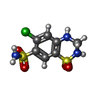
ChemComp-HCZ:
6-chloro-3,4-dihydro-2H-1,2,4-benzothiadiazine-7-sulfonamide 1,1-dioxide

Source
  • Escherichia coli (E. coli)
  • homo sapiens (human)
KeywordsMEMBRANE PROTEIN / Complex / Membrane / Enzyme / Transport / Vitamin B6 / Target / Dimer / Drug

+
About Yorodumi Papers

-
News

-
Feb 9, 2022. New format data for meta-information of EMDB entries

New format data for meta-information of EMDB entries

  • Version 3 of the EMDB header file is now the official format.
  • The previous official version 1.9 will be removed from the archive.

Related info.:EMDB header

External links:wwPDB to switch to version 3 of the EMDB data model

-
Aug 12, 2020. Covid-19 info

Covid-19 info

URL: https://pdbj.org/emnavi/covid19.php

New page: Covid-19 featured information page in EM Navigator.

Related info.:Covid-19 info / Mar 5, 2020. Novel coronavirus structure data

+
Mar 5, 2020. Novel coronavirus structure data

Novel coronavirus structure data

Related info.:Yorodumi Speices / Aug 12, 2020. Covid-19 info

External links:COVID-19 featured content - PDBj / Molecule of the Month (242):Coronavirus Proteases

+
Jan 31, 2019. EMDB accession codes are about to change! (news from PDBe EMDB page)

EMDB accession codes are about to change! (news from PDBe EMDB page)

  • The allocation of 4 digits for EMDB accession codes will soon come to an end. Whilst these codes will remain in use, new EMDB accession codes will include an additional digit and will expand incrementally as the available range of codes is exhausted. The current 4-digit format prefixed with “EMD-” (i.e. EMD-XXXX) will advance to a 5-digit format (i.e. EMD-XXXXX), and so on. It is currently estimated that the 4-digit codes will be depleted around Spring 2019, at which point the 5-digit format will come into force.
  • The EM Navigator/Yorodumi systems omit the EMD- prefix.

Related info.:Q: What is EMD? / ID/Accession-code notation in Yorodumi/EM Navigator

External links:EMDB Accession Codes are Changing Soon! / Contact to PDBj

+
Jul 12, 2017. Major update of PDB

Major update of PDB

  • wwPDB released updated PDB data conforming to the new PDBx/mmCIF dictionary.
  • This is a major update changing the version number from 4 to 5, and with Remediation, in which all the entries are updated.
  • In this update, many items about electron microscopy experimental information are reorganized (e.g. em_software).
  • Now, EM Navigator and Yorodumi are based on the updated data.

External links:wwPDB Remediation / Enriched Model Files Conforming to OneDep Data Standards Now Available in the PDB FTP Archive

-
Yorodumi Papers

Database of articles cited by EMDB/PDB/SASBDB data

  • Database of articles cited by EMDB, PDB, and SASBDB entries
  • Using PubMed data

Related info.:EMDB / PDB / SASBDB / Yorodumi / EMN Papers / Changes in new EM Navigator and Yorodumi

Read more