 Movie
Movie Controller
 Structure viewers
 About Yorodumi Papers


+Search query
-Structure paper
| Title | Helical structure of the needle of the type III secretion system of Shigella flexneri. |
|---|---|
| Journal, issue, pages | J Biol Chem, Vol. 278, Issue 19, Page 17103-17107, Year 2003 |
| Publish date | May 9, 2003 |
 Authors Authors | Frank S Cordes / Kaoru Komoriya / Eric Larquet / Shixin Yang / Edward H Egelman / Ariel Blocker / Susan M Lea /  |
| PubMed Abstract | Gram-negative bacteria commonly interact with animal and plant hosts using type III secretion systems (TTSSs) for translocation of proteins into eukaryotic cells during infection. 10 of the 25 TTSS- ...Gram-negative bacteria commonly interact with animal and plant hosts using type III secretion systems (TTSSs) for translocation of proteins into eukaryotic cells during infection. 10 of the 25 TTSS-encoding genes are homologous to components of the bacterial flagellar basal body, which the TTSS needle complex morphologically resembles. This indicates a common ancestry, although no TTSS sequence homologues for the genes encoding the flagellum are found. We here present an approximately 16-A structure of the central component, the needle, of the TTSS. Although the needle subunit is significantly smaller and shares no sequence homology with the flagellar hook and filament, it shares a common helical architecture ( approximately 5.6 subunits/turn, 24-A helical pitch). This common architecture implies that there will be further mechanistic analogies in the functioning of these two bacterial systems. |
 External links External links | J Biol Chem / PubMed:12571230 |
| Methods | EM (helical sym.) |
| Resolution | 16.0 Å |
| Structure data | 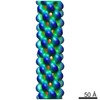 EMDB-1416: |
| Source |
|
 Shigella flexneri (bacteria)