 Movie
Movie Controller
 Structure viewers
 About Yorodumi Papers


+Search query
-Structure paper
| Title | Architecture of the Dam1 kinetochore ring complex and implications for microtubule-driven assembly and force-coupling mechanisms. |
|---|---|
| Journal, issue, pages | Nat Struct Mol Biol, Vol. 14, Issue 8, Page 721-726, Year 2007 |
| Publish date | Jul 22, 2007 |
 Authors Authors | Hong-Wei Wang / Vincent H Ramey / Stefan Westermann / Andres E Leschziner / Julie P I Welburn / Yuko Nakajima / David G Drubin / Georjana Barnes / Eva Nogales /  |
| PubMed Abstract | The Dam1 kinetochore complex is essential for chromosome segregation in budding yeast. This ten-protein complex self-assembles around microtubules, forming ring-like structures that move with ...The Dam1 kinetochore complex is essential for chromosome segregation in budding yeast. This ten-protein complex self-assembles around microtubules, forming ring-like structures that move with depolymerizing microtubule ends, a mechanism with implications for cellular function. Here we used EM-based single-particle and helical analyses to define the architecture of the Dam1 complex at 30-A resolution and the self-assembly mechanism. Ring oligomerization seems to be facilitated by a conformational change upon binding to microtubules, suggesting that the Dam1 ring is not preformed, but self-assembles around kinetochore microtubules. The C terminus of the Dam1p protein, where most of the Aurora kinase Ipl1 phosphorylation sites reside, is in a strategic location to affect oligomerization and interactions with the microtubule. One of Ipl1's roles might be to fine-tune the coupling of the microtubule interaction with the conformational change required for oligomerization, with phosphorylation resulting in ring breakdown. |
 External links External links | Nat Struct Mol Biol / PubMed:17643123 |
| Methods | EM (helical sym.) / EM (single particle) |
| Resolution | 28.0 - 30.0 Å |
| Structure data |  EMDB-1371:  EMDB-1372: 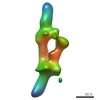 EMDB-1373: |
| Source |
|

 Saccharomyces cerevisiae (brewer's yeast)