 ムービー
ムービー コントローラー
 構造ビューア
 万見文献について


+検索条件
-Structure paper
| タイトル | Lysosomal endonuclease RNase T2 and PLD exonucleases cooperatively generate RNA ligands for TLR7 activation. |
|---|---|
| ジャーナル・号・ページ | Immunity, Vol. 57, Issue 7, Page 1482-11496.e8, Year 2024 |
| 掲載日 | 2024年7月9日 |
 著者 著者 | Marleen Bérouti / Katja Lammens / Matthias Heiss / Larissa Hansbauer / Stefan Bauernfried / Jan Stöckl / Francesca Pinci / Ignazio Piseddu / Wilhelm Greulich / Meiyue Wang / Christophe Jung / Thomas Fröhlich / Thomas Carell / Karl-Peter Hopfner / Veit Hornung /  |
| PubMed 要旨 | Toll-like receptor 7 (TLR7) is essential for recognition of RNA viruses and initiation of antiviral immunity. TLR7 contains two ligand-binding pockets that recognize different RNA degradation ...Toll-like receptor 7 (TLR7) is essential for recognition of RNA viruses and initiation of antiviral immunity. TLR7 contains two ligand-binding pockets that recognize different RNA degradation products: pocket 1 recognizes guanosine, while pocket 2 coordinates pyrimidine-rich RNA fragments. We found that the endonuclease RNase T2, along with 5' exonucleases PLD3 and PLD4, collaboratively generate the ligands for TLR7. Specifically, RNase T2 generated guanosine 2',3'-cyclic monophosphate-terminated RNA fragments. PLD exonuclease activity further released the terminal 2',3'-cyclic guanosine monophosphate (2',3'-cGMP) to engage pocket 1 and was also needed to generate RNA fragments for pocket 2. Loss-of-function studies in cell lines and primary cells confirmed the critical requirement for PLD activity. Biochemical and structural studies showed that PLD enzymes form homodimers with two ligand-binding sites important for activity. Previously identified disease-associated PLD mutants failed to form stable dimers. Together, our data provide a mechanistic basis for the detection of RNA fragments by TLR7. |
 リンク リンク | Immunity / PubMed:38697119 / PubMed Central |
| 手法 | EM (単粒子) |
| 解像度 | 2.8 Å |
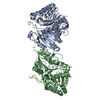
| 構造データ | EMDB-19798, PDB-8s86: |
| 由来 |
|
 キーワード キーワード | IMMUNE SYSTEM / Exonuclease |
 homo sapiens (ヒト)