[English] 日本語
Yorodumi Papers
- Database of articles cited by EMDB/PDB/SASBDB data -

+
Search query

Keywords
Structure methods
Author
Journal
IF

-
Structure paper

TitleF-Type Pyocin Versus Phage λ Tail: Conserved Hub, Divergent Fibers.
Journal, issue, pagesAdv Sci (Weinh), Page e77063, Year 2026
Publish dateAug 10, 2026
AuthorsZhiwei Gu / Yufan Xie / Lanxin Wang / Luyan Ma / Xiaofei Ge / Jiawei Wang /
PubMed AbstractBacteriocins are ribosomally synthesized antimicrobial peptides or proteins that offer an alternative to conventional antibiotics against multidrug-resistant pathogens. Phage tail-like bacteriocins ...Bacteriocins are ribosomally synthesized antimicrobial peptides or proteins that offer an alternative to conventional antibiotics against multidrug-resistant pathogens. Phage tail-like bacteriocins (tailocins) are classified into rigid R-type and flexible F-type variants. While R-type pyocins from Pseudomonas aeruginosa are well-characterized, F-type pyocins remain poorly understood, especially with respect to the molecular mechanisms for their Gram-negative bactericidal activity. Here, we report cryo-electron microscopy structures of the F-type pyocin from P. aeruginosa ATCC 15442 at 2.29-3.26 Å resolution, encompassing three modular components: the tail cap, tail tip, and tail fiber. Structural comparisons with bacteriophage λ reveal a conserved tail tip architecture, including the baseplate hub proteins, distal tail protein, tail assembly protein, and tape measure protein. Unexpectedly, we identify three trimeric side fibers that attach not to the distal tail protein, as in canonical systems, but to the α-helical shaft of the central fiber, indicating a previously unrecognized attachment mode. The receptor-binding domain of the side fiber shares structural similarity with LPS-recognizing domains of R-type pyocins. Together, these results define the structural basis of F-type pyocin assembly and host recognition, reveal conserved and unique features relative to phage λ, and provide a framework for engineering tailocins as precision antimicrobials against drug-resistant P. aeruginosa.
External linksAdv Sci (Weinh) / PubMed:42573577 / PubMed Central
MethodsEM (single particle)
Resolution2.29 - 3.26 Å
Structure data

EMDB-80401, PDB-25vd:
Cap of F2-pyocin
Method: EM (single particle) / Resolution: 2.55 Å

EMDB-80402, PDB-25ve:
side fiber of F2-pyocin
Method: EM (single particle) / Resolution: 2.78 Å

EMDB-80403, PDB-25vf:
F2-pyocin tail Tip
Method: EM (single particle) / Resolution: 2.29 Å

EMDB-80404, PDB-25vj:
tail fiber of F2-pyocin
Method: EM (single particle) / Resolution: 3.26 Å

EMDB-80538, PDB-26ci:
F2-pyocin FNIII and AHS
Method: EM (single particle) / Resolution: 2.63 Å

Chemicals

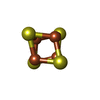
ChemComp-SF4:
IRON/SULFUR CLUSTER

Source
  • pseudomonas aeruginosa (bacteria)
KeywordsVIRAL PROTEIN / pyocin / phage / cap / tail F2 pyocin tip / F2-pyocin tail tip AHS FNIII

+
About Yorodumi Papers

-
News

-
Feb 9, 2022. New format data for meta-information of EMDB entries

New format data for meta-information of EMDB entries

  • Version 3 of the EMDB header file is now the official format.
  • The previous official version 1.9 will be removed from the archive.

Related info.:EMDB header

External links:wwPDB to switch to version 3 of the EMDB data model

-
Aug 12, 2020. Covid-19 info

Covid-19 info

URL: https://pdbj.org/emnavi/covid19.php

New page: Covid-19 featured information page in EM Navigator.

Related info.:Covid-19 info / Mar 5, 2020. Novel coronavirus structure data

+
Mar 5, 2020. Novel coronavirus structure data

Novel coronavirus structure data

Related info.:Yorodumi Speices / Aug 12, 2020. Covid-19 info

External links:COVID-19 featured content - PDBj / Molecule of the Month (242):Coronavirus Proteases

+
Jan 31, 2019. EMDB accession codes are about to change! (news from PDBe EMDB page)

EMDB accession codes are about to change! (news from PDBe EMDB page)

  • The allocation of 4 digits for EMDB accession codes will soon come to an end. Whilst these codes will remain in use, new EMDB accession codes will include an additional digit and will expand incrementally as the available range of codes is exhausted. The current 4-digit format prefixed with “EMD-” (i.e. EMD-XXXX) will advance to a 5-digit format (i.e. EMD-XXXXX), and so on. It is currently estimated that the 4-digit codes will be depleted around Spring 2019, at which point the 5-digit format will come into force.
  • The EM Navigator/Yorodumi systems omit the EMD- prefix.

Related info.:Q: What is EMD? / ID/Accession-code notation in Yorodumi/EM Navigator

External links:EMDB Accession Codes are Changing Soon! / Contact to PDBj

+
Jul 12, 2017. Major update of PDB

Major update of PDB

  • wwPDB released updated PDB data conforming to the new PDBx/mmCIF dictionary.
  • This is a major update changing the version number from 4 to 5, and with Remediation, in which all the entries are updated.
  • In this update, many items about electron microscopy experimental information are reorganized (e.g. em_software).
  • Now, EM Navigator and Yorodumi are based on the updated data.

External links:wwPDB Remediation / Enriched Model Files Conforming to OneDep Data Standards Now Available in the PDB FTP Archive

-
Yorodumi Papers

Database of articles cited by EMDB/PDB/SASBDB data

  • Database of articles cited by EMDB, PDB, and SASBDB entries
  • Using PubMed data

Related info.:EMDB / PDB / SASBDB / Yorodumi / EMN Papers / Changes in new EM Navigator and Yorodumi

Read more