 Movie
Movie Controller
 Structure viewers
 About Yorodumi Papers


+Search query
-Structure paper
| Title | Cryo-EM Structure of the C. Elegans Septin Tetramer Reveals a Revised Architecture and Conserved Positional Orthology. |
|---|---|
| Journal, issue, pages | J Mol Biol, Vol. 438, Issue 19, Page 169915, Year 2026 |
| Publish date | Oct 1, 2026 |
 Authors Authors | Giovanna Christe Dos Reis Saladino / Heloísa Ciol / Deborah Cezar Mendonça / Adriano Alves Furtado / Humberto D'Muniz Pereira / Bruno P Klaholz / Ana Paula Ulian Araujo / Richard Charles Garratt /   |
| PubMed Abstract | Septins are cytoskeletal proteins that assemble into hetero-oligomeric complexes, which polymerize into filaments to regulate many cellular processes, including cytokinesis and membrane remodeling. ...Septins are cytoskeletal proteins that assemble into hetero-oligomeric complexes, which polymerize into filaments to regulate many cellular processes, including cytokinesis and membrane remodeling. In Caenorhabditis elegans, the core septin complex is a tetramer composed of two copies each of two different subunits, UNC-59 and UNC-61. Historically, low-resolution models suggested a subunit order of UNC-59-UNC-61-UNC-61-UNC-59 for the tetramer. However, this arrangement contradicted the positional conservation of septins observed in other species. Using cryo-EM, we obtained a structure for the tetramer with a global resolution of 2.7 Å, definitively establishing the subunit order to be UNC-61-UNC-59-UNC-59-UNC-61. This places UNC-59 at the center of the particle where it forms a homodimeric G-interface, confirming it to be a positional ortholog of human SEPT7. This arrangement is further supported by mutational/biophysical analyses. Despite the stability of the tetramer, the complex failed to polymerize into filaments in vitro, which we attribute to the structural instability of the terminal UNC-61 G-interfaces. Our results suggest that post-translational modifications or specific cellular factors may be required to initiate higher-order assembly in C. elegans. Furthermore, our structure reveals that while UNC-59 possesses key characteristics of the SEPT7 group, it also features unique structural adaptations that may be related to the unique arrangement of the C. elegans complex. We demonstrate that the previous misidentification of the subunit order within the tetramer likely stemmed from N-terminal domain swapping, reinforcing the importance of high-resolution structural studies for understanding the evolutionary history and the diversity of septins. |
 External links External links | J Mol Biol / PubMed:42336232 |
| Methods | EM (single particle) |
| Resolution | 2.65 Å |
| Structure data | EMDB-76887, PDB-12zn: |
| Chemicals | 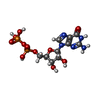 ChemComp-GDP: |
| Source |
|
 Keywords Keywords | CELL CYCLE / GTPase / Cytoskeleton component |


 caenorhabditis elegans (invertebrata)