 Movie
Movie Controller
 Structure viewers
 About Yorodumi Papers


+Search query
-Structure paper
| Title | INAAC: An affinity chromatography strategy enabling characterization and quantification of influenza neuraminidase antigens in vaccines. |
|---|---|
| Journal, issue, pages | J Biol Chem, Page 113138, Year 2026 |
| Publish date | May 11, 2026 |
 Authors Authors | Hyeog Kang / Anna Borowska / Tapan Kanai / Jin Gao / Hai Yu / Xi Chen / Jason Gorman / Dirk-Jan Slotboom / Robert Daniels /   |
| PubMed Abstract | Seasonal influenza vaccines are produced using viruses containing the hemagglutinin (HA) and neuraminidase (NA) antigens. However, NA amounts have not been monitored for more than 50 years due to ...Seasonal influenza vaccines are produced using viruses containing the hemagglutinin (HA) and neuraminidase (NA) antigens. However, NA amounts have not been monitored for more than 50 years due to lack of strategies for isolating NA reference antigens from viruses, limiting the ability to evaluate any contributions from NA. Here, we developed an influenza neuraminidase active-site affinity chromatography (INAAC) strategy that uses an active-site binding antibody to isolate functional NAs from influenza A and B vaccine strains. INAAC recovered 20-60% of detergent-solubilized NA activity from vaccine viruses and recombinant sources, with CaCl elution proving most effective. ELISA results with the isolated NA from the H1N1 strain and recombinant full-length N1 showed that a commercial vaccine contains functional N1 and H1 at a ratio of ∼1:10. Structure determination by cryo-electron microscopy confirmed the native tetrameric conformation of the isolated N1 and provided insight into the stalk conformation of a virus-derived NA. Finally, comparative analyses of NAs isolated from recent egg-propagated vaccine strains (H1N1, H3N2 and type B) revealed a unique proteolytic susceptibility of type B NA and strain-specific differences in sialic acid affinities and catalytic rates. These results demonstrate that INAAC supports multiple applications from NA structural analysis to producing NA vaccine antigens and reference standards, addressing longstanding challenges for incorporating NA into influenza vaccine development and quality control. |
 External links External links | J Biol Chem / PubMed:42119981 |
| Methods | EM (single particle) |
| Resolution | 3.58 Å |
| Structure data | EMDB-56126, PDB-9tq7: |
| Chemicals | 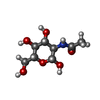 ChemComp-NAG:  ChemComp-CA: |
| Source |
|
 Keywords Keywords | HYDROLASE / glycosidase / influenza virus / viral release |


 influenza a virus (a/(h1n1))