 Movie
Movie Controller
 Structure viewers
 About Yorodumi Papers


+Search query
-Structure paper
| Title | Cetacean coronavirus spikes highlight S glycoprotein structural plasticity. |
|---|---|
| Journal, issue, pages | PLoS Pathog, Vol. 22, Issue 4, Page e1013855, Year 2026 |
| Publish date | Apr 8, 2026 |
 Authors Authors | Ruben J G Hulswit / Tatiana M Shamorkina / Joline van der Lee / Floor Rosman / Lisanne S Wetzels / Frank J M van Kuppeveld / Joost Snijder / Berend Jan Bosch / Daniel L Hurdiss /  |
| PubMed Abstract | Coronaviruses (CoVs) exhibit a remarkable ability for spill-over infections into naive host populations. While much research has focused on the spike (S) glycoproteins of zoonotic alpha- and ...Coronaviruses (CoVs) exhibit a remarkable ability for spill-over infections into naive host populations. While much research has focused on the spike (S) glycoproteins of zoonotic alpha- and betacoronaviruses, the S proteins of gamma- and deltacoronaviruses, which predominantly infect avian hosts, remain poorly understood. Here, we present high-resolution cryo-EM structures of S proteins from two distinct gammacoronaviruses (75.7% sequence identity) that atypically infect marine mammals and belong to the Gammacoronavirus delphinapteri species. The cryo-EM reconstructions reveal that the spikes exhibit a unique quaternary architecture that distinguishes them from other coronaviruses. The S protein features a previously unidentified, tripodal quaternary assembly of the S1 subunit, in which S1B domains are presented in an upright position while their putative receptor binding sites are shielded by extended loops from the S1A domain of the same protomers. Additionally, the CeCoV spike proteins have evolved an additional and unique ~200 residue N-terminal domain (S10). S10 lacks homology to known protein sequences but displays structural similarity to members of the cupin protein superfamily. This represents a remarkable case of coronaviral exaptation of a host protein integrated into the S glycoprotein. Moreover, glycoproteomic analyses reveal that CeCoV S proteins are extensively N-glycosylated (>100 N-glycans per trimer), with a notable abundance of high-mannose glycans on S10 and O-glycosylation sites within a mucin-like loop at the trimer apex, all contributing to a dense glycan shield and potentially masking immunogenic epitopes. These findings demonstrate the structural diversity and adaptability of CoV S proteins, including alternative quaternary assemblies, additional domains, and diverse glycosylation strategies, offering new insights into the evolutionary mechanisms that enable coronaviruses to expand their host range and establish infections in novel species. |
 External links External links | PLoS Pathog / PubMed:41950284 / PubMed Central |
| Methods | EM (single particle) |
| Resolution | 2.24 - 2.65 Å |
| Structure data | EMDB-53512, PDB-9r1q: EMDB-53513, PDB-9r1r: |
| Chemicals | 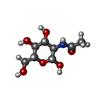 ChemComp-NAG: |
| Source |
|
 Keywords Keywords | VIRAL PROTEIN / spike / glycoprotein / coronavirus |


 beluga whale coronavirus sw1