 Movie
Movie Controller


+ Open data

- Basic information
| Entry | Database: PDB / ID: 9r1r | |||||||||||||||||||||||||||
|---|---|---|---|---|---|---|---|---|---|---|---|---|---|---|---|---|---|---|---|---|---|---|---|---|---|---|---|---|
| Title | Bottlenose dolphin coronavirus spike glycoprotein | |||||||||||||||||||||||||||
 Components Components | Spike glycoprotein | |||||||||||||||||||||||||||
 Keywords Keywords | VIRAL PROTEIN / spike / glycoprotein / coronavirus | |||||||||||||||||||||||||||
| Function / homology |  Function and homology information Function and homology informationreceptor-mediated virion attachment to host cell / endocytosis involved in viral entry into host cell / fusion of virus membrane with host plasma membrane / fusion of virus membrane with host endosome membrane / viral envelope / virion membrane / membrane Similarity search - Function | |||||||||||||||||||||||||||
| Biological species |  Bottlenose dolphin coronavirus HKU22 Bottlenose dolphin coronavirus HKU22 | |||||||||||||||||||||||||||
| Method | ELECTRON MICROSCOPY / single particle reconstruction / cryo EM / Resolution: 2.65 Å | |||||||||||||||||||||||||||
 Authors Authors | Hulswit, R.J.G. / Hurdiss, D.L. | |||||||||||||||||||||||||||
| Funding support |  Switzerland, 1items Switzerland, 1items
| |||||||||||||||||||||||||||
 Citation Citation | Journal: PLoS Pathog / Year: 2026 Title: Cetacean coronavirus spikes highlight S glycoprotein structural plasticity. Authors: Ruben J G Hulswit / Tatiana M Shamorkina / Joline van der Lee / Floor Rosman / Lisanne S Wetzels / Frank J M van Kuppeveld / Joost Snijder / Berend Jan Bosch / Daniel L Hurdiss /  Abstract: Coronaviruses (CoVs) exhibit a remarkable ability for spill-over infections into naive host populations. While much research has focused on the spike (S) glycoproteins of zoonotic alpha- and ...Coronaviruses (CoVs) exhibit a remarkable ability for spill-over infections into naive host populations. While much research has focused on the spike (S) glycoproteins of zoonotic alpha- and betacoronaviruses, the S proteins of gamma- and deltacoronaviruses, which predominantly infect avian hosts, remain poorly understood. Here, we present high-resolution cryo-EM structures of S proteins from two distinct gammacoronaviruses (75.7% sequence identity) that atypically infect marine mammals and belong to the Gammacoronavirus delphinapteri species. The cryo-EM reconstructions reveal that the spikes exhibit a unique quaternary architecture that distinguishes them from other coronaviruses. The S protein features a previously unidentified, tripodal quaternary assembly of the S1 subunit, in which S1B domains are presented in an upright position while their putative receptor binding sites are shielded by extended loops from the S1A domain of the same protomers. Additionally, the CeCoV spike proteins have evolved an additional and unique ~200 residue N-terminal domain (S10). S10 lacks homology to known protein sequences but displays structural similarity to members of the cupin protein superfamily. This represents a remarkable case of coronaviral exaptation of a host protein integrated into the S glycoprotein. Moreover, glycoproteomic analyses reveal that CeCoV S proteins are extensively N-glycosylated (>100 N-glycans per trimer), with a notable abundance of high-mannose glycans on S10 and O-glycosylation sites within a mucin-like loop at the trimer apex, all contributing to a dense glycan shield and potentially masking immunogenic epitopes. These findings demonstrate the structural diversity and adaptability of CoV S proteins, including alternative quaternary assemblies, additional domains, and diverse glycosylation strategies, offering new insights into the evolutionary mechanisms that enable coronaviruses to expand their host range and establish infections in novel species. | |||||||||||||||||||||||||||
| History |
|
- Structure visualization
| Structure viewer | Molecule: MolmilJmol/JSmol |
|---|
- Downloads & links
-Download
| PDBx/mmCIF format | 9r1r.cif.gz | 780.4 KB | Display | PDBx/mmCIF format |
|---|---|---|---|---|
| PDB format | pdb9r1r.ent.gz | 651.3 KB | Display | PDB format |
| PDBx/mmJSON format | 9r1r.json.gz | Tree view | PDBx/mmJSON format | |
| Others |  Other downloads Other downloads |
-Validation report
| Arichive directory | https://data.pdbj.org/pub/pdb/validation_reports/r1/9r1rftp://data.pdbj.org/pub/pdb/validation_reports/r1/9r1r | HTTPS FTP |
|---|
-Related structure data
| Related structure data |  53513MC  9r1qC M: map data used to model this data C: citing same article ( |
|---|---|
| Similar structure data |

-Links
 PDBj
PDBj- Assembly
| Deposited unit | 
|
|---|---|
| 1 |
|
-Components
-Protein , 1 types, 3 molecules ABC
| #1: Protein | Mass: 150644.297 Da / Num. of mol.: 3 Source method: isolated from a genetically manipulated source Source: (gene. exp.) Bottlenose dolphin coronavirus HKU22 / Cell line (production host): HEK 293F / Production host:  Homo sapiens (human) / References: UniProt: V5TEW2 Homo sapiens (human) / References: UniProt: V5TEW2 |
|---|
-Sugars , 6 types, 93 molecules 
| #2: Polysaccharide | beta-D-mannopyranose-(1-4)-2-acetamido-2-deoxy-beta-D-glucopyranose-(1-4)-2-acetamido-2-deoxy-beta- ...beta-D-mannopyranose-(1-4)-2-acetamido-2-deoxy-beta-D-glucopyranose-(1-4)-2-acetamido-2-deoxy-beta-D-glucopyranose Source method: isolated from a genetically manipulated source #3: Polysaccharide | 2-acetamido-2-deoxy-beta-D-glucopyranose-(1-4)-2-acetamido-2-deoxy-beta-D-glucopyranose Source method: isolated from a genetically manipulated source #4: Polysaccharide | alpha-D-mannopyranose-(1-6)-beta-D-mannopyranose-(1-4)-2-acetamido-2-deoxy-beta-D-glucopyranose-(1- ...alpha-D-mannopyranose-(1-6)-beta-D-mannopyranose-(1-4)-2-acetamido-2-deoxy-beta-D-glucopyranose-(1-4)-2-acetamido-2-deoxy-beta-D-glucopyranose Source method: isolated from a genetically manipulated source #5: Polysaccharide | Source method: isolated from a genetically manipulated source #6: Polysaccharide | Source method: isolated from a genetically manipulated source #7: Sugar | ChemComp-NAG / 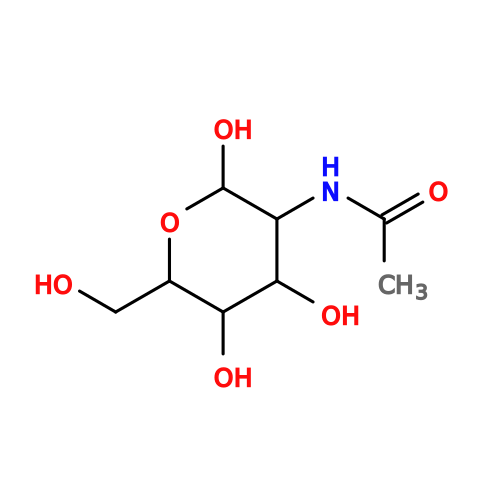 Type: D-saccharide, beta linking / Mass: 221.208 Da / Num. of mol.: 36 / Source method: obtained synthetically / Formula: C8H15NO6 Type: D-saccharide, beta linking / Mass: 221.208 Da / Num. of mol.: 36 / Source method: obtained synthetically / Formula: C8H15NO6 |
|---|
-Details
| Has ligand of interest | N |
|---|---|
| Has protein modification | Y |
-Experimental details
-Experiment
| Experiment | Method: ELECTRON MICROSCOPY |
|---|---|
| EM experiment | Aggregation state: PARTICLE / 3D reconstruction method: single particle reconstruction |
- Sample preparation
| Component | Name: bottlenose dolphin coronavirus S glycoprotein / Type: COMPLEX / Entity ID: #1 / Source: RECOMBINANT |
|---|---|
| Source (natural) | Organism: Bottlenose dolphin coronavirus HKU22 |
| Source (recombinant) | Organism: Homo sapiens (human) |
| Details of virus | Empty: NO / Enveloped: YES / Isolate: OTHER / Type: VIRION |
| Buffer solution | pH: 8 |
| Specimen | Embedding applied: NO / Shadowing applied: NO / Staining applied: NO / Vitrification applied: YES |
| Vitrification | Cryogen name: ETHANE |
- Electron microscopy imaging
| Experimental equipment |  Model: Titan Krios / Image courtesy: FEI Company |
|---|---|
| Microscopy | Model: TFS KRIOS |
| Electron gun | Electron source:  FIELD EMISSION GUN / Accelerating voltage: 300 kV / Illumination mode: FLOOD BEAM FIELD EMISSION GUN / Accelerating voltage: 300 kV / Illumination mode: FLOOD BEAM |
| Electron lens | Mode: BRIGHT FIELD / Nominal magnification: 105000 X / Nominal defocus max: 2500 nm / Nominal defocus min: 1200 nm |
| Image recording | Electron dose: 50 e/Å2 / Film or detector model: GATAN K3 BIOQUANTUM (6k x 4k) |
- Processing
| EM software | Name: PHENIX / Version: 1.21.1_5286 / Category: model refinement |
|---|---|
| CTF correction | Type: PHASE FLIPPING AND AMPLITUDE CORRECTION |
| Symmetry | Point symmetry: C3 (3 fold cyclic) |
| 3D reconstruction | Resolution: 2.65 Å / Resolution method: FSC 0.143 CUT-OFF / Num. of particles: 321116 / Symmetry type: POINT |
| Refinement | Highest resolution: 2.65 Å Stereochemistry target values: REAL-SPACE (WEIGHTED MAP SUM AT ATOM CENTERS) |
