[English] 日本語
Yorodumi Papers
- Database of articles cited by EMDB/PDB/SASBDB data -

+
Search query

Keywords
Structure methods
Author
Journal
IF

-
Structure paper

TitleStructural basis of human zinc-activated channel (ZAC) signaling and modulation.
Journal, issue, pagesCell Discov, Vol. 12, Issue 1, Year 2026
Publish dateMar 31, 2026
AuthorsZixuan Zhou / Yonghui Long / Yulin Chao / Chuanhui Yang / Yi-Quan Tang / Yilai Shu / Hongtao Zhu / Anders A Jensen / Qianhui Qu /
PubMed AbstractZinc (Zn) plays essential roles in a plethora of physiological processes, including key functions as a neuromodulator. The zinc-activated channel (ZAC) belongs to the Cys-loop receptor (CLR) ...Zinc (Zn) plays essential roles in a plethora of physiological processes, including key functions as a neuromodulator. The zinc-activated channel (ZAC) belongs to the Cys-loop receptor (CLR) superfamily of pentameric ligand-gated ion channels, which also comprises receptors for the important neurotransmitters acetylcholine, serotonin, GABA and glycine. In contrast to these classical CLRs, which have been extensively explored over decades, ZAC remains poorly characterized despite its potential significance in mammals. Here, we present several cryo-EM structures of human ZAC, including the ligand-free resting state, the Zn-bound state, and several antagonist-bound states. In the Zn-bound structure, Zn ions bind to the subunit interfaces of the extracellular domain, corresponding to the canonical agonist-binding sites in the classical CLRs, and are primarily coordinated through cation‒π interactions with two aromatic residues. While the antagonist TTFB inhibits ZAC by insertion between the transmembrane M2 helices of adjacent subunits, d-tubocurarine acts in a dual manner by blocking the channel and interfering with agonist binding. Combined with mutagenesis and electrophysiological analysis, these evaluations highlight the distinctive structural and functional features of this atypical CLR.
External linksCell Discov / PubMed:41912481 / PubMed Central
MethodsEM (single particle)
Resolution2.54 - 3.35 Å
Structure data

EMDB-63033, PDB-9let:
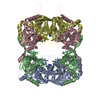
Cryo-EM structure of human ZAC in zinc Binding State
Method: EM (single particle) / Resolution: 2.62 Å

EMDB-63034, PDB-9leu:
Cryo-EM structure of human ZAC with A152 mutant in zinc binding state
Method: EM (single particle) / Resolution: 2.63 Å

EMDB-63035, PDB-9lev:
Cryo-EM structure of human ZAC in nanodisc in apo state
Method: EM (single particle) / Resolution: 3.35 Å

EMDB-63036, PDB-9lex:
Cryo-EM structure of human ZAC in zinc partially binding state in nanodisc
Method: EM (single particle) / Resolution: 2.85 Å

EMDB-63037, PDB-9ley:
Cryo-EM structure of human ZAC in complex with d-tubocurarine
Method: EM (single particle) / Resolution: 2.97 Å

EMDB-63038, PDB-9lez:
Cryo-EM structure of human ZAC in complex with N-(4-(tert-butyl)thiazol-2-yl)-3-fluorobenzamide (TTFB)
Method: EM (single particle) / Resolution: 2.54 Å

Chemicals

ChemComp-ZN:
Unknown entry

ChemComp-TC9:
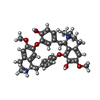
D-TUBOCURARINE

PDB-1ekj:
THE X-RAY CRYSTALLOGRAPHIC STRUCTURE OF BETA CARBONIC ANHYDRASE FROM THE C3 DICOT PISUM SATIVUM

Source
  • homo sapiens (human)
  • enterovirus a71
  • human enterovirus 71
KeywordsMEMBRANE PROTEIN / Cys-loop receptor / homopentamer / cation channel / zinc-binding state / d-tubocurarine-binding site / TTFB binding state

+
About Yorodumi Papers

-
News

-
Feb 9, 2022. New format data for meta-information of EMDB entries

New format data for meta-information of EMDB entries

  • Version 3 of the EMDB header file is now the official format.
  • The previous official version 1.9 will be removed from the archive.

Related info.:EMDB header

External links:wwPDB to switch to version 3 of the EMDB data model

-
Aug 12, 2020. Covid-19 info

Covid-19 info

URL: https://pdbj.org/emnavi/covid19.php

New page: Covid-19 featured information page in EM Navigator.

Related info.:Covid-19 info / Mar 5, 2020. Novel coronavirus structure data

+
Mar 5, 2020. Novel coronavirus structure data

Novel coronavirus structure data

Related info.:Yorodumi Speices / Aug 12, 2020. Covid-19 info

External links:COVID-19 featured content - PDBj / Molecule of the Month (242):Coronavirus Proteases

+
Jan 31, 2019. EMDB accession codes are about to change! (news from PDBe EMDB page)

EMDB accession codes are about to change! (news from PDBe EMDB page)

  • The allocation of 4 digits for EMDB accession codes will soon come to an end. Whilst these codes will remain in use, new EMDB accession codes will include an additional digit and will expand incrementally as the available range of codes is exhausted. The current 4-digit format prefixed with “EMD-” (i.e. EMD-XXXX) will advance to a 5-digit format (i.e. EMD-XXXXX), and so on. It is currently estimated that the 4-digit codes will be depleted around Spring 2019, at which point the 5-digit format will come into force.
  • The EM Navigator/Yorodumi systems omit the EMD- prefix.

Related info.:Q: What is EMD? / ID/Accession-code notation in Yorodumi/EM Navigator

External links:EMDB Accession Codes are Changing Soon! / Contact to PDBj

+
Jul 12, 2017. Major update of PDB

Major update of PDB

  • wwPDB released updated PDB data conforming to the new PDBx/mmCIF dictionary.
  • This is a major update changing the version number from 4 to 5, and with Remediation, in which all the entries are updated.
  • In this update, many items about electron microscopy experimental information are reorganized (e.g. em_software).
  • Now, EM Navigator and Yorodumi are based on the updated data.

External links:wwPDB Remediation / Enriched Model Files Conforming to OneDep Data Standards Now Available in the PDB FTP Archive

-
Yorodumi Papers

Database of articles cited by EMDB/PDB/SASBDB data

  • Database of articles cited by EMDB, PDB, and SASBDB entries
  • Using PubMed data

Related info.:EMDB / PDB / SASBDB / Yorodumi / EMN Papers / Changes in new EM Navigator and Yorodumi

Read more