[English] 日本語
Yorodumi Papers
- Database of articles cited by EMDB/PDB/SASBDB data -

+
Search query

Keywords
Structure methods
Author
Journal
IF

-
Structure paper

TitleCryo-EM structural analyses of chlorophyll b-enriched PSI-LHC and PSII-LHC supercomplexes of the siphonous green alga Bryopsis corticulans.
Journal, issue, pagesPlant Commun, Vol. 7, Issue 5, Page 101738, Year 2026
Publish dateMay 11, 2026
AuthorsXueyang Liu / Zhenhua Li / Liangliang Shen / Lili Shen / Bin Wu / Xiaoyi Li / Yanyan Yang / Shan Gao / Guangye Han / Tingyun Kuang / Cheng Liu / Jian-Ren Shen / Wenda Wang /
PubMed AbstractThe light-harvesting complexes of photosystem I (PSI) and PSII (LHCI and LHCII) in Bryopsis corticulans (B. corticulans) are homologous to those in Chlamydomonas reinhardtii and land plants but ...The light-harvesting complexes of photosystem I (PSI) and PSII (LHCI and LHCII) in Bryopsis corticulans (B. corticulans) are homologous to those in Chlamydomonas reinhardtii and land plants but exhibit a distinct chlorophyll (Chl) and carotenoid composition. Here, we report cryo-electron microscopy structures of the PSI-LHCI-LHCII supercomplex, comprising three LHCII trimers, and the CSMN-type PSII-LHCII supercomplex from B. corticulans. In the PSI supercomplex, ten LHCI subunits assemble into two belts and one heterodimer, coordinating a total of 86 Chl a and 65 Chl b molecules (Chl a/b ratio of 1.3, compared with 3.4 in C. reinhardtii), as well as 18 siphonaxanthin, 2 siphonein, and 13 α-carotene molecules. Of the three LHCII trimers bound to the PSI-LHCI supercomplex, two are anchored to the PSI core primarily via phosphorylated subunits, whereas the third, non-phosphorylated trimer is stabilized through interactions with Lhca-d and the adjacent LHCII trimer. In the CSMN-type PSII-LHCII supercomplex, the N-LHCII is positioned closer to the PSII core than in C. reinhardtii, likely owing to loss of the linker motif in the N-terminal region of B. corticulans CP29. Structure-based energy transfer analysis suggests that this spatial rearrangement enhances the efficiency of excitation energy transfer from N-LHCII to the PSII core. Collectively, these findings reveal structural adaptations that underlie the acclimation strategies of siphonous green algae inhabiting intertidal environments.
External linksPlant Commun / PubMed:41578646 / PubMed Central
MethodsEM (single particle)
Resolution2.68 - 3.07 Å
Structure data

EMDB-61940, PDB-9jzr:
Structure of PSI-LHCI-LHCII supercomplex from Bryopsis corticulans
Method: EM (single particle) / Resolution: 2.73 Å

EMDB-61973, PDB-9k1e:
Structural insights into photosystem I complex of Bryopsis corticulans
Method: EM (single particle) / Resolution: 2.68 Å

EMDB-62153, PDB-9k7v:
Structural insights into photosystem II supercomplex of a a siphonous green algae Bryopsis corticulans from intertidal zone
Method: EM (single particle) / Resolution: 3.07 Å

Chemicals

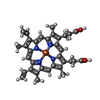
ChemComp-CHL:
CHLOROPHYLL B

ChemComp-CLA:
CHLOROPHYLL A

ChemComp-8CT:
(6'R,11cis,11'cis,13cis,15cis)-4',5'-didehydro-5',6'-dihydro-beta,beta-carotene

ChemComp-0UR:
Siphonein

ChemComp-LHG:
1,2-DIPALMITOYL-PHOSPHATIDYL-GLYCEROLE / phospholipid*YM

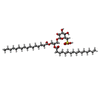
ChemComp-SQD:
1,2-DI-O-ACYL-3-O-[6-DEOXY-6-SULFO-ALPHA-D-GLUCOPYRANOSYL]-SN-GLYCEROL

ChemComp-LMG:
1,2-DISTEAROYL-MONOGALACTOSYL-DIGLYCERIDE

ChemComp-0IE:
Siphonaxanthin

ChemComp-PQN:
PHYLLOQUINONE

ChemComp-CL0:
CHLOROPHYLL A ISOMER

ChemComp-SF4:
IRON/SULFUR CLUSTER

ChemComp-DGD:
DIGALACTOSYL DIACYL GLYCEROL (DGDG)

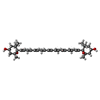
ChemComp-NEX:
(1R,3R)-6-{(3E,5E,7E,9E,11E,13E,15E,17E)-18-[(1S,4R,6R)-4-HYDROXY-2,2,6-TRIMETHYL-7-OXABICYCLO[4.1.0]HEPT-1-YL]-3,7,12,16-TETRAMETHYLOCTADECA-1,3,5,7,9,11,13,15,17-NONAENYLIDENE}-1,5,5-TRIMETHYLCYCLOHEXANE-1,3-DIOL

ChemComp-HEM:
PROTOPORPHYRIN IX CONTAINING FE

ChemComp-XAT:
(3S,5R,6S,3'S,5'R,6'S)-5,6,5',6'-DIEPOXY-5,6,5',6'- TETRAHYDRO-BETA,BETA-CAROTENE-3,3'-DIOL

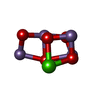
ChemComp-OEX:
CA-MN4-O5 CLUSTER

ChemComp-PHO:
PHEOPHYTIN A

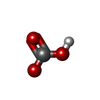
ChemComp-BCT:
BICARBONATE ION / pH buffer*YM

ChemComp-FE2:
Unknown entry

ChemComp-PL9:
2,3-DIMETHYL-5-(3,7,11,15,19,23,27,31,35-NONAMETHYL-2,6,10,14,18,22,26,30,34-HEXATRIACONTANONAENYL-2,5-CYCLOHEXADIENE-1,4-DIONE-2,3-DIMETHYL-5-SOLANESYL-1,4-BENZOQUINONE

Source
  • bryopsis corticulans (plant)
KeywordsPHOTOSYNTHESIS / photosystem II / PSI-LHCI supercomplex / PSII-LHCII supercomplex

+
About Yorodumi Papers

-
News

-
Feb 9, 2022. New format data for meta-information of EMDB entries

New format data for meta-information of EMDB entries

  • Version 3 of the EMDB header file is now the official format.
  • The previous official version 1.9 will be removed from the archive.

Related info.:EMDB header

External links:wwPDB to switch to version 3 of the EMDB data model

-
Aug 12, 2020. Covid-19 info

Covid-19 info

URL: https://pdbj.org/emnavi/covid19.php

New page: Covid-19 featured information page in EM Navigator.

Related info.:Covid-19 info / Mar 5, 2020. Novel coronavirus structure data

+
Mar 5, 2020. Novel coronavirus structure data

Novel coronavirus structure data

Related info.:Yorodumi Speices / Aug 12, 2020. Covid-19 info

External links:COVID-19 featured content - PDBj / Molecule of the Month (242):Coronavirus Proteases

+
Jan 31, 2019. EMDB accession codes are about to change! (news from PDBe EMDB page)

EMDB accession codes are about to change! (news from PDBe EMDB page)

  • The allocation of 4 digits for EMDB accession codes will soon come to an end. Whilst these codes will remain in use, new EMDB accession codes will include an additional digit and will expand incrementally as the available range of codes is exhausted. The current 4-digit format prefixed with “EMD-” (i.e. EMD-XXXX) will advance to a 5-digit format (i.e. EMD-XXXXX), and so on. It is currently estimated that the 4-digit codes will be depleted around Spring 2019, at which point the 5-digit format will come into force.
  • The EM Navigator/Yorodumi systems omit the EMD- prefix.

Related info.:Q: What is EMD? / ID/Accession-code notation in Yorodumi/EM Navigator

External links:EMDB Accession Codes are Changing Soon! / Contact to PDBj

+
Jul 12, 2017. Major update of PDB

Major update of PDB

  • wwPDB released updated PDB data conforming to the new PDBx/mmCIF dictionary.
  • This is a major update changing the version number from 4 to 5, and with Remediation, in which all the entries are updated.
  • In this update, many items about electron microscopy experimental information are reorganized (e.g. em_software).
  • Now, EM Navigator and Yorodumi are based on the updated data.

External links:wwPDB Remediation / Enriched Model Files Conforming to OneDep Data Standards Now Available in the PDB FTP Archive

-
Yorodumi Papers

Database of articles cited by EMDB/PDB/SASBDB data

  • Database of articles cited by EMDB, PDB, and SASBDB entries
  • Using PubMed data

Related info.:EMDB / PDB / SASBDB / Yorodumi / EMN Papers / Changes in new EM Navigator and Yorodumi

Read more