[English] 日本語
Yorodumi Papers
- Database of articles cited by EMDB/PDB/SASBDB data -

+
Search query

Keywords
Structure methods
Author
Journal
IF

-
Structure paper

TitleStructural basis of microtubule-mediated signal transduction.
Journal, issue, pagesCell, Year 2025
Publish dateDec 8, 2025
AuthorsSung Ryul Choi / Thorsten B Blum / Matteo Giono / Bibhas Roy / Ioannis Vakonakis / Dominic Schmid / Nicole Oelgarth / Apisha Ranganathan / Alvar D Gossert / G V Shivashankar / Alfred Zippelius / Michel O Steinmetz /
PubMed AbstractMicrotubules have long been recognized as upstream mediators of intracellular signaling, but the mechanisms underlying this fundamental function remain elusive. Here, we identify the structural basis ...Microtubules have long been recognized as upstream mediators of intracellular signaling, but the mechanisms underlying this fundamental function remain elusive. Here, we identify the structural basis by which microtubules regulate the guanine nucleotide exchange factor H1 (GEFH1), a key activator of the Ras homolog family member A (RhoA) pathway. We show that specific features of the microtubule lattice bind the C1 domain of GEFH1, leading to the sequestration and inactivation of this signaling protein. Targeted mutations in C1 residues disrupt this interaction, triggering GEFH1 release and activation of RhoA-dependent immune responses. Building on this sequestration-and-release mechanism, we identify microtubule-binding C1 domains in additional signaling proteins, including other guanine nucleotide exchange factors (GEFs), kinases, a GTPase-activating protein (GAP), and a tumor suppressor, and show that microtubule-mediated regulation via C1 domains is conserved in the Ras association domain-containing protein 1A (RASSF1A). Our findings establish a structural framework for understanding how microtubules can function as spatiotemporal signal sensors, integrating and processing diverse signaling pathways to control important cellular processes.
External linksCell / PubMed:41365297
MethodsEM (single particle) / NMR (solution)
Resolution2.74 - 3.4 Å
Structure data

EMDB-51768, PDB-9h1o:
Cryo-EM structure of taxol-microtubules in complex with the C1 domain of GEFH1
Method: EM (single particle) / Resolution: 3.4 Å

EMDB-54112: CryoEM structure of the microtubule-AKAP13 C1 domain complex
Method: EM (single particle) / Resolution: 2.74 Å

PDB-9h75:
NMR solution structure of the GEFH1 C1 domain
Method: SOLUTION NMR

Chemicals

ChemComp-ZN:
Unknown entry

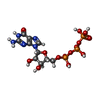
ChemComp-GTP:
GUANOSINE-5'-TRIPHOSPHATE / GTP, energy-carrying molecule*YM

ChemComp-MG:
Unknown entry

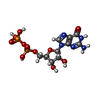
ChemComp-GDP:
GUANOSINE-5'-DIPHOSPHATE / GDP, energy-carrying molecule*YM

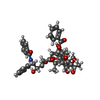
ChemComp-TA1:
TAXOL / medication, chemotherapy*YM

Source
  • homo sapiens (human)
  • bos taurus (domestic cattle)
  • Sus scrofa (pig)
KeywordsSIGNALING PROTEIN / RhoGEF / C1 / Cytoskeleton / Complex / PROTEIN BINDING / STRUCTURE FROM CYANA 3.98.4

+
About Yorodumi Papers

-
News

-
Feb 9, 2022. New format data for meta-information of EMDB entries

New format data for meta-information of EMDB entries

  • Version 3 of the EMDB header file is now the official format.
  • The previous official version 1.9 will be removed from the archive.

Related info.:EMDB header

External links:wwPDB to switch to version 3 of the EMDB data model

-
Aug 12, 2020. Covid-19 info

Covid-19 info

URL: https://pdbj.org/emnavi/covid19.php

New page: Covid-19 featured information page in EM Navigator.

Related info.:Covid-19 info / Mar 5, 2020. Novel coronavirus structure data

+
Mar 5, 2020. Novel coronavirus structure data

Novel coronavirus structure data

Related info.:Yorodumi Speices / Aug 12, 2020. Covid-19 info

External links:COVID-19 featured content - PDBj / Molecule of the Month (242):Coronavirus Proteases

+
Jan 31, 2019. EMDB accession codes are about to change! (news from PDBe EMDB page)

EMDB accession codes are about to change! (news from PDBe EMDB page)

  • The allocation of 4 digits for EMDB accession codes will soon come to an end. Whilst these codes will remain in use, new EMDB accession codes will include an additional digit and will expand incrementally as the available range of codes is exhausted. The current 4-digit format prefixed with “EMD-” (i.e. EMD-XXXX) will advance to a 5-digit format (i.e. EMD-XXXXX), and so on. It is currently estimated that the 4-digit codes will be depleted around Spring 2019, at which point the 5-digit format will come into force.
  • The EM Navigator/Yorodumi systems omit the EMD- prefix.

Related info.:Q: What is EMD? / ID/Accession-code notation in Yorodumi/EM Navigator

External links:EMDB Accession Codes are Changing Soon! / Contact to PDBj

+
Jul 12, 2017. Major update of PDB

Major update of PDB

  • wwPDB released updated PDB data conforming to the new PDBx/mmCIF dictionary.
  • This is a major update changing the version number from 4 to 5, and with Remediation, in which all the entries are updated.
  • In this update, many items about electron microscopy experimental information are reorganized (e.g. em_software).
  • Now, EM Navigator and Yorodumi are based on the updated data.

External links:wwPDB Remediation / Enriched Model Files Conforming to OneDep Data Standards Now Available in the PDB FTP Archive

-
Yorodumi Papers

Database of articles cited by EMDB/PDB/SASBDB data

  • Database of articles cited by EMDB, PDB, and SASBDB entries
  • Using PubMed data

Related info.:EMDB / PDB / SASBDB / Yorodumi / EMN Papers / Changes in new EM Navigator and Yorodumi

Read more