 Movie
Movie Controller
 Structure viewers
 About Yorodumi Papers


+Search query
-Structure paper
| Title | Antigenic landscape of Nipah virus attachment glycoprotein analysis reveals a protective immunodominant epitope across species. |
|---|---|
| Journal, issue, pages | NPJ Vaccines, Vol. 11, Issue 1, Page 5, Year 2025 |
| Publish date | Nov 28, 2025 |
 Authors Authors | Dan Zhou / Yong Wang / Yanfeng Yao / Wenhua Kuang / Rao Cheng / Gan Zhang / Hang Liu / Xin Li / Sandra Chiu / Zengqin Deng / Haiyan Zhao /  |
| PubMed Abstract | Nipah virus (NiV) and Hendra virus (HeV), two highly pathogenic Henipaviruses (HNVs), pose a significant public health threat. The attachment glycoprotein (G) plays a crucial role in viral attachment ...Nipah virus (NiV) and Hendra virus (HeV), two highly pathogenic Henipaviruses (HNVs), pose a significant public health threat. The attachment glycoprotein (G) plays a crucial role in viral attachment and entry, making it an attractive target for vaccine and therapeutic antibody development. However, the antigenic landscape and neutralization sensitivity of the diverse HNV G proteins remain poorly defined. Here, we systematically characterize 27 monoclonal antibodies (mAbs) elicited by NiV G head (G) nanoparticle-immunized mice. Among these, 25 mAbs exhibit neutralizing activity against two major NiV strains, NiV-Malaysia and NiV-Bangladesh, with five mAbs also cross-inhibiting HeV infection. Notably, mAbs from two distinct groups conferred complete protection to hamsters against lethal NiV-Malaysia challenge. Structural analysis of NiV G in complex with representative Fabs reveals four non-overlapping epitopes, including two novel antigenic sites and one public protective epitope shared across species. MAbs targeting the novel sites bind to the top or side faces of G protein's β-propeller and inhibit viral infection by blocking either receptor engagement or membrane fusion. MAbs recognizing the public epitope block the receptor binding directly. Our study provides a comprehensive antigenic map of the NiV G and offers new insights and opportunities for antibody-based therapies and rational vaccine development. |
 External links External links | NPJ Vaccines / PubMed:41315143 / PubMed Central |
| Methods | EM (single particle) / X-ray diffraction |
| Resolution | 3 - 3.03 Å |
| Structure data | EMDB-63395, PDB-9lue:  PDB-9lu3: |
| Chemicals | 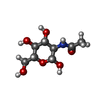 ChemComp-NAG: |
| Source |
|
 Keywords Keywords | VIRAL PROTEIN/IMMUNE SYSTEM / Glycoprotein G / Fab / VIRAL PROTEIN-IMMUNE SYSTEM complex / Nipah G protein / Antibodies |


 henipavirus nipahense
 mesocricetus auratus (golden hamster)
 mus musculus (house mouse)