[English] 日本語
Yorodumi Papers
- Database of articles cited by EMDB/PDB/SASBDB data -

+
Search query

Keywords
Structure methods
Author
Journal
IF

-
Structure paper

TitleDistinct quaternary states, intermediates, and autoinhibition during loading of the DnaB-replicative helicase by the phage λP helicase loader.
Journal, issue, pagesNucleic Acids Res, Vol. 53, Issue 22, Year 2025
Publish dateNov 26, 2025
AuthorsAbhipsa Shatarupa / Dhanjai Brown / Paul Dominic B Olinares / Jillian Chase / Eta Isiorho / Brian T Chait / David Jeruzalmi /
PubMed AbstractReplicative helicases need loader proteins to assemble at DNA replication origins. Multiple copies of the bacteriophage λP (P) loader bind and load the Escherichia coli DnaB (B) replicative helicase ...Replicative helicases need loader proteins to assemble at DNA replication origins. Multiple copies of the bacteriophage λP (P) loader bind and load the Escherichia coli DnaB (B) replicative helicase onto single-stranded (ss) DNA from the replication origin. We find that the E. coli DnaB•λP complex exists in two forms: B6P5 and B6P6. In the 2.66 Å cryo-EM structure of B6P5, five λP loader copies form a crown-like shape that tightly grips DnaB. In this complex, the closed, planar DnaB is reconfigured into an open spiral with a large enough breach to allow ssDNA to enter an internal chamber. Transition to the open spiral involves λP-induced changes to the Docking Helix (DH)-Linker Helix (LH) interface. Unexpectedly, one λP chain in B6P5 is positioned across the breach. The disposition of this λP chain implies a complex pathway for entry of a replication-origin-derived ssDNA "bubble" ssDNA into the B6P5 complex. We propose that the B6P6 complex is an early intermediate in helicase activation in which neither DnaB nor λP has reached its final form. In this complex, DnaB adopts a partially open, ajar planar configuration. λP in B6P6 interacts more loosely with DnaB. The ssDNA- and ATP-binding sites in both complexes are not correctly configured for binding or hydrolysis. Our findings detail the distinct conformations of B6P6 and B6P5, allowing us to propose a structural model for the transition from an ajar planar to an open spiral configuration in the helicase loading pathway.
External linksNucleic Acids Res / PubMed:41312769 / PubMed Central
MethodsEM (single particle) / X-ray diffraction
Resolution1.86 - 3.85 Å
Structure data

EMDB-43082, PDB-8v9t:
Ecoli DnaB helicase and Phage Lambda loader P with ADP-Mg in a 6:5 stoichiometry ratio
Method: EM (single particle) / Resolution: 2.84 Å

EMDB-70269, PDB-9oa1:
Ecoli DnaB helicase and Phage Lambda loader P with ADP-Mg in a 6:5 stoichiometry ratio.
Method: EM (single particle) / Resolution: 2.66 Å

EMDB-70271, PDB-9oa2:
Ecoli DnaB helicase and Phage Lambda loader P with ADP-Mg in a 6:6 stoichiometry ratio.
Method: EM (single particle) / Resolution: 3.85 Å

PDB-8v9s:
Distinct Quaternary States, Intermediates, and Autoinhibition During Loading of the DnaB-Replicative Helicase by the Phage Lambda P Helicase Loader
Method: X-RAY DIFFRACTION / Resolution: 1.86 Å

Chemicals

ChemComp-HOH:
WATER

ChemComp-ADP:
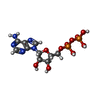
ADENOSINE-5'-DIPHOSPHATE / ADP, energy-carrying molecule*YM

ChemComp-MG:
Unknown entry

Source
  • escherichia coli (E. coli)
  • escherichia phage lambda (virus)
KeywordsREPLICATION / hexameric DnaB helicase / replicative loader / Phage Lambda P helicase loader / bacterial DNA replication initiation / DNA BINDING PROTEIN / auto inhibition / bacterial DNA replication initiation intermediate

+
About Yorodumi Papers

-
News

-
Feb 9, 2022. New format data for meta-information of EMDB entries

New format data for meta-information of EMDB entries

  • Version 3 of the EMDB header file is now the official format.
  • The previous official version 1.9 will be removed from the archive.

Related info.:EMDB header

External links:wwPDB to switch to version 3 of the EMDB data model

-
Aug 12, 2020. Covid-19 info

Covid-19 info

URL: https://pdbj.org/emnavi/covid19.php

New page: Covid-19 featured information page in EM Navigator.

Related info.:Covid-19 info / Mar 5, 2020. Novel coronavirus structure data

+
Mar 5, 2020. Novel coronavirus structure data

Novel coronavirus structure data

Related info.:Yorodumi Speices / Aug 12, 2020. Covid-19 info

External links:COVID-19 featured content - PDBj / Molecule of the Month (242):Coronavirus Proteases

+
Jan 31, 2019. EMDB accession codes are about to change! (news from PDBe EMDB page)

EMDB accession codes are about to change! (news from PDBe EMDB page)

  • The allocation of 4 digits for EMDB accession codes will soon come to an end. Whilst these codes will remain in use, new EMDB accession codes will include an additional digit and will expand incrementally as the available range of codes is exhausted. The current 4-digit format prefixed with “EMD-” (i.e. EMD-XXXX) will advance to a 5-digit format (i.e. EMD-XXXXX), and so on. It is currently estimated that the 4-digit codes will be depleted around Spring 2019, at which point the 5-digit format will come into force.
  • The EM Navigator/Yorodumi systems omit the EMD- prefix.

Related info.:Q: What is EMD? / ID/Accession-code notation in Yorodumi/EM Navigator

External links:EMDB Accession Codes are Changing Soon! / Contact to PDBj

+
Jul 12, 2017. Major update of PDB

Major update of PDB

  • wwPDB released updated PDB data conforming to the new PDBx/mmCIF dictionary.
  • This is a major update changing the version number from 4 to 5, and with Remediation, in which all the entries are updated.
  • In this update, many items about electron microscopy experimental information are reorganized (e.g. em_software).
  • Now, EM Navigator and Yorodumi are based on the updated data.

External links:wwPDB Remediation / Enriched Model Files Conforming to OneDep Data Standards Now Available in the PDB FTP Archive

-
Yorodumi Papers

Database of articles cited by EMDB/PDB/SASBDB data

  • Database of articles cited by EMDB, PDB, and SASBDB entries
  • Using PubMed data

Related info.:EMDB / PDB / SASBDB / Yorodumi / EMN Papers / Changes in new EM Navigator and Yorodumi

Read more