[English] 日本語
Yorodumi Papers
- Database of articles cited by EMDB/PDB/SASBDB data -

+
Search query

Keywords
Structure methods
Author
Journal
IF

-
Structure paper

TitleStructural basis for lipid transport at membrane contact sites by the IST2-OSH6 complex.
Journal, issue, pagesNat Struct Mol Biol, Vol. 32, Issue 11, Page 2219-2230, Year 2025
Publish dateAug 27, 2025
AuthorsMelanie Arndt / Angela Schweri / Raimund Dutzler /
PubMed AbstractMembrane contact sites are hubs for interorganellar lipid transport within eukaryotic cells. As a principal tether bridging the endoplasmic reticulum (ER) and the plasma membrane in Saccharomyces ...Membrane contact sites are hubs for interorganellar lipid transport within eukaryotic cells. As a principal tether bridging the endoplasmic reticulum (ER) and the plasma membrane in Saccharomyces cerevisiae, the protein IST2 has a major role during lipid transport between both compartments. Here, we show a comprehensive investigation elucidating the structural and mechanistic properties of IST2 and its interaction with the soluble lipid transfer protein OSH6. The ER-embedded transmembrane domain of IST2 is homologous to the TMEM16 family and acts as a constitutively active lipid scramblase. The extended C terminus binds to the plasma membrane and the phosphatidylserine-phosphatidylinositol 4-phosphate exchanger OSH6. Through cellular growth assays and biochemical and structural studies, we characterized the interaction between both proteins and show that OSH6 remains associated with IST2 during lipid shuttling between membranes. These results highlight the role of the IST2-OSH6 complex in lipid trafficking and offer initial insights into the relevance of scramblases for carrier-like lipid transport mechanisms.
External linksNat Struct Mol Biol / PubMed:40866577 / PubMed Central
MethodsEM (single particle) / X-ray diffraction
Resolution1.84 - 4.2 Å
Structure data

EMDB-52170, PDB-9hhe:
Structure of the Ist2 TMEM16 homology domain in the detergent GDN
Method: EM (single particle) / Resolution: 2.84 Å

EMDB-53200, PDB-9qja:
Structure of the transmembrane domain of full-length Ist2 at low resolution
Method: EM (single particle) / Resolution: 4.2 Å

EMDB-53210, PDB-9qjt:
Structure of the transmembrane domain of Ist2 in lipid nanodiscs (wide state)
Method: EM (single particle) / Resolution: 3.8 Å

EMDB-53211, PDB-9qju:
Structure of the transmembrane domain of Ist2 in lipid nanodiscs (narrow state)
Method: EM (single particle) / Resolution: 3.34 Å

PDB-9hdh:
Structure of s.c.Osh6 in complex with Ist2 732-761 and POPS
Method: X-RAY DIFFRACTION / Resolution: 1.84 Å

PDB-9hdk:
Structure of s.c.Osh6 in complex with Ist2 732-756 and POPS
Method: X-RAY DIFFRACTION / Resolution: 1.93 Å

Chemicals

ChemComp-P5S:
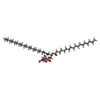
O-[(R)-{[(2R)-2,3-bis(octadecanoyloxy)propyl]oxy}(hydroxy)phosphoryl]-L-serine

ChemComp-HOH:
WATER

Source
  • saccharomyces cerevisiae (brewer's yeast)

KeywordsLIPID TRANSPORT / Lipid transport protein / complex / Oxysterol-binding protein / membrane contact sites / MEMBRANE PROTEIN / TMEM16 proteins / lipid scramblase / tethering protein / scramblase / TMEM16 protein

+
About Yorodumi Papers

-
News

-
Feb 9, 2022. New format data for meta-information of EMDB entries

New format data for meta-information of EMDB entries

  • Version 3 of the EMDB header file is now the official format.
  • The previous official version 1.9 will be removed from the archive.

Related info.:EMDB header

External links:wwPDB to switch to version 3 of the EMDB data model

-
Aug 12, 2020. Covid-19 info

Covid-19 info

URL: https://pdbj.org/emnavi/covid19.php

New page: Covid-19 featured information page in EM Navigator.

Related info.:Covid-19 info / Mar 5, 2020. Novel coronavirus structure data

+
Mar 5, 2020. Novel coronavirus structure data

Novel coronavirus structure data

Related info.:Yorodumi Speices / Aug 12, 2020. Covid-19 info

External links:COVID-19 featured content - PDBj / Molecule of the Month (242):Coronavirus Proteases

+
Jan 31, 2019. EMDB accession codes are about to change! (news from PDBe EMDB page)

EMDB accession codes are about to change! (news from PDBe EMDB page)

  • The allocation of 4 digits for EMDB accession codes will soon come to an end. Whilst these codes will remain in use, new EMDB accession codes will include an additional digit and will expand incrementally as the available range of codes is exhausted. The current 4-digit format prefixed with “EMD-” (i.e. EMD-XXXX) will advance to a 5-digit format (i.e. EMD-XXXXX), and so on. It is currently estimated that the 4-digit codes will be depleted around Spring 2019, at which point the 5-digit format will come into force.
  • The EM Navigator/Yorodumi systems omit the EMD- prefix.

Related info.:Q: What is EMD? / ID/Accession-code notation in Yorodumi/EM Navigator

External links:EMDB Accession Codes are Changing Soon! / Contact to PDBj

+
Jul 12, 2017. Major update of PDB

Major update of PDB

  • wwPDB released updated PDB data conforming to the new PDBx/mmCIF dictionary.
  • This is a major update changing the version number from 4 to 5, and with Remediation, in which all the entries are updated.
  • In this update, many items about electron microscopy experimental information are reorganized (e.g. em_software).
  • Now, EM Navigator and Yorodumi are based on the updated data.

External links:wwPDB Remediation / Enriched Model Files Conforming to OneDep Data Standards Now Available in the PDB FTP Archive

-
Yorodumi Papers

Database of articles cited by EMDB/PDB/SASBDB data

  • Database of articles cited by EMDB, PDB, and SASBDB entries
  • Using PubMed data

Related info.:EMDB / PDB / SASBDB / Yorodumi / EMN Papers / Changes in new EM Navigator and Yorodumi

Read more