 Movie
Movie Controller
 Structure viewers
 About Yorodumi Papers


+Search query
-Structure paper
| Title | Structural Analysis and Molecular Dynamics Simulations of Urease From Ureaplasma parvum. |
|---|---|
| Journal, issue, pages | J Mol Biol, Vol. 437, Issue 21, Page 169368, Year 2025 |
| Publish date | Aug 5, 2025 |
 Authors Authors | Heng Ning Wu / Junso Fujita / Yukiko Nakura / Masao Inoue / Koichiro Suzuki / Toru Ekimoto / Bingjie Yin / Yohta Fukuda / Kazuo Harada / Tsuyoshi Inoue / Mitsunori Ikeguchi / Keiichi Namba / Itaru Yanagihara /  |
| PubMed Abstract | Ureaplasma is one of the smallest pathogenic bacteria, generating approximately 95% of its adenosine triphosphate (ATP) solely through urease. Studies on Ureaplasma parvum, a species of Ureaplasma, ...Ureaplasma is one of the smallest pathogenic bacteria, generating approximately 95% of its adenosine triphosphate (ATP) solely through urease. Studies on Ureaplasma parvum, a species of Ureaplasma, have confirmed that adding urease inhibitors inhibits bacterial growth. The K and V of the urease-mediated reaction were estimated to be 4.3 ± 0.2 mM and 3,333.3 ± 38.0 μmol NH/min/mg protein, respectively. The cryo-electron microscopy (cryo-EM) structure of Ureaplasma parvum urease (UPU) at a resolution of 2.03 Å reveals a trimer of heterotrimers comprising three proteins: UreA, UreB, and UreC. The active site is well conserved among the known ureases. However, the V of UPU was higher than that of most known ureases, including those ureases derived from Sporosarcina pasteurii (SPU) and Klebsiella aerogenes (KAU) with identical oligomeric state. All-atom molecular dynamics simulations showed that the flap and UreB are more open in UPU than SPU and KAU. His-tagged wild-type recombinant UPU (WT-rUPU) revealed estimated K and V values of 4.1 ± 0.3 mM and 769.2 ± 7.4 µmol NH/min/mg protein, respectively. Amino acid substitutions of recombinant UPUs within the flap region to SPU. Amongst the flap region variants, the V of K331N variant was 48-fold lower than that of WT-rUPU. ICP-MS analysis reveals that one molecule of UPU, WT-rUPU, and K331N-rUPU contains 3.7, 0.8, and 0.1 Ni atoms, respectively, suggesting that a wide-open flap of urease may contribute to delivering nickel into the enzyme, resulting in a high V. Ureaplasma evolved highly efficient UPU through a few amino acid substitutions in the disorganized loop of the mobile flap region. |
 External links External links | J Mol Biol / PubMed:40752870 |
| Methods | EM (single particle) |
| Resolution | 2.03 Å |
| Structure data | EMDB-60854, PDB-9it2: |
| Chemicals | 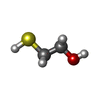 ChemComp-BME:  ChemComp-NI:  ChemComp-HOH: |
| Source |
|
 Keywords Keywords | HYDROLASE / urease |


 ureaplasma parvum serovar 3 (strain atcc 700970) (bacteria)