[English] 日本語
Yorodumi Papers
- Database of articles cited by EMDB/PDB/SASBDB data -

+
Search query

Keywords
Structure methods
Author
Journal
IF

-
Structure paper

TitleMolecular basis for substrate recognition and transport of mammalian taurine transporters.
Journal, issue, pagesProc Natl Acad Sci U S A, Vol. 122, Issue 27, Page e2425549122, Year 2025
Publish dateJul 8, 2025
AuthorsMingxing Wang / Jin He / Qianwen Cai / Shen-Ao Zhang / Ji She /
PubMed AbstractThe taurine transporter (TAUT) mediates cellular taurine uptake, playing a critical role in human health and longevity. In this study, we present cryogenic electron microscopy structures of both ...The taurine transporter (TAUT) mediates cellular taurine uptake, playing a critical role in human health and longevity. In this study, we present cryogenic electron microscopy structures of both mouse and human TAUT in various conformational states. The taurine-bound, occluded forms of mouse and human TAUT reveal the substrate binding pocket and the ion binding sites. The amino group of taurine interacts with Glu406 at the binding site, constituting a key structural feature determining substrate preference. While both imidazole acetic acid and guanidinoethyl sulfonate (GES) inhibit TAUT by competing with taurine for the binding site, GES also functions as a substrate of TAUT. Moreover, mouse TAUT is captured in an inward-open apo conformation, where the tilted movement of transmembrane helix (TM) 1a opens the intracellular gate. Notably, TM6 exhibits two distinct conformational states: the canonical form consisting of two half-helices and a continuous straight helix. In the latter conformation, TM6 partially occupies the substrate binding site, likely promoting taurine release. Together, our findings provide critical insights into the molecular mechanisms by which TAUT recognizes and transports taurine.
External linksProc Natl Acad Sci U S A / PubMed:40601627 / PubMed Central
MethodsEM (single particle)
Resolution2.84 - 3.3 Å
Structure data

EMDB-62434, PDB-9kmi:
Taurine bound mTAUT
Method: EM (single particle) / Resolution: 3.05 Å

EMDB-62435, PDB-9kmj:
Taurine bound hTAUT
Method: EM (single particle) / Resolution: 3.1 Å

EMDB-62436, PDB-9kmk:
apo mTAUT in inward open II state
Method: EM (single particle) / Resolution: 3.06 Å

EMDB-62437, PDB-9kml:
apo mTAUT in inward open I state
Method: EM (single particle) / Resolution: 3.11 Å

EMDB-62438, PDB-9kmm:
IAA bound mTAUT
Method: EM (single particle) / Resolution: 3.3 Å

EMDB-62648, PDB-9kyo:
GES bound mTAUT
Method: EM (single particle) / Resolution: 2.84 Å

Chemicals

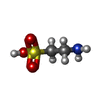
ChemComp-TAU:
2-AMINOETHANESULFONIC ACID

ChemComp-CL:
Unknown entry

ChemComp-NA:
Unknown entry

ChemComp-HOH:
WATER

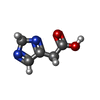
ChemComp-IZC:
2H-IMIDAZOL-4-YLACETIC ACID / neurotransmitter*YM

ChemComp-3S5:
Taurocyamine

Source
  • mus musculus (house mouse)
  • homo sapiens (human)
KeywordsMEMBRANE PROTEIN/IMMUNE SYSTEM / Transporter / Taurine / Chlorine / Sodium / MEMBRANE PROTEIN-IMMUNE SYSTEM complex / SLC6A6

+
About Yorodumi Papers

-
News

-
Feb 9, 2022. New format data for meta-information of EMDB entries

New format data for meta-information of EMDB entries

  • Version 3 of the EMDB header file is now the official format.
  • The previous official version 1.9 will be removed from the archive.

Related info.:EMDB header

External links:wwPDB to switch to version 3 of the EMDB data model

-
Aug 12, 2020. Covid-19 info

Covid-19 info

URL: https://pdbj.org/emnavi/covid19.php

New page: Covid-19 featured information page in EM Navigator.

Related info.:Covid-19 info / Mar 5, 2020. Novel coronavirus structure data

+
Mar 5, 2020. Novel coronavirus structure data

Novel coronavirus structure data

Related info.:Yorodumi Speices / Aug 12, 2020. Covid-19 info

External links:COVID-19 featured content - PDBj / Molecule of the Month (242):Coronavirus Proteases

+
Jan 31, 2019. EMDB accession codes are about to change! (news from PDBe EMDB page)

EMDB accession codes are about to change! (news from PDBe EMDB page)

  • The allocation of 4 digits for EMDB accession codes will soon come to an end. Whilst these codes will remain in use, new EMDB accession codes will include an additional digit and will expand incrementally as the available range of codes is exhausted. The current 4-digit format prefixed with “EMD-” (i.e. EMD-XXXX) will advance to a 5-digit format (i.e. EMD-XXXXX), and so on. It is currently estimated that the 4-digit codes will be depleted around Spring 2019, at which point the 5-digit format will come into force.
  • The EM Navigator/Yorodumi systems omit the EMD- prefix.

Related info.:Q: What is EMD? / ID/Accession-code notation in Yorodumi/EM Navigator

External links:EMDB Accession Codes are Changing Soon! / Contact to PDBj

+
Jul 12, 2017. Major update of PDB

Major update of PDB

  • wwPDB released updated PDB data conforming to the new PDBx/mmCIF dictionary.
  • This is a major update changing the version number from 4 to 5, and with Remediation, in which all the entries are updated.
  • In this update, many items about electron microscopy experimental information are reorganized (e.g. em_software).
  • Now, EM Navigator and Yorodumi are based on the updated data.

External links:wwPDB Remediation / Enriched Model Files Conforming to OneDep Data Standards Now Available in the PDB FTP Archive

-
Yorodumi Papers

Database of articles cited by EMDB/PDB/SASBDB data

  • Database of articles cited by EMDB, PDB, and SASBDB entries
  • Using PubMed data

Related info.:EMDB / PDB / SASBDB / Yorodumi / EMN Papers / Changes in new EM Navigator and Yorodumi

Read more