[English] 日本語
Yorodumi Papers
- Database of articles cited by EMDB/PDB/SASBDB data -

+
Search query

Keywords
Structure methods
Author
Journal
IF

-
Structure paper

TitlePolarity protein Par6 facilitates the processive phosphorylation of Lgl via a dynamic interaction with aPKC.
Journal, issue, pagesCommun Biol, Vol. 8, Issue 1, Page 967, Year 2025
Publish dateJul 1, 2025
AuthorsLior Almagor / William I Weis /
PubMed AbstractPolarity along an apical-basal axis is essential for epithelial cell shape and function. The atypical protein Kinase-C (aPKC) and its regulatory partner Par6 form a complex that is essential for ...Polarity along an apical-basal axis is essential for epithelial cell shape and function. The atypical protein Kinase-C (aPKC) and its regulatory partner Par6 form a complex that is essential for polarization, a primary function of which is to phosphorylate the Lethal giant larvae (Lgl) protein to prevent it from binding to the apical membrane (thereby facilitating its basolateral localization). Par6 binds Lgl directly and is essential for this process, but its mechanism was obscure. Here, we utilize cryo-EM and various biochemical techniques to characterize the interaction of Lgl2 with the aPKCι/Par6 complex and to study the roles of Par6 in promoting Lgl2 phosphorylation. We find that Par6 proteins stabilize a ternary Lgl2/aPKCι/Par6 complex that involves a unique multi-surface interaction of Lgl2 with both aPKCι and Par6. Importantly, we find Par6b induces processive phosphorylation that results in a multi-phosphorylated Lgl2 after a single interaction with the aPKCι/Par6b complex. This is enabled by a Par6b/Lgl2 interaction that maintains contact of Lgl2 with the kinase throughout its distinct nucleotide-binding states. Our results reveal the mechanistic basis for the efficient regulation of Lgl's membrane binding by aPKC/Par6 and provide invaluable structural data for further understanding the mechanisms of this polarity complex.
External linksCommun Biol / PubMed:40595028 / PubMed Central
MethodsEM (single particle)
Resolution3.08 - 4.05 Å
Structure data

EMDB-48103, PDB-9ejk:
Lgl2 bound to the aPKCiota-Par6b complex in nucleotide-free form. Head sub-complex region subtracted
Method: EM (single particle) / Resolution: 3.08 Å

EMDB-48104, PDB-9ejl:
Lgl2 bound to the aPKCiota-Par6B complex in nucleotide-free form. Conformation with visible head sub-complex.
Method: EM (single particle) / Resolution: 3.48 Å

EMDB-48105, PDB-9ejm:
Lgl2 bound to the aPKCiota-Par6B complex in its ADP-bound form
Method: EM (single particle) / Resolution: 3.33 Å

EMDB-48106: Lgl2 bound to the aPKCiota-Par6a complex in its nucleotide-free form.
Method: EM (single particle) / Resolution: 4.05 Å

EMDB-48107: Lgl2 bound to the aPKCiota-Par6A complex in its ADP-bound form
Method: EM (single particle) / Resolution: 3.31 Å

Chemicals

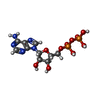
ChemComp-ADP:
ADENOSINE-5'-DIPHOSPHATE / ADP, energy-carrying molecule*YM

ChemComp-MG:
Unknown entry

Source
  • mus musculus (house mouse)
  • homo sapiens (human)
KeywordsLIPID BINDING PROTEIN / Cell Polarity / Kinase / Complex / Complex.

+
About Yorodumi Papers

-
News

-
Feb 9, 2022. New format data for meta-information of EMDB entries

New format data for meta-information of EMDB entries

  • Version 3 of the EMDB header file is now the official format.
  • The previous official version 1.9 will be removed from the archive.

Related info.:EMDB header

External links:wwPDB to switch to version 3 of the EMDB data model

-
Aug 12, 2020. Covid-19 info

Covid-19 info

URL: https://pdbj.org/emnavi/covid19.php

New page: Covid-19 featured information page in EM Navigator.

Related info.:Covid-19 info / Mar 5, 2020. Novel coronavirus structure data

+
Mar 5, 2020. Novel coronavirus structure data

Novel coronavirus structure data

Related info.:Yorodumi Speices / Aug 12, 2020. Covid-19 info

External links:COVID-19 featured content - PDBj / Molecule of the Month (242):Coronavirus Proteases

+
Jan 31, 2019. EMDB accession codes are about to change! (news from PDBe EMDB page)

EMDB accession codes are about to change! (news from PDBe EMDB page)

  • The allocation of 4 digits for EMDB accession codes will soon come to an end. Whilst these codes will remain in use, new EMDB accession codes will include an additional digit and will expand incrementally as the available range of codes is exhausted. The current 4-digit format prefixed with “EMD-” (i.e. EMD-XXXX) will advance to a 5-digit format (i.e. EMD-XXXXX), and so on. It is currently estimated that the 4-digit codes will be depleted around Spring 2019, at which point the 5-digit format will come into force.
  • The EM Navigator/Yorodumi systems omit the EMD- prefix.

Related info.:Q: What is EMD? / ID/Accession-code notation in Yorodumi/EM Navigator

External links:EMDB Accession Codes are Changing Soon! / Contact to PDBj

+
Jul 12, 2017. Major update of PDB

Major update of PDB

  • wwPDB released updated PDB data conforming to the new PDBx/mmCIF dictionary.
  • This is a major update changing the version number from 4 to 5, and with Remediation, in which all the entries are updated.
  • In this update, many items about electron microscopy experimental information are reorganized (e.g. em_software).
  • Now, EM Navigator and Yorodumi are based on the updated data.

External links:wwPDB Remediation / Enriched Model Files Conforming to OneDep Data Standards Now Available in the PDB FTP Archive

-
Yorodumi Papers

Database of articles cited by EMDB/PDB/SASBDB data

  • Database of articles cited by EMDB, PDB, and SASBDB entries
  • Using PubMed data

Related info.:EMDB / PDB / SASBDB / Yorodumi / EMN Papers / Changes in new EM Navigator and Yorodumi

Read more