 Movie
Movie Controller
 Structure viewers
 About Yorodumi Papers


+Search query
-Structure paper
| Title | MFSD6 is an entry receptor for enterovirus D68. |
|---|---|
| Journal, issue, pages | Nature, Vol. 641, Issue 8065, Page 1268-1275, Year 2025 |
| Publish date | Mar 25, 2025 |
 Authors Authors | Lauren Varanese / Lily Xu / Christine E Peters / Grigore Pintilie / David S Roberts / Suyash Raj / Mengying Liu / Yaw Shin Ooi / Jonathan Diep / Wenjie Qiao / Christopher M Richards / Jeremy Callaway / Carolyn R Bertozzi / Sabrina Jabs / Erik de Vries / Frank J M van Kuppeveld / Claude M Nagamine / Wah Chiu / Jan E Carette /     |
| PubMed Abstract | With the near eradication of poliovirus due to global vaccination campaigns, attention has shifted to other enteroviruses that can cause polio-like paralysis syndrome (now termed acute flaccid ...With the near eradication of poliovirus due to global vaccination campaigns, attention has shifted to other enteroviruses that can cause polio-like paralysis syndrome (now termed acute flaccid myelitis). In particular, enterovirus D68 (EV-D68) is believed to be the main driver of epidemic outbreaks of acute flaccid myelitis in recent years, yet not much is known about EV-D68 host interactions. EV-D68 is a respiratory virus but, in rare cases, can spread to the central nervous system to cause severe neuropathogenesis. Here we use genome-scale CRISPR screens to identify the poorly characterized multipass membrane transporter MFSD6 as a host entry factor for EV-D68. Knockout of MFSD6 expression abrogated EV-D68 infection in cell lines and primary cells corresponding to respiratory and neural cells. MFSD6 localized to the plasma membrane and was required for viral entry into host cells. MFSD6 bound directly to EV-D68 particles through its extracellular, third loop (L3). We determined the cryo-electron microscopy structure of EV-D68 in a complex with MFSD6 L3, revealing the interaction interface. A decoy receptor, engineered by fusing MFSD6 L3 to Fc, blocked EV-D68 infection of human primary lung epithelial cells and provided near-complete protection in a lethal mouse model of EV-D68 infection. Collectively, our results reveal MFSD6 as an entry receptor for EV-D68, and support the targeting of MFSD6 as a potential mechanism to combat infections by this emerging pathogen with pandemic potential. |
 External links External links | Nature / PubMed:40132641 / PubMed Central |
| Methods | EM (single particle) |
| Resolution | 2.0 - 2.1 Å |
| Structure data | EMDB-48705, PDB-9mwz: EMDB-48713, PDB-9mxc: |
| Chemicals |  ChemComp-HOH:  ChemComp-NA: |
| Source |
|
 Keywords Keywords | VIRUS / Enterovirus / Glycan / MFSD6 / Receptor |

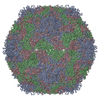

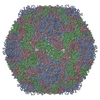
 enterovirus d68
 homo sapiens (human)