[English] 日本語
Yorodumi Papers
- Database of articles cited by EMDB/PDB/SASBDB data -

+
Search query

Keywords
Structure methods
Author
Journal
IF

-
Structure paper

TitleMechanistic basis of temperature adaptation in microtubule dynamics across frog species.
Journal, issue, pagesCurr Biol, Vol. 35, Issue 3, Page 612-628.e6, Year 2025
Publish dateFeb 3, 2025
AuthorsLuca Troman / Ella de Gaulejac / Abin Biswas / Jennifer Stiens / Benno Kuropka / Carolyn A Moores / Simone Reber /
PubMed AbstractCellular processes are remarkably effective across diverse temperature ranges, even with highly conserved proteins. In the context of the microtubule cytoskeleton, which is critically involved in a ...Cellular processes are remarkably effective across diverse temperature ranges, even with highly conserved proteins. In the context of the microtubule cytoskeleton, which is critically involved in a wide range of cellular activities, this is particularly striking, as tubulin is one of the most conserved proteins while microtubule dynamic instability is highly temperature sensitive. Here, we leverage the diversity of natural tubulin variants from three closely related frog species that live at different temperatures. We determine the microtubule structure across all three species at between 3.0 and 3.6 Å resolution by cryo-electron microscopy and find small differences at the β-tubulin lateral interactions. Using in vitro reconstitution assays and quantitative biochemistry, we show that tubulin's free energy scales inversely with temperature. The observed weakening of lateral contacts and the low apparent activation energy for tubulin incorporation provide an explanation for the overall stability and higher growth rates of microtubules in cold-adapted frog species. This study thus broadens our conceptual framework for understanding microtubule dynamics and provides insights into how conserved cellular processes are tailored to different ecological niches.
External linksCurr Biol / PubMed:39798564
MethodsEM (single particle)
Resolution3.0 - 3.6 Å
Structure data

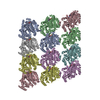
EMDB-50811, PDB-9fvj:
Xenopus borealis undecorated microtubule - 15 protofilament, 3-start helix
Method: EM (single particle) / Resolution: 3.2 Å

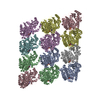
EMDB-50941, PDB-9g0o:
Xenopus borealis undecorated microtubule - 14 protofilament, 3-start helix
Method: EM (single particle) / Resolution: 3.3 Å

EMDB-50942, PDB-9g0p:
Xenopus laevis undecorated microtubule - 14 protofilament, 3-start helix
Method: EM (single particle) / Resolution: 3.0 Å

EMDB-50943, PDB-9g0q:
Xenopus laevis undecorated microtubule - 15 protofilament, 3-start helix
Method: EM (single particle) / Resolution: 3.2 Å

EMDB-50945, PDB-9g0r:
Xenopus laevis undecorated microtubule - 15 protofilament, 4-start helix
Method: EM (single particle) / Resolution: 3.1 Å

EMDB-50946, PDB-9g0s:
Xenopus tropicalis undecorated microtubule - 14 protofilament, 3-start helix
Method: EM (single particle) / Resolution: 3.6 Å

EMDB-50947, PDB-9g0t:
Xenopus tropicalis undecorated microtubule - 15 protofilament, 3-start helix
Method: EM (single particle) / Resolution: 3.5 Å

Chemicals

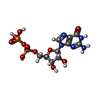
ChemComp-GDP:
GUANOSINE-5'-DIPHOSPHATE / GDP, energy-carrying molecule*YM

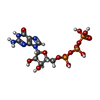
ChemComp-GTP:
GUANOSINE-5'-TRIPHOSPHATE / GTP, energy-carrying molecule*YM

ChemComp-MG:
Unknown entry

Source
  • xenopus borealis (Kenyan clawed frog)
  • xenopus laevis (African clawed frog)
  • xenopus tropicalis (tropical clawed frog)
KeywordsPROTEIN FIBRIL / Microtubule Tubulin Cytoskeleton Filament

+
About Yorodumi Papers

-
News

-
Feb 9, 2022. New format data for meta-information of EMDB entries

New format data for meta-information of EMDB entries

  • Version 3 of the EMDB header file is now the official format.
  • The previous official version 1.9 will be removed from the archive.

Related info.:EMDB header

External links:wwPDB to switch to version 3 of the EMDB data model

-
Aug 12, 2020. Covid-19 info

Covid-19 info

URL: https://pdbj.org/emnavi/covid19.php

New page: Covid-19 featured information page in EM Navigator.

Related info.:Covid-19 info / Mar 5, 2020. Novel coronavirus structure data

+
Mar 5, 2020. Novel coronavirus structure data

Novel coronavirus structure data

Related info.:Yorodumi Speices / Aug 12, 2020. Covid-19 info

External links:COVID-19 featured content - PDBj / Molecule of the Month (242):Coronavirus Proteases

+
Jan 31, 2019. EMDB accession codes are about to change! (news from PDBe EMDB page)

EMDB accession codes are about to change! (news from PDBe EMDB page)

  • The allocation of 4 digits for EMDB accession codes will soon come to an end. Whilst these codes will remain in use, new EMDB accession codes will include an additional digit and will expand incrementally as the available range of codes is exhausted. The current 4-digit format prefixed with “EMD-” (i.e. EMD-XXXX) will advance to a 5-digit format (i.e. EMD-XXXXX), and so on. It is currently estimated that the 4-digit codes will be depleted around Spring 2019, at which point the 5-digit format will come into force.
  • The EM Navigator/Yorodumi systems omit the EMD- prefix.

Related info.:Q: What is EMD? / ID/Accession-code notation in Yorodumi/EM Navigator

External links:EMDB Accession Codes are Changing Soon! / Contact to PDBj

+
Jul 12, 2017. Major update of PDB

Major update of PDB

  • wwPDB released updated PDB data conforming to the new PDBx/mmCIF dictionary.
  • This is a major update changing the version number from 4 to 5, and with Remediation, in which all the entries are updated.
  • In this update, many items about electron microscopy experimental information are reorganized (e.g. em_software).
  • Now, EM Navigator and Yorodumi are based on the updated data.

External links:wwPDB Remediation / Enriched Model Files Conforming to OneDep Data Standards Now Available in the PDB FTP Archive

-
Yorodumi Papers

Database of articles cited by EMDB/PDB/SASBDB data

  • Database of articles cited by EMDB, PDB, and SASBDB entries
  • Using PubMed data

Related info.:EMDB / PDB / SASBDB / Yorodumi / EMN Papers / Changes in new EM Navigator and Yorodumi

Read more