[English] 日本語
Yorodumi Papers
- Database of articles cited by EMDB/PDB/SASBDB data -

+
Search query

Keywords
Structure methods
Author
Journal
IF

-
Structure paper

TitleSpontaneous base flipping helps drive Nsp15's preferences in double stranded RNA substrates.
Journal, issue, pagesNat Commun, Vol. 16, Issue 1, Page 391, Year 2025
Publish dateJan 4, 2025
AuthorsZoe M Wright / Kevin John Butay / Juno M Krahn / Isha M Wilson / Scott A Gabel / Eugene F DeRose / Israa S Hissein / Jason G Williams / Mario J Borgnia / Meredith N Frazier / Geoffrey A Mueller / Robin E Stanley /
PubMed AbstractCoronaviruses evade detection by the host immune system with the help of the endoribonuclease Nsp15, which regulates levels of viral double stranded RNA by cleaving 3' of uridine (U). While prior ...Coronaviruses evade detection by the host immune system with the help of the endoribonuclease Nsp15, which regulates levels of viral double stranded RNA by cleaving 3' of uridine (U). While prior structural data shows that to cleave double stranded RNA, Nsp15's target U must be flipped out of the helix, it is not yet understood whether Nsp15 initiates flipping or captures spontaneously flipped bases. We address this gap by designing fluorinated double stranded RNA substrates that allow us to directly relate a U's sequence context to both its tendency to spontaneously flip and its susceptibility to cleavage by Nsp15. Through a combination of nuclease assays, F NMR spectroscopy, mass spectrometry, and single particle cryo-EM, we determine that Nsp15 acts most efficiently on unpaired Us, particularly those that are already flipped. Across sequence contexts, we find Nsp15's cleavage efficiency to be directly related to that U's tendency to spontaneously flip. Overall, our findings unify previous characterizations of Nsp15's cleavage preferences, and suggest that activity of Nsp15 during infection is partially driven by bulged or otherwise relatively accessible Us that appear at strategic positions in the viral RNA.
External linksNat Commun / PubMed:39755678 / PubMed Central
MethodsEM (single particle)
Resolution3.24 Å
Structure data

EMDB-44590, PDB-9bih:
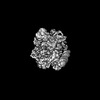
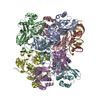
SARS-CoV-2 endoribonuclease Nsp15 bound to dsRNA with 1 nucleotide bulge
Method: EM (single particle) / Resolution: 3.24 Å

Source
  • severe acute respiratory syndrome coronavirus 2

KeywordsVIRAL PROTEIN / Uridine-specific endonuclease / bulged dsRNA / unpaired nucleotide / coronavirus

+
About Yorodumi Papers

-
News

-
Feb 9, 2022. New format data for meta-information of EMDB entries

New format data for meta-information of EMDB entries

  • Version 3 of the EMDB header file is now the official format.
  • The previous official version 1.9 will be removed from the archive.

Related info.:EMDB header

External links:wwPDB to switch to version 3 of the EMDB data model

-
Aug 12, 2020. Covid-19 info

Covid-19 info

URL: https://pdbj.org/emnavi/covid19.php

New page: Covid-19 featured information page in EM Navigator.

Related info.:Covid-19 info / Mar 5, 2020. Novel coronavirus structure data

+
Mar 5, 2020. Novel coronavirus structure data

Novel coronavirus structure data

Related info.:Yorodumi Speices / Aug 12, 2020. Covid-19 info

External links:COVID-19 featured content - PDBj / Molecule of the Month (242):Coronavirus Proteases

+
Jan 31, 2019. EMDB accession codes are about to change! (news from PDBe EMDB page)

EMDB accession codes are about to change! (news from PDBe EMDB page)

  • The allocation of 4 digits for EMDB accession codes will soon come to an end. Whilst these codes will remain in use, new EMDB accession codes will include an additional digit and will expand incrementally as the available range of codes is exhausted. The current 4-digit format prefixed with “EMD-” (i.e. EMD-XXXX) will advance to a 5-digit format (i.e. EMD-XXXXX), and so on. It is currently estimated that the 4-digit codes will be depleted around Spring 2019, at which point the 5-digit format will come into force.
  • The EM Navigator/Yorodumi systems omit the EMD- prefix.

Related info.:Q: What is EMD? / ID/Accession-code notation in Yorodumi/EM Navigator

External links:EMDB Accession Codes are Changing Soon! / Contact to PDBj

+
Jul 12, 2017. Major update of PDB

Major update of PDB

  • wwPDB released updated PDB data conforming to the new PDBx/mmCIF dictionary.
  • This is a major update changing the version number from 4 to 5, and with Remediation, in which all the entries are updated.
  • In this update, many items about electron microscopy experimental information are reorganized (e.g. em_software).
  • Now, EM Navigator and Yorodumi are based on the updated data.

External links:wwPDB Remediation / Enriched Model Files Conforming to OneDep Data Standards Now Available in the PDB FTP Archive

-
Yorodumi Papers

Database of articles cited by EMDB/PDB/SASBDB data

  • Database of articles cited by EMDB, PDB, and SASBDB entries
  • Using PubMed data

Related info.:EMDB / PDB / SASBDB / Yorodumi / EMN Papers / Changes in new EM Navigator and Yorodumi

Read more