[English] 日本語
Yorodumi Papers
- Database of articles cited by EMDB/PDB/SASBDB data -

+
Search query

Keywords
Structure methods
Author
Journal
IF

-
Structure paper

TitleThe structure of FCGBP is formed as a disulfide-mediated homodimer between its C-terminal domains.
Journal, issue, pagesFEBS J, Vol. 292, Issue 3, Page 582-601, Year 2025
Publish dateJan 3, 2025
AuthorsErik Ehrencrona / Pablo Gallego / Sergio Trillo-Muyo / Maria-Jose Garcia-Bonete / Christian V Recktenwald / Gunnar C Hansson / Malin E V Johansson /
PubMed AbstractMucus in the colon is crucial for intestinal homeostasis by forming a barrier that separates microbes from the epithelium. This is achieved by the structural arrangement of the major mucus proteins, ...Mucus in the colon is crucial for intestinal homeostasis by forming a barrier that separates microbes from the epithelium. This is achieved by the structural arrangement of the major mucus proteins, such as MUC2 and FCGBP, both of which are comprised of several von Willebrand D domains (vWD) and assemblies. Numerous disulfide bonds stabilise these domains, and intermolecular bonds generate multimers of MUC2. The oligomeric nature of FCGBP is not known. Human hFCGBP contains 13 vWD domains whereas mouse mFCGBP consists of only 7. We found unpaired cysteines in the vWD1 (human and mouse) and vWD5 (mouse)/vWD11 (human) assemblies which were not involved in disulfide bonds. However, the most C-terminal vWD domains, vWD7 (mouse)/vWD13 (human), formed disulfide-linked dimers. The intermolecular bond between C and C of human hFCGBP was observed by using mass spectrometry to generate the dimer. Cryo-EM structure analysis of recombinant mouse mFCGBP revealed a compact dimer with two symmetric intermolecular disulfide bonds between C and C, corresponding to the dimerising cysteines in the human hFCGBP. This compact conformation involves interactions between the vWD assemblies, but although the domains involved at the interface are the same, the nature of the interactions differ. Mouse mFCGBP was also found to exist in a semi-extended conformation. These different interactions offer insights into the dynamic nature of the FCGBP homodimer.
External linksFEBS J / PubMed:39754272 / PubMed Central
MethodsEM (single particle)
Resolution3.7 - 7.5 Å
Structure data

EMDB-18803, PDB-8r0t:
STRUCTURE OF THE MOUSE FCGBP DIMER PROTEIN IN ITS SEMIEXTENDED CONFORMATION
Method: EM (single particle) / Resolution: 3.9 Å

EMDB-19070, PDB-8rde:
STRUCTURE OF THE MOUSE FCGBP DIMER PROTEIN IN ITS COMPACT CONFORMATION
Method: EM (single particle) / Resolution: 3.7 Å

EMDB-19071: Low resolution map of the semi-extended mouse fcgbp
Method: EM (single particle) / Resolution: 7.5 Å

Chemicals

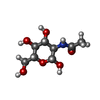
ChemComp-NAG:
2-acetamido-2-deoxy-beta-D-glucopyranose

ChemComp-CA:
Unknown entry

Source
  • mus musculus (house mouse)
KeywordsSTRUCTURAL PROTEIN / MUCUS / EPITHELIA

+
About Yorodumi Papers

-
News

-
Feb 9, 2022. New format data for meta-information of EMDB entries

New format data for meta-information of EMDB entries

  • Version 3 of the EMDB header file is now the official format.
  • The previous official version 1.9 will be removed from the archive.

Related info.:EMDB header

External links:wwPDB to switch to version 3 of the EMDB data model

-
Aug 12, 2020. Covid-19 info

Covid-19 info

URL: https://pdbj.org/emnavi/covid19.php

New page: Covid-19 featured information page in EM Navigator.

Related info.:Covid-19 info / Mar 5, 2020. Novel coronavirus structure data

+
Mar 5, 2020. Novel coronavirus structure data

Novel coronavirus structure data

Related info.:Yorodumi Speices / Aug 12, 2020. Covid-19 info

External links:COVID-19 featured content - PDBj / Molecule of the Month (242):Coronavirus Proteases

+
Jan 31, 2019. EMDB accession codes are about to change! (news from PDBe EMDB page)

EMDB accession codes are about to change! (news from PDBe EMDB page)

  • The allocation of 4 digits for EMDB accession codes will soon come to an end. Whilst these codes will remain in use, new EMDB accession codes will include an additional digit and will expand incrementally as the available range of codes is exhausted. The current 4-digit format prefixed with “EMD-” (i.e. EMD-XXXX) will advance to a 5-digit format (i.e. EMD-XXXXX), and so on. It is currently estimated that the 4-digit codes will be depleted around Spring 2019, at which point the 5-digit format will come into force.
  • The EM Navigator/Yorodumi systems omit the EMD- prefix.

Related info.:Q: What is EMD? / ID/Accession-code notation in Yorodumi/EM Navigator

External links:EMDB Accession Codes are Changing Soon! / Contact to PDBj

+
Jul 12, 2017. Major update of PDB

Major update of PDB

  • wwPDB released updated PDB data conforming to the new PDBx/mmCIF dictionary.
  • This is a major update changing the version number from 4 to 5, and with Remediation, in which all the entries are updated.
  • In this update, many items about electron microscopy experimental information are reorganized (e.g. em_software).
  • Now, EM Navigator and Yorodumi are based on the updated data.

External links:wwPDB Remediation / Enriched Model Files Conforming to OneDep Data Standards Now Available in the PDB FTP Archive

-
Yorodumi Papers

Database of articles cited by EMDB/PDB/SASBDB data

  • Database of articles cited by EMDB, PDB, and SASBDB entries
  • Using PubMed data

Related info.:EMDB / PDB / SASBDB / Yorodumi / EMN Papers / Changes in new EM Navigator and Yorodumi

Read more