[English] 日本語
Yorodumi Papers
- Database of articles cited by EMDB/PDB/SASBDB data -

+
Search query

Keywords
Structure methods
Author
Journal
IF

-
Structure paper

TitleMechanism of connexin channel inhibition by mefloquine and 2-aminoethoxydiphenyl borate.
Journal, issue, pagesPLoS One, Vol. 19, Issue 12, Page e0315510, Year 2024
Publish dateDec 31, 2024
AuthorsPia Lavriha / Yufei Han / Xinyue Ding / Dina Schuster / Chao Qi / Anand Vaithia / Paola Picotti / Volodymyr M Korkhov /
PubMed AbstractGap junction intercellular communication (GJIC) between two adjacent cells involves direct exchange of cytosolic ions and small molecules via connexin gap junction channels (GJCs). Connexin GJCs have ...Gap junction intercellular communication (GJIC) between two adjacent cells involves direct exchange of cytosolic ions and small molecules via connexin gap junction channels (GJCs). Connexin GJCs have emerged as drug targets, with small molecule connexin inhibitors considered a viable therapeutic strategy in several diseases. The molecular mechanisms of GJC inhibition by known small molecule connexin inhibitors remain unknown, preventing the development of more potent and connexin-specific therapeutics. Here we show that two GJC inhibitors, mefloquine (MFQ) and 2-aminoethoxydiphenyl borate (2APB) bind to Cx32 and block dye permeation across Cx32 hemichannels (HCs) and GJCs. Cryo-EM analysis shows that 2APB binds to "site A", close to the N-terminal gating helix of Cx32 GJC, restricting the entrance to the channel pore. In contrast, MFQ binds to a distinct "site M", deeply buried within the pore. MFQ binding to this site modifies the electrostatic properties of Cx32 pore. Mutagenesis of V37, a key residue located in the site M, renders Cx32 HCs and GJCs insensitive to MFQ-mediated inhibition. Moreover, our cryo-EM analysis, mutagenesis and activity assays show that MFQ targets the M site in Cx43 GJC similarly to Cx32. Taken together, our results point to a conserved inhibitor binding site in connexin channels, opening a new route for development of specific drugs targeting connexins.
External linksPLoS One / PubMed:39739741 / PubMed Central
MethodsEM (single particle)
Resolution2.86 - 3.73 Å
Structure data

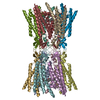
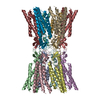
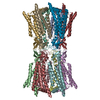
EMDB-18446, PDB-8qjf:
Connexin-32 gap junction channel in complex with 2-aminoethoxydiphenyl borate
Method: EM (single particle) / Resolution: 2.86 Å

EMDB-18447, PDB-8qjh:
Connexin-32 gap junction channel in complex with mefloquine
Method: EM (single particle) / Resolution: 2.91 Å

EMDB-18457, PDB-8qk6:
Connexin-32 hemichannel upon addition of 2-aminoetoxydiphenyl borate
Method: EM (single particle) / Resolution: 3.18 Å

EMDB-18463, PDB-8qki:
Connexin-32 hemichannel upon addition of mefloquine
Method: EM (single particle) / Resolution: 3.46 Å

EMDB-18468, PDB-8qko:
Connexin-43 gap junction channel in complex with mefloquine
Method: EM (single particle) / Resolution: 3.73 Å

Chemicals

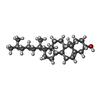
ChemComp-CLR:
CHOLESTEROL

Source
  • homo sapiens (human)
KeywordsMEMBRANE PROTEIN / complex / cell communication / channel / connexin / hemichannel / mefloqine / gap junction channel / mefloquine

+
About Yorodumi Papers

-
News

-
Feb 9, 2022. New format data for meta-information of EMDB entries

New format data for meta-information of EMDB entries

  • Version 3 of the EMDB header file is now the official format.
  • The previous official version 1.9 will be removed from the archive.

Related info.:EMDB header

External links:wwPDB to switch to version 3 of the EMDB data model

-
Aug 12, 2020. Covid-19 info

Covid-19 info

URL: https://pdbj.org/emnavi/covid19.php

New page: Covid-19 featured information page in EM Navigator.

Related info.:Covid-19 info / Mar 5, 2020. Novel coronavirus structure data

+
Mar 5, 2020. Novel coronavirus structure data

Novel coronavirus structure data

Related info.:Yorodumi Speices / Aug 12, 2020. Covid-19 info

External links:COVID-19 featured content - PDBj / Molecule of the Month (242):Coronavirus Proteases

+
Jan 31, 2019. EMDB accession codes are about to change! (news from PDBe EMDB page)

EMDB accession codes are about to change! (news from PDBe EMDB page)

  • The allocation of 4 digits for EMDB accession codes will soon come to an end. Whilst these codes will remain in use, new EMDB accession codes will include an additional digit and will expand incrementally as the available range of codes is exhausted. The current 4-digit format prefixed with “EMD-” (i.e. EMD-XXXX) will advance to a 5-digit format (i.e. EMD-XXXXX), and so on. It is currently estimated that the 4-digit codes will be depleted around Spring 2019, at which point the 5-digit format will come into force.
  • The EM Navigator/Yorodumi systems omit the EMD- prefix.

Related info.:Q: What is EMD? / ID/Accession-code notation in Yorodumi/EM Navigator

External links:EMDB Accession Codes are Changing Soon! / Contact to PDBj

+
Jul 12, 2017. Major update of PDB

Major update of PDB

  • wwPDB released updated PDB data conforming to the new PDBx/mmCIF dictionary.
  • This is a major update changing the version number from 4 to 5, and with Remediation, in which all the entries are updated.
  • In this update, many items about electron microscopy experimental information are reorganized (e.g. em_software).
  • Now, EM Navigator and Yorodumi are based on the updated data.

External links:wwPDB Remediation / Enriched Model Files Conforming to OneDep Data Standards Now Available in the PDB FTP Archive

-
Yorodumi Papers

Database of articles cited by EMDB/PDB/SASBDB data

  • Database of articles cited by EMDB, PDB, and SASBDB entries
  • Using PubMed data

Related info.:EMDB / PDB / SASBDB / Yorodumi / EMN Papers / Changes in new EM Navigator and Yorodumi

Read more