[English] 日本語
Yorodumi Papers
- Database of articles cited by EMDB/PDB/SASBDB data -

+
Search query

Keywords
Structure methods
Author
Journal
IF

-
Structure paper

TitleCryo-EM Structure of Recombinantly Expressed hUGDH Unveils a Hidden, Alternative Allosteric Inhibitor.
Journal, issue, pagesBiochemistry, Vol. 64, Issue 1, Page 92-9104, Year 2025
Publish dateJan 7, 2025
AuthorsJohn H O'Brien / Renuka Kadirvelraj / Po-Sen Tseng / Nolan Ross-Kemppinen / David Crich / Richard M Walsh / Zachary A Wood /
PubMed AbstractHuman UDP-glucose dehydrogenase (hUGDH) catalyzes the oxidation of UDP-glucose into UDP-glucuronic acid, an essential substrate in the Phase II metabolism of drugs. hUGDH is a hexamer that exists in ...Human UDP-glucose dehydrogenase (hUGDH) catalyzes the oxidation of UDP-glucose into UDP-glucuronic acid, an essential substrate in the Phase II metabolism of drugs. hUGDH is a hexamer that exists in an equilibrium between an active (E) state and an inactive (E) state, with the latter being stabilized by the binding of the allosteric inhibitor UDP-xylose (UDP-Xyl). The allosteric transition between E and E is slow and can be observed as a lag in progress curves. Previous analysis of the lag suggested that unliganded hUGDH exists mainly as E, but two unique crystal forms suggest that the enzyme favors the E state. Resolving this discrepancy is necessary to fully understand the allosteric mechanism of hUGDH. Here, we used cryo-EM to show that recombinant hUGDH expressed in copurifies with UDP-4-keto-xylose (UX4O), which mimics the UDP-Xyl inhibitor and favors the E state. Cryo-EM studies show that removing UX4O from hUGDH shifts the ensemble to favor the E state. This shift is consistent with progress curve analysis, which shows the absence of a lag for unliganded hUGDH. Inhibition studies show that hUGDH has similar affinities for UDP-Xyl and UX4O. The discovery that UX4O inhibits allosteric hUGDH suggests that UX4O may be the physiologically relevant inhibitor of allosteric UGDHs in bacteria that do not make UDP-Xyl.
External linksBiochemistry / PubMed:39680853 / PubMed Central
MethodsEM (single particle)
Resolution2.06 - 2.38 Å
Structure data

EMDB-46853, PDB-9dgz:
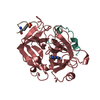
The Cryo-EM structure of recombinantly expressed apo hUGDH
Method: EM (single particle) / Resolution: 2.06 Å

EMDB-46854, PDB-9dh0:
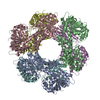
The Cryo-EM structure of recombinantly expressed hUGDH in complex with UDP-4-keto-xylose
Method: EM (single particle) / Resolution: 2.38 Å

Chemicals

ChemComp-HOH:
WATER

PDB-1bcu:
ALPHA-THROMBIN COMPLEXED WITH HIRUGEN AND PROFLAVIN

Source
  • homo sapiens (human)
KeywordsOXIDOREDUCTASE / Unliganded human UDP-Glucose Dehydrogenase / OXIDOREDUCTASE/INHIBITOR / Human UDP-Glucose Dehydrogenase / UDP-4-keto-xylose / OXIDOREDUCTASE-INHIBITOR complex

+
About Yorodumi Papers

-
News

-
Feb 9, 2022. New format data for meta-information of EMDB entries

New format data for meta-information of EMDB entries

  • Version 3 of the EMDB header file is now the official format.
  • The previous official version 1.9 will be removed from the archive.

Related info.:EMDB header

External links:wwPDB to switch to version 3 of the EMDB data model

-
Aug 12, 2020. Covid-19 info

Covid-19 info

URL: https://pdbj.org/emnavi/covid19.php

New page: Covid-19 featured information page in EM Navigator.

Related info.:Covid-19 info / Mar 5, 2020. Novel coronavirus structure data

+
Mar 5, 2020. Novel coronavirus structure data

Novel coronavirus structure data

Related info.:Yorodumi Speices / Aug 12, 2020. Covid-19 info

External links:COVID-19 featured content - PDBj / Molecule of the Month (242):Coronavirus Proteases

+
Jan 31, 2019. EMDB accession codes are about to change! (news from PDBe EMDB page)

EMDB accession codes are about to change! (news from PDBe EMDB page)

  • The allocation of 4 digits for EMDB accession codes will soon come to an end. Whilst these codes will remain in use, new EMDB accession codes will include an additional digit and will expand incrementally as the available range of codes is exhausted. The current 4-digit format prefixed with “EMD-” (i.e. EMD-XXXX) will advance to a 5-digit format (i.e. EMD-XXXXX), and so on. It is currently estimated that the 4-digit codes will be depleted around Spring 2019, at which point the 5-digit format will come into force.
  • The EM Navigator/Yorodumi systems omit the EMD- prefix.

Related info.:Q: What is EMD? / ID/Accession-code notation in Yorodumi/EM Navigator

External links:EMDB Accession Codes are Changing Soon! / Contact to PDBj

+
Jul 12, 2017. Major update of PDB

Major update of PDB

  • wwPDB released updated PDB data conforming to the new PDBx/mmCIF dictionary.
  • This is a major update changing the version number from 4 to 5, and with Remediation, in which all the entries are updated.
  • In this update, many items about electron microscopy experimental information are reorganized (e.g. em_software).
  • Now, EM Navigator and Yorodumi are based on the updated data.

External links:wwPDB Remediation / Enriched Model Files Conforming to OneDep Data Standards Now Available in the PDB FTP Archive

-
Yorodumi Papers

Database of articles cited by EMDB/PDB/SASBDB data

  • Database of articles cited by EMDB, PDB, and SASBDB entries
  • Using PubMed data

Related info.:EMDB / PDB / SASBDB / Yorodumi / EMN Papers / Changes in new EM Navigator and Yorodumi

Read more