[English] 日本語
Yorodumi Papers
- Database of articles cited by EMDB/PDB/SASBDB data -

+
Search query

Keywords
Structure methods
Author
Journal
IF

-
Structure paper

TitleTetramerization of deoxyadenosine kinase meets the demands of a DNA replication substrate challenge in Giardia intestinalis.
Journal, issue, pagesNucleic Acids Res, Vol. 52, Issue 22, Page 14061-14076, Year 2024
Publish dateDec 11, 2024
AuthorsFarahnaz Ranjbarian / Karim Rafie / Kasturika Shankar / Sascha Krakovka / Staffan G Svärd / Lars-Anders Carlson / Anders Hofer /
PubMed AbstractThe protozoan parasite Giardia intestinalis is one of only a few organisms lacking de novo synthesis of DNA building blocks (deoxyribonucleotides). Instead, the parasite relies exclusively on ...The protozoan parasite Giardia intestinalis is one of only a few organisms lacking de novo synthesis of DNA building blocks (deoxyribonucleotides). Instead, the parasite relies exclusively on salvaging deoxyadenosine and other deoxyribonucleosides from its host environment. Here, we report that G. intestinalis has a deoxyribonucleoside kinase with a 1000-fold higher catalytic efficiency (kcat/KM) for deoxyadenosine than the corresponding mammalian kinases and can thereby provide sufficient deoxyadenosine triphosphate levels for DNA synthesis despite the lack of de novo synthesis. Several deoxyadenosine analogs were also potent substrates and showed comparable EC50 values on cultured G. intestinalis cells as metronidazole, the current first-line treatment, with the additional advantage of being effective against metronidazole-resistant parasites. Structural analysis using cryo-EM and X-ray crystallography showed that the enzyme is unique within its family of deoxyribonucleoside kinases by forming a tetramer stabilized by extended N- and C-termini in a novel dimer-dimer interaction. Removal of the two termini resulted in lost ability to form tetramers and a markedly reduced affinity for the deoxyribonucleoside substrate. The development of highly efficient deoxyribonucleoside kinases via oligomerization may represent a critical evolutionary adaptation in organisms that rely solely on deoxyribonucleoside salvage.
External linksNucleic Acids Res / PubMed:39607702 / PubMed Central
MethodsEM (single particle) / X-ray diffraction
Resolution2.1 - 6.304 Å
Structure data

EMDB-17948: Cryo-EM map of Giardia intestinalis deoxyadenosine kinase
Method: EM (single particle) / Resolution: 6.304 Å

PDB-8puu:
Giardia intestinalis deoxyadenosine kinase forms a functional tetramer
Method: X-RAY DIFFRACTION / Resolution: 2.1 Å

Chemicals

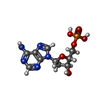
ChemComp-DAT:
2'-DEOXYADENOSINE-5'-DIPHOSPHATE

ChemComp-D5M:
2'-DEOXYADENOSINE-5'-MONOPHOSPHATE

ChemComp-HOH:
WATER

Source
  • giardia intestinalis (eukaryote)
KeywordsTRANSFERASE / deoxyadenosine kinase / homotetramer / Giardia intestinales

+
About Yorodumi Papers

-
News

-
Feb 9, 2022. New format data for meta-information of EMDB entries

New format data for meta-information of EMDB entries

  • Version 3 of the EMDB header file is now the official format.
  • The previous official version 1.9 will be removed from the archive.

Related info.:EMDB header

External links:wwPDB to switch to version 3 of the EMDB data model

-
Aug 12, 2020. Covid-19 info

Covid-19 info

URL: https://pdbj.org/emnavi/covid19.php

New page: Covid-19 featured information page in EM Navigator.

Related info.:Covid-19 info / Mar 5, 2020. Novel coronavirus structure data

+
Mar 5, 2020. Novel coronavirus structure data

Novel coronavirus structure data

Related info.:Yorodumi Speices / Aug 12, 2020. Covid-19 info

External links:COVID-19 featured content - PDBj / Molecule of the Month (242):Coronavirus Proteases

+
Jan 31, 2019. EMDB accession codes are about to change! (news from PDBe EMDB page)

EMDB accession codes are about to change! (news from PDBe EMDB page)

  • The allocation of 4 digits for EMDB accession codes will soon come to an end. Whilst these codes will remain in use, new EMDB accession codes will include an additional digit and will expand incrementally as the available range of codes is exhausted. The current 4-digit format prefixed with “EMD-” (i.e. EMD-XXXX) will advance to a 5-digit format (i.e. EMD-XXXXX), and so on. It is currently estimated that the 4-digit codes will be depleted around Spring 2019, at which point the 5-digit format will come into force.
  • The EM Navigator/Yorodumi systems omit the EMD- prefix.

Related info.:Q: What is EMD? / ID/Accession-code notation in Yorodumi/EM Navigator

External links:EMDB Accession Codes are Changing Soon! / Contact to PDBj

+
Jul 12, 2017. Major update of PDB

Major update of PDB

  • wwPDB released updated PDB data conforming to the new PDBx/mmCIF dictionary.
  • This is a major update changing the version number from 4 to 5, and with Remediation, in which all the entries are updated.
  • In this update, many items about electron microscopy experimental information are reorganized (e.g. em_software).
  • Now, EM Navigator and Yorodumi are based on the updated data.

External links:wwPDB Remediation / Enriched Model Files Conforming to OneDep Data Standards Now Available in the PDB FTP Archive

-
Yorodumi Papers

Database of articles cited by EMDB/PDB/SASBDB data

  • Database of articles cited by EMDB, PDB, and SASBDB entries
  • Using PubMed data

Related info.:EMDB / PDB / SASBDB / Yorodumi / EMN Papers / Changes in new EM Navigator and Yorodumi

Read more