[English] 日本語
Yorodumi Papers
- Database of articles cited by EMDB/PDB/SASBDB data -

+
Search query

Keywords
Structure methods
Author
Journal
IF

-
Structure paper

TitleStructure-function analyses of human TRPV6 ancestral and derived haplotypes.
Journal, issue, pagesStructure, Vol. 33, Issue 1, Page 91-103.e5, Year 2025
Publish dateJan 2, 2025
AuthorsArthur Neuberger / Alexey Shalygin / Yury A Trofimov / Irina I Veretenenko / Kirill D Nadezhdin / Nikolay A Krylov / Thomas Gudermann / Roman G Efremov / Vladimir Chubanov / Alexander I Sobolevsky /
PubMed AbstractTRPV6 is a Ca selective channel that mediates calcium uptake in the gut and contributes to the development and progression of human cancers. TRPV6 is represented by the ancestral and derived ...TRPV6 is a Ca selective channel that mediates calcium uptake in the gut and contributes to the development and progression of human cancers. TRPV6 is represented by the ancestral and derived haplotypes that differ by three non-synonymous polymorphisms, located in the N-terminal ankyrin repeat domain (C157R), S1-S2 extracellular loop (M378V), and C-terminus (M681T). The ancestral and derived haplotypes were proposed to serve as genomic factors causing a different outcome for cancer patients of African ancestry. We solved cryoelectron microscopy (cryo-EM) structures of ancestral and derived TRPV6 in the open and calmodulin (CaM)-bound inactivated states. Neither state shows substantial structural differences caused by the non-synonymous polymorphisms. Functional properties assessed by electrophysiological recordings and Ca uptake measurements, and water and ion permeation evaluated by molecular modeling also appear similar between the haplotypes. Therefore, ancestral and derived TRPV6 have similar structure and function, implying that other factors are responsible for the differences in susceptibility to cancer.
External linksStructure / PubMed:39500315 / PubMed Central
MethodsEM (single particle)
Resolution2.78 - 3.42 Å
Structure data

EMDB-45933, PDB-9cuh:
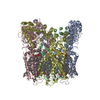
Structure of human full-length ancestral TRPV6 channel in apo open state
Method: EM (single particle) / Resolution: 3.03 Å

EMDB-45934, PDB-9cui:
Structure of human full-length ancestral TRPV6 channel in Calmodulin-bound state
Method: EM (single particle) / Resolution: 3.42 Å

EMDB-45935, PDB-9cuj:
Structure of human full-length derived TRPV6 channel in apo open state
Method: EM (single particle) / Resolution: 2.78 Å

EMDB-45936, PDB-9cuk:
Structure of human full-length derived TRPV6 channel in Calmodulin-bound state
Method: EM (single particle) / Resolution: 3.26 Å

Chemicals

ChemComp-Y01:
CHOLESTEROL HEMISUCCINATE

ChemComp-PCW:
1,2-DIOLEOYL-SN-GLYCERO-3-PHOSPHOCHOLINE / DOPC, phospholipid*YM

ChemComp-POV:
(2S)-3-(hexadecanoyloxy)-2-[(9Z)-octadec-9-enoyloxy]propyl 2-(trimethylammonio)ethyl phosphate / phospholipid*YM

ChemComp-CA:
Unknown entry

ChemComp-HOH:
WATER

ChemComp-CLR:
CHOLESTEROL

Source
  • homo sapiens (human)
KeywordsMEMBRANE PROTEIN / transient receptor potential V family member 6 / TRP / channel / TRPV6 / TRP channels / ancestral / calmodulin / derived

+
About Yorodumi Papers

-
News

-
Feb 9, 2022. New format data for meta-information of EMDB entries

New format data for meta-information of EMDB entries

  • Version 3 of the EMDB header file is now the official format.
  • The previous official version 1.9 will be removed from the archive.

Related info.:EMDB header

External links:wwPDB to switch to version 3 of the EMDB data model

-
Aug 12, 2020. Covid-19 info

Covid-19 info

URL: https://pdbj.org/emnavi/covid19.php

New page: Covid-19 featured information page in EM Navigator.

Related info.:Covid-19 info / Mar 5, 2020. Novel coronavirus structure data

+
Mar 5, 2020. Novel coronavirus structure data

Novel coronavirus structure data

Related info.:Yorodumi Speices / Aug 12, 2020. Covid-19 info

External links:COVID-19 featured content - PDBj / Molecule of the Month (242):Coronavirus Proteases

+
Jan 31, 2019. EMDB accession codes are about to change! (news from PDBe EMDB page)

EMDB accession codes are about to change! (news from PDBe EMDB page)

  • The allocation of 4 digits for EMDB accession codes will soon come to an end. Whilst these codes will remain in use, new EMDB accession codes will include an additional digit and will expand incrementally as the available range of codes is exhausted. The current 4-digit format prefixed with “EMD-” (i.e. EMD-XXXX) will advance to a 5-digit format (i.e. EMD-XXXXX), and so on. It is currently estimated that the 4-digit codes will be depleted around Spring 2019, at which point the 5-digit format will come into force.
  • The EM Navigator/Yorodumi systems omit the EMD- prefix.

Related info.:Q: What is EMD? / ID/Accession-code notation in Yorodumi/EM Navigator

External links:EMDB Accession Codes are Changing Soon! / Contact to PDBj

+
Jul 12, 2017. Major update of PDB

Major update of PDB

  • wwPDB released updated PDB data conforming to the new PDBx/mmCIF dictionary.
  • This is a major update changing the version number from 4 to 5, and with Remediation, in which all the entries are updated.
  • In this update, many items about electron microscopy experimental information are reorganized (e.g. em_software).
  • Now, EM Navigator and Yorodumi are based on the updated data.

External links:wwPDB Remediation / Enriched Model Files Conforming to OneDep Data Standards Now Available in the PDB FTP Archive

-
Yorodumi Papers

Database of articles cited by EMDB/PDB/SASBDB data

  • Database of articles cited by EMDB, PDB, and SASBDB entries
  • Using PubMed data

Related info.:EMDB / PDB / SASBDB / Yorodumi / EMN Papers / Changes in new EM Navigator and Yorodumi

Read more