 Movie
Movie Controller
 Structure viewers
 About Yorodumi Papers


+Search query
-Structure paper
| Title | Structure of human Frizzled5 by fiducial-assisted cryo-EM supports a heterodimeric mechanism of canonical Wnt signaling. |
|---|---|
| Journal, issue, pages | Elife, Vol. 9, Year 2020 |
| Publish date | Aug 7, 2020 |
 Authors Authors | Naotaka Tsutsumi / Somnath Mukherjee / Deepa Waghray / Claudia Y Janda / Kevin M Jude / Yi Miao / John S Burg / Nanda Gowtham Aduri / Anthony A Kossiakoff / Cornelius Gati / K Christopher Garcia /   |
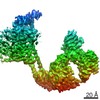
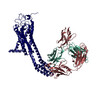
| PubMed Abstract | Frizzleds (Fzd) are the primary receptors for Wnt morphogens, which are essential regulators of stem cell biology, yet the structural basis of Wnt signaling through Fzd remains poorly understood. ...Frizzleds (Fzd) are the primary receptors for Wnt morphogens, which are essential regulators of stem cell biology, yet the structural basis of Wnt signaling through Fzd remains poorly understood. Here we report the structure of an unliganded human Fzd5 determined by single-particle cryo-EM at 3.7 Å resolution, with the aid of an antibody chaperone acting as a fiducial marker. We also analyzed the topology of low-resolution XWnt8/Fzd5 complex particles, which revealed extreme flexibility between the Wnt/Fzd-CRD and the Fzd-TM regions. Analysis of Wnt/β-catenin signaling in response to Wnt3a versus a 'surrogate agonist' that cross-links Fzd to LRP6, revealed identical structure-activity relationships. Thus, canonical Wnt/β-catenin signaling appears to be principally reliant on ligand-induced Fzd/LRP6 heterodimerization, versus the allosteric mechanisms seen in structurally analogous class A G protein-coupled receptors, and Smoothened. These findings deepen our mechanistic understanding of Wnt signal transduction, and have implications for harnessing Wnt agonism in regenerative medicine. |
 External links External links | Elife / PubMed:32762848 / PubMed Central |
| Methods | EM (single particle) |
| Resolution | 3.7 Å |
| Structure data | EMDB-21927, PDB-6ww2: |
| Source |
|
 Keywords Keywords | MEMBRANE PROTEIN / Wnt pathway / Frizzled / Developmental biology |
 homo sapiens (human)
 escherichia coli (E. coli)