 Movie
Movie Controller
 Structure viewers
 About Yorodumi Papers


+Search query
-Structure paper
| Title | Globular tetramers of beta(2)-microglobulin assemble into elaborate amyloid fibrils. |
|---|---|
| Journal, issue, pages | J Mol Biol, Vol. 389, Issue 1, Page 48-57, Year 2009 |
| Publish date | May 29, 2009 |
 Authors Authors | Helen E White / Julie L Hodgkinson / Thomas R Jahn / Sara Cohen-Krausz / Walraj S Gosal / Shirley Müller / Elena V Orlova / Sheena E Radford / Helen R Saibil /  |
| PubMed Abstract | Amyloid fibrils are ordered polymers in which constituent polypeptides adopt a non-native fold. Despite their importance in degenerative human diseases, the overall structure of amyloid fibrils ...Amyloid fibrils are ordered polymers in which constituent polypeptides adopt a non-native fold. Despite their importance in degenerative human diseases, the overall structure of amyloid fibrils remains unknown. High-resolution studies of model peptide assemblies have identified residues forming cross-beta-strands and have revealed some details of local beta-strand packing. However, little is known about the assembly contacts that define the fibril architecture. Here we present a set of three-dimensional structures of amyloid fibrils formed from full-length beta(2)-microglobulin, a 99-residue protein involved in clinical amyloidosis. Our cryo-electron microscopy maps reveal a hierarchical fibril structure built from tetrameric units of globular density, with at least three different subunit interfaces in this homopolymeric assembly. These findings suggest a more complex superstructure for amyloid than hitherto suspected and prompt a re-evaluation of the defining features of the amyloid fold. |
 External links External links | J Mol Biol / PubMed:19345691 / PubMed Central |
| Methods | EM (helical sym.) |
| Resolution | 25.0 - 29.0 Å |
| Structure data | 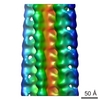 EMDB-1613:  EMDB-1614: |
| Source |
|
 Homo sapiens (human)