National Institutes of Health/National Institute of General Medical Sciences (NIH/NIGMS)
5R01GM152412
United States
National Institutes of Health/National Institute of Arthritis and Musculoskeletal and Skin Diseases (NIH/NIAMS)
5R01GM073791
United States
National Institutes of Health/National Institute of Arthritis and Musculoskeletal and Skin Diseases (NIH/NIAMS)
5T32AR053461-20
United States
Citation
Journal: Nat Commun / Year: 2026 Title: Leiomodin 2 is a processive pointed-end elongator of actin filaments. Authors: Sudipta Biswas / Tania M Larrinaga / Sandeep Choubey / Carol C Gregorio / Shashank Shekhar / Abstract: The actin cytoskeleton drives essential processes like cell migration and muscle contraction. While barbed-end polymerization is well-established, pointed-end elongation was long considered ...The actin cytoskeleton drives essential processes like cell migration and muscle contraction. While barbed-end polymerization is well-established, pointed-end elongation was long considered impossible in vivo. Here, we demonstrate that Leiomodin 2 (Lmod2), which localizes to thin-filament pointed ends in striated muscle cells, functions as an actin polymerase for pointed-end elongation. Single-molecule and single-filament imaging reveal that Lmod2 remains processively bound to pointed ends in vitro, enabling elongation even in the presence of high profilin concentrations found in the cytoplasm that otherwise would cause depolymerization of free pointed ends. Kinetic analysis indicates that Lmod2-mediated elongation proceeds through a linked two-step mechanism, in which monomer addition is followed by a first-order transition at the Lmod2-bound pointed end that limits elongation at high actin concentrations. Lmod2's activity also persists in the presence of tropomyosin, underscoring its physiological relevance. Both processivity and elongation rate of Lmod2 are dependent on its WH2 domain. Remarkably, human dilated cardiomyopathy-associated mutations in Lmod2 greatly reduce Lmod2's pointed-end elongation activity, providing a potential mechanism for disease progression and supporting a role for Lmod2-mediated polymerization in the formation and maintenance of muscle sarcomeres.
History
Deposition
Jan 7, 2026
Deposition site: RCSB / Processing site: RCSB
Revision 1.0
Jun 24, 2026
Provider: repository / Type: Initial release
Revision 1.0
Jun 24, 2026
Data content type: EM metadata / Data content type: EM metadata / Provider: repository / Type: Initial release
Revision 1.0
Jun 24, 2026
Data content type: FSC / Data content type: FSC / Provider: repository / Type: Initial release
Revision 1.0
Jun 24, 2026
Data content type: Half map / Part number: 1 / Data content type: Half map / Provider: repository / Type: Initial release
Revision 1.0
Jun 24, 2026
Data content type: Half map / Part number: 2 / Data content type: Half map / Provider: repository / Type: Initial release
Revision 1.0
Jun 24, 2026
Data content type: Image / Data content type: Image / Provider: repository / Type: Initial release
Revision 1.0
Jun 24, 2026
Data content type: Primary map / Data content type: Primary map / Provider: repository / Type: Initial release
Data content type: EM metadata / Data content type: EM metadata / EM metadata / Group: Database references / Experimental summary / Data content type: EM metadata / EM metadata / EM metadata / Category: citation / citation_author / em_admin Data content type: EM metadata / EM metadata ...EM metadata / EM metadata / EM metadata / EM metadata / EM metadata / EM metadata / EM metadata / EM metadata / EM metadata / EM metadata Item: _citation.country / _citation.journal_abbrev ..._citation.country / _citation.journal_abbrev / _citation.journal_id_CSD / _citation.journal_id_ISSN / _citation.journal_volume / _citation.pdbx_database_id_DOI / _citation.pdbx_database_id_PubMed / _citation.title / _citation.year / _em_admin.last_update
Mass: 41875.633 Da / Num. of mol.: 6 / Source method: isolated from a natural source / Source: (natural) Oryctolagus cuniculus (rabbit) / Tissue: skeletal muscle References: UniProt: P68135, Hydrolases; Acting on acid anhydrides; Acting on acid anhydrides to facilitate cellular and subcellular movement
In the structure databanks used in Yorodumi, some data are registered as the other names, "COVID-19 virus" and "2019-nCoV". Here are the details of the virus and the list of structure data.
Jan 31, 2019. EMDB accession codes are about to change! (news from PDBe EMDB page)
EMDB accession codes are about to change! (news from PDBe EMDB page)
The allocation of 4 digits for EMDB accession codes will soon come to an end. Whilst these codes will remain in use, new EMDB accession codes will include an additional digit and will expand incrementally as the available range of codes is exhausted. The current 4-digit format prefixed with “EMD-” (i.e. EMD-XXXX) will advance to a 5-digit format (i.e. EMD-XXXXX), and so on. It is currently estimated that the 4-digit codes will be depleted around Spring 2019, at which point the 5-digit format will come into force.
The EM Navigator/Yorodumi systems omit the EMD- prefix.
Related info.:Q: What is EMD? / ID/Accession-code notation in Yorodumi/EM Navigator
Yorodumi is a browser for structure data from EMDB, PDB, SASBDB, etc.
This page is also the successor to EM Navigator detail page, and also detail information page/front-end page for Omokage search.
The word "yorodu" (or yorozu) is an old Japanese word meaning "ten thousand". "mi" (miru) is to see.
Related info.:EMDB / PDB / SASBDB / Comparison of 3 databanks / Yorodumi Search / Aug 31, 2016. New EM Navigator & Yorodumi / Yorodumi Papers / Jmol/JSmol / Function and homology information / Changes in new EM Navigator and Yorodumi
 Movie
Movie Controller


 Open data
 Basic information
 Components
 Keywords
 Function and homology information
 Homo sapiens (human)
 Oryctolagus cuniculus (rabbit)
 Authors
 United States, 3items
  Citation
 Structure visualization
 Downloads & links
 Other downloads
 PDBj
PDBj
 Assembly

 Escherichia coli 'BL21-Gold(DE3)pLysS AG' (bacteria)
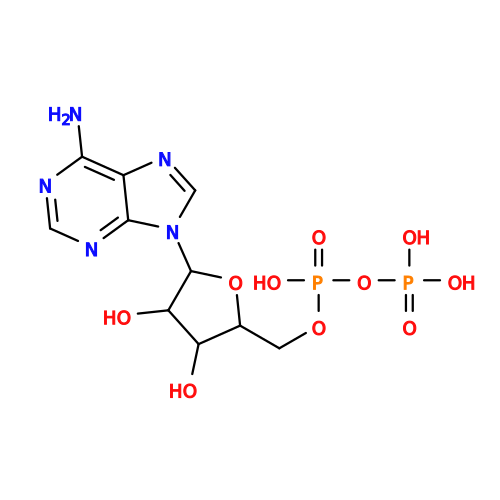 Mass: 427.201 Da / Num. of mol.: 5 / Source method: obtained synthetically / Formula: C10H15N5O10P2 / Comment: ADP, energy-carrying molecule*YM
 Mass: 24.305 Da / Num. of mol.: 6 / Source method: obtained synthetically / Formula: Mg
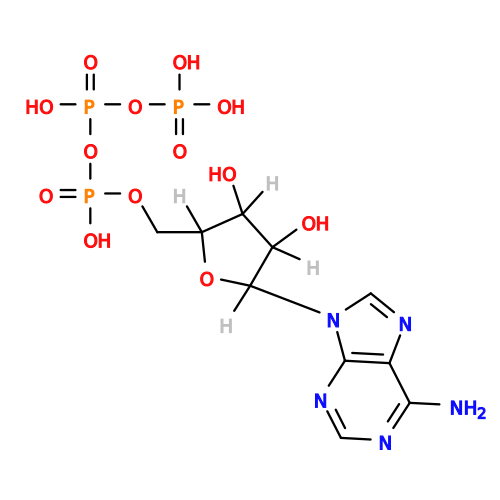 Mass: 507.181 Da / Num. of mol.: 1 / Source method: obtained synthetically / Formula: C10H16N5O13P3 / Comment: ATP, energy-carrying molecule*YM
 Sample preparation
 Electron microscopy imaging
 FIELD EMISSION GUN / Accelerating voltage: 300 kV / Illumination mode: FLOOD BEAM
 Processing
