 Movie
Movie Controller


+ Open data

- Basic information
| Entry | Database: PDB / ID: 9zvm | ||||||||||||||||||||||||
|---|---|---|---|---|---|---|---|---|---|---|---|---|---|---|---|---|---|---|---|---|---|---|---|---|---|
| Title | Dimer structure of Thlaspi arvense plastid biotin carboxylase | ||||||||||||||||||||||||
 Components Components | Maltodextrin-binding protein,Biotin carboxylase | ||||||||||||||||||||||||
 Keywords Keywords | LIGASE / homodimer / carboxylase | ||||||||||||||||||||||||
| Function / homology |  Function and homology information Function and homology informationbiotin carboxylase / biotin carboxylase activity / carbohydrate transmembrane transporter activity / maltose binding / maltose transport / maltodextrin transmembrane transport / ATP-binding cassette (ABC) transporter complex, substrate-binding subunit-containing / chloroplast / fatty acid biosynthetic process / outer membrane-bounded periplasmic space ...biotin carboxylase / biotin carboxylase activity / carbohydrate transmembrane transporter activity / maltose binding / maltose transport / maltodextrin transmembrane transport / ATP-binding cassette (ABC) transporter complex, substrate-binding subunit-containing / chloroplast / fatty acid biosynthetic process / outer membrane-bounded periplasmic space / metal ion binding / ATP binding Similarity search - Function | ||||||||||||||||||||||||
| Biological species |  Thlaspi arvense (field pennycress) Thlaspi arvense (field pennycress) | ||||||||||||||||||||||||
| Method | ELECTRON MICROSCOPY / single particle reconstruction / cryo EM / Resolution: 2.85 Å | ||||||||||||||||||||||||
 Authors Authors | Madison, H.J. / Van Doren, S.R. / Yokom, A.L. | ||||||||||||||||||||||||
| Funding support | 1items
| ||||||||||||||||||||||||
 Citation Citation | Journal: Biochem J / Year: 2026 Title: Oligomeric assemblies of plant biotin carboxylase revealed by cryo-EM and cross-linking. Authors: Hunter J Madison / Luke Dunn / Youngki You / Gabriel Lemes Jorge / Ljiljana Paša-Tolić / Jay J Thelen / Steven R Van Doren / Adam L Yokom /  Abstract: Due to the interest in fatty acid synthesis by oilseed crops, we conducted structural studies of the biotin carboxylase (BC) subunit of the plastid acetyl-CoA carboxylase (ACCase). ACCase catalyzes ...Due to the interest in fatty acid synthesis by oilseed crops, we conducted structural studies of the biotin carboxylase (BC) subunit of the plastid acetyl-CoA carboxylase (ACCase). ACCase catalyzes the first committed step in the fatty acid synthesis pathway and is highly regulated. Cryo-electron microscopy revealed that Thlaspi arvense (pennycress) BC forms a symmetric dimer and contains a subpopulation of a dimer-of-dimers. The domain of BC that closes over the catalytic cleft (the B-domain) appears to be dynamic, judging from the B-factors, normal mode analysis of BC structures, and its high susceptibility to acetylation. An increase in the BC concentration decreased the reactivity of the B-domain, however, suggesting structural hindrance. The partial protection of the B-domain was consistent with cross-links that formed between dimers of BC using a cross-linker cleavable in the mass spectrometer. Cross-links guided HADDOCK docking calculations suggesting a dimer of dimers of BC that is asymmetric, staggered, and tilted between dimers, with conservation in the interface. In contrast, a minimal population of a symmetric dimer of dimers with a small, non-conserved interface was observed by cryo-electron microscopy. Taken together, our structural models are the first for Brassicaceae family BC homologs and are the first from plants. These models suggest dimer interactions that might contribute to larger oligomers of BC and influence associations with other subunits of the heteromeric ACCase. #1: Journal: Acta Crystallogr D Struct Biol / Year: 2019 Title: Macromolecular structure determination using X-rays, neutrons and electrons: recent developments in Phenix. Authors: Dorothee Liebschner / Pavel V Afonine / Matthew L Baker / Gábor Bunkóczi / Vincent B Chen / Tristan I Croll / Bradley Hintze / Li Wei Hung / Swati Jain / Airlie J McCoy / Nigel W Moriarty ...Authors: Dorothee Liebschner / Pavel V Afonine / Matthew L Baker / Gábor Bunkóczi / Vincent B Chen / Tristan I Croll / Bradley Hintze / Li Wei Hung / Swati Jain / Airlie J McCoy / Nigel W Moriarty / Robert D Oeffner / Billy K Poon / Michael G Prisant / Randy J Read / Jane S Richardson / David C Richardson / Massimo D Sammito / Oleg V Sobolev / Duncan H Stockwell / Thomas C Terwilliger / Alexandre G Urzhumtsev / Lizbeth L Videau / Christopher J Williams / Paul D Adams /   Abstract: Diffraction (X-ray, neutron and electron) and electron cryo-microscopy are powerful methods to determine three-dimensional macromolecular structures, which are required to understand biological ...Diffraction (X-ray, neutron and electron) and electron cryo-microscopy are powerful methods to determine three-dimensional macromolecular structures, which are required to understand biological processes and to develop new therapeutics against diseases. The overall structure-solution workflow is similar for these techniques, but nuances exist because the properties of the reduced experimental data are different. Software tools for structure determination should therefore be tailored for each method. Phenix is a comprehensive software package for macromolecular structure determination that handles data from any of these techniques. Tasks performed with Phenix include data-quality assessment, map improvement, model building, the validation/rebuilding/refinement cycle and deposition. Each tool caters to the type of experimental data. The design of Phenix emphasizes the automation of procedures, where possible, to minimize repetitive and time-consuming manual tasks, while default parameters are chosen to encourage best practice. A graphical user interface provides access to many command-line features of Phenix and streamlines the transition between programs, project tracking and re-running of previous tasks. | ||||||||||||||||||||||||
| History |
|
- Structure visualization
| Structure viewer | Molecule: MolmilJmol/JSmol |
|---|
- Downloads & links
-Download
| PDBx/mmCIF format | 9zvm.cif.gz | 432.9 KB | Display | PDBx/mmCIF format |
|---|---|---|---|---|
| PDB format | pdb9zvm.ent.gz | 278.9 KB | Display | PDB format |
| PDBx/mmJSON format | 9zvm.json.gz | Tree view | PDBx/mmJSON format | |
| Others |  Other downloads Other downloads |
-Validation report
| Arichive directory | https://data.pdbj.org/pub/pdb/validation_reports/zv/9zvmftp://data.pdbj.org/pub/pdb/validation_reports/zv/9zvm | HTTPS FTP |
|---|
-Related structure data
| Related structure data |  74880MC M: map data used to model this data C: citing same article ( |
|---|---|
| Similar structure data |

-Links
 PDBj
PDBj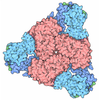
- Assembly
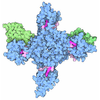
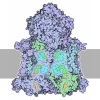
| Deposited unit | 
|
|---|---|
| 1 |
|
-Components
| #1: Protein | Mass: 94663.461 Da / Num. of mol.: 2 Source method: isolated from a genetically manipulated source Source: (gene. exp.) Thlaspi arvense (field pennycress)Gene: malE, malE_1, ABE91_029440, ACU57_23670, B6R31_000964, BANRA_00036, BANRA_02908, BANRA_05111, BCB93_001091, BG944_002391, BGM66_004246, BK300_12795, BMT50_07545, BMT91_12860, BRV02_002252, ...Gene: malE, malE_1, ABE91_029440, ACU57_23670, B6R31_000964, BANRA_00036, BANRA_02908, BANRA_05111, BCB93_001091, BG944_002391, BGM66_004246, BK300_12795, BMT50_07545, BMT91_12860, BRV02_002252, BTB68_002078, BTQ06_17300, BvCmsKKP061_03224, C0P57_003867, C1Q91_002164, C2R31_001890, C3F40_15210, C6669_07330, C719_004008, C7B02_13920, C9160_08140, C9194_00175, CCS08_02575, CF22_001770, CG702_16655, CIG67_12040, CQ842_10105, CQ842_11395, CR538_23895, CTR35_003815, CV83915_02005, CWS33_15915, D4M65_12865, DIV22_28370, DL968_20910, DNX30_07695, DS732_01860, DTL43_19585, E2863_04856, E4K51_08355, E5H86_20640, E6D34_15030, EAI46_20350, ECs5017, EIZ93_13775, EN85_000970, EPS97_17355, ExPECSC038_04540, EXX87_20045, F9461_21760, FGAF848_44030, FIJ20_18085, FJQ40_13885, FOI11_015465, FOI11_20215, FPS11_04610, FV293_00135, FWK02_22115, G3V95_18070, G4A38_02205, G4A47_04495, GAI89_05080, GAJ12_13200, GKF66_19285, GNW61_17855, GOP25_18965, GP965_07770, GP975_07695, GP979_10140, GQA06_09595, GQM04_22095, GQM21_08325, GQN24_10395, GRW05_14255, GRW24_12940, GUC01_08260, HEP30_015080, HHH44_003952, HKA49_001043, HLX92_13085, HMV95_14740, HV109_22180, HV209_20940, HVW43_14700, HVY77_23840, HX136_23390, I6H02_15990, IDONEFKE_03431, J0541_001933, J5U05_001620, J8F57_003138, JNA65_10350, JNA68_19710, JNP96_01525, NCTC10279_03406, NCTC10418_07064, NCTC10429_00012, NCTC10865_05806, NCTC11126_02082, NCTC11181_01902, NCTC13148_04480, NCTC8009_08341, NCTC8179_05034, NCTC8333_05503, NCTC8500_05253, NCTC8622_01707, NCTC8960_02276, NCTC8985_03950, NCTC9706_01951, NCTC9962_03706, NOI85_19130, NQD80_13745, NY836_27910, OFN31_11500, P6223_003521, Q2V20_09975, QDW62_24215, RZR61_19445, SAMEA3472044_04499, SAMEA3752557_02201, TUM18780_41180, WR15_07725, TAV2_LOCUS20518 Production host:   Escherichia coli BL21(DE3) (bacteria) Escherichia coli BL21(DE3) (bacteria)References: UniProt: C3SHQ8, UniProt: A0AAU9SW86, biotin carboxylase Has protein modification | N | |
|---|
-Experimental details
-Experiment
| Experiment | Method: ELECTRON MICROSCOPY |
|---|---|
| EM experiment | Aggregation state: PARTICLE / 3D reconstruction method: single particle reconstruction |
- Sample preparation
| Component | Name: homodimeric complex of biotin carboxylase / Type: COMPLEX / Entity ID: all / Source: RECOMBINANT | |||||||||||||||||||||||||
|---|---|---|---|---|---|---|---|---|---|---|---|---|---|---|---|---|---|---|---|---|---|---|---|---|---|---|
| Molecular weight | Value: 0.052 MDa / Experimental value: NO | |||||||||||||||||||||||||
| Source (natural) | Organism: Thlaspi arvense (field pennycress) | |||||||||||||||||||||||||
| Source (recombinant) | Organism: Escherichia coli (E. coli) / Strain: BL21 DE3 | |||||||||||||||||||||||||
| Buffer solution | pH: 8 Details: 50mM HEPES pH 8.0, 4mM MgCl2, 5% glycerol, 0.5mM TCEP | |||||||||||||||||||||||||
| Buffer component |
| |||||||||||||||||||||||||
| Specimen | Conc.: 0.8 mg/ml / Embedding applied: NO / Shadowing applied: NO / Staining applied: NO / Vitrification applied: YES | |||||||||||||||||||||||||
| Specimen support | Grid material: GOLD / Grid mesh size: 300 divisions/in. | |||||||||||||||||||||||||
| Vitrification | Instrument: FEI VITROBOT MARK IV / Cryogen name: ETHANE / Humidity: 100 % / Chamber temperature: 277 K |
- Electron microscopy imaging
| Experimental equipment |  Model: Titan Krios / Image courtesy: FEI Company |
|---|---|
| Microscopy | Model: TFS KRIOS |
| Electron gun | Electron source:  FIELD EMISSION GUN / Accelerating voltage: 300 kV / Illumination mode: FLOOD BEAM FIELD EMISSION GUN / Accelerating voltage: 300 kV / Illumination mode: FLOOD BEAM |
| Electron lens | Mode: BRIGHT FIELD / Nominal defocus max: 3000 nm / Nominal defocus min: 300 nm / Cs: 2.7 mm |
| Specimen holder | Cryogen: NITROGEN |
| Image recording | Electron dose: 40 e/Å2 / Film or detector model: FEI FALCON IV (4k x 4k) |
- Processing
| EM software |
| ||||||||||||||||||||||||||||
|---|---|---|---|---|---|---|---|---|---|---|---|---|---|---|---|---|---|---|---|---|---|---|---|---|---|---|---|---|---|
| CTF correction | Type: PHASE FLIPPING AND AMPLITUDE CORRECTION | ||||||||||||||||||||||||||||
| Particle selection | Num. of particles selected: 703126 | ||||||||||||||||||||||||||||
| Symmetry | Point symmetry: C2 (2 fold cyclic) | ||||||||||||||||||||||||||||
| 3D reconstruction | Resolution: 2.85 Å / Resolution method: FSC 0.143 CUT-OFF / Num. of particles: 142000 / Num. of class averages: 50 / Symmetry type: POINT | ||||||||||||||||||||||||||||
| Atomic model building | Source name: AlphaFold / Type: in silico model | ||||||||||||||||||||||||||||
| Refinement | Cross valid method: NONE Stereochemistry target values: GeoStd + Monomer Library + CDL v1.2 | ||||||||||||||||||||||||||||
| Displacement parameters | Biso mean: 45.99 Å2 | ||||||||||||||||||||||||||||
| Refine LS restraints |
|
