 Movie
Movie Controller


+ Open data

- Basic information
| Entry | Database: PDB / ID: 9zs2 | |||||||||||||||||||||
|---|---|---|---|---|---|---|---|---|---|---|---|---|---|---|---|---|---|---|---|---|---|---|
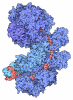
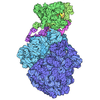
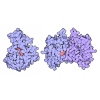
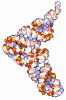
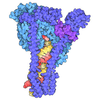
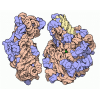
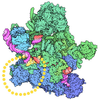
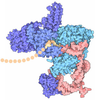
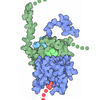
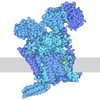
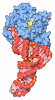
| Title | S. marcescens Cas10-Csm unbound to target RNA | |||||||||||||||||||||
 Components Components |
| |||||||||||||||||||||
 Keywords Keywords | RNA BINDING PROTEIN / CRISPR / crRNA / Cas10 / type III | |||||||||||||||||||||
| Function / homology |  Function and homology information Function and homology informationexonuclease activity / transferase activity / endonuclease activity / defense response to virus / hydrolase activity / RNA binding / ATP binding Similarity search - Function | |||||||||||||||||||||
| Biological species |  Serratia (bacteria) Serratia (bacteria) | |||||||||||||||||||||
| Method | ELECTRON MICROSCOPY / single particle reconstruction / cryo EM / Resolution: 4.4 Å | |||||||||||||||||||||
 Authors Authors | Perdigao, C.C. / Dokland, T. / Dunkle, J.A. | |||||||||||||||||||||
| Funding support |  United States, 2items United States, 2items
| |||||||||||||||||||||
 Citation Citation | Journal: bioRxiv / Year: 2026 Title: Structural insights into target detection by the type III CRISPR complex and its deployment in SNP identification. Authors: Calvin C Perdigao / Luqman O Ajisafe / Anju T Sunny / Si Wu / Terje Dokland / Jack A Dunkle / Abstract: Type III CRISPR systems utilize a complex containing Cas10, additional Cas proteins and a crRNA to detect foreign transcripts. Upon detection, Cas10 synthesizes cyclic oligoadenylates (cOA), ...Type III CRISPR systems utilize a complex containing Cas10, additional Cas proteins and a crRNA to detect foreign transcripts. Upon detection, Cas10 synthesizes cyclic oligoadenylates (cOA), signaling molecules that coordinate interference by stimulating downstream enzymes with DNase, RNase, protease or other activities. Type III systems are among the most abundant CRISPR systems in prokaryotes and understanding the structure-function relationships that control transcript detection and cOA synthesis will advance the understanding of the broader physiological roles of these systems. Type III systems possess properties well-suited to their deployment as molecule diagnostics: specific detection and activation of a cascade of multi-turnover enzymatic reactions that can be harnessed for signal generation. We determined that Cas10-Csm (SmCas10-Csm) synthesizes predominantly cA molecules and this synthesis is sensitive to mismatches in the crRNA-target RNA duplex adjacent to Cas10. We determined the structure of SmCas10-Csm unbound and bound to target RNA identifying conformational changes associated with target binding. We demonstrate that SmCas10-Csm can distinguish between single nucleotide polymorphisms that occur in the human transcript that are associated with sickle cell disease indicating an additional role for type III CRISPR systems in point-of-care diagnostics in low-resource settings. | |||||||||||||||||||||
| History |
|
- Structure visualization
| Structure viewer | Molecule: MolmilJmol/JSmol |
|---|
- Downloads & links
-Download
| PDBx/mmCIF format | 9zs2.cif.gz | 431.4 KB | Display | PDBx/mmCIF format |
|---|---|---|---|---|
| PDB format | pdb9zs2.ent.gz | Display | PDB format | |
| PDBx/mmJSON format | 9zs2.json.gz | Tree view | PDBx/mmJSON format | |
| Others |  Other downloads Other downloads |
-Validation report
| Arichive directory | https://data.pdbj.org/pub/pdb/validation_reports/zs/9zs2ftp://data.pdbj.org/pub/pdb/validation_reports/zs/9zs2 | HTTPS FTP |
|---|
-Related structure data
| Related structure data |  74675MC M: map data used to model this data C: citing same article ( |
|---|---|
| Similar structure data |

-Links
 PDBj
PDBj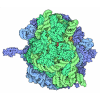
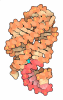
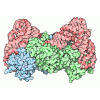
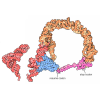
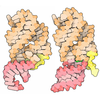
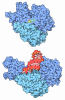
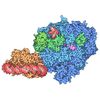
- Assembly
| Deposited unit | 
|
|---|---|
| 1 |
|
-Components
| #1: Protein | Mass: 90390.656 Da / Num. of mol.: 1 Source method: isolated from a genetically manipulated source Source: (gene. exp.) Serratia (bacteria) / Gene: cas10, CWC46_19900, Ser39006_019895 / Production host:  Escherichia coli (E. coli) / References: UniProt: A0A2I5TNR6 Escherichia coli (E. coli) / References: UniProt: A0A2I5TNR6 | ||||||||
|---|---|---|---|---|---|---|---|---|---|
| #2: Protein | Mass: 27185.859 Da / Num. of mol.: 4 / Mutation: D43A Source method: isolated from a genetically manipulated source Source: (gene. exp.) Serratia (bacteria) / Gene: csm3, CWC46_19910, Ser39006_019905 / Production host: Escherichia coli (E. coli) / References: UniProt: A0A2I5TNQ0#3: Protein | | Mass: 35770.551 Da / Num. of mol.: 1 Source method: isolated from a genetically manipulated source Source: (gene. exp.) Serratia (bacteria) / Gene: CWC46_19915, Ser39006_019910 / Production host: Escherichia coli (E. coli) / References: UniProt: A0A2I5TQV2#4: Protein | | Mass: 63148.707 Da / Num. of mol.: 1 Source method: isolated from a genetically manipulated source Source: (gene. exp.) Serratia (bacteria) / Gene: CWC46_19920, Ser39006_019915 / Production host: Escherichia coli (E. coli) / References: UniProt: A0A2I5TBB3#5: RNA chain | | Mass: 13361.948 Da / Num. of mol.: 1 Source method: isolated from a genetically manipulated source Source: (gene. exp.) Serratia (bacteria) / Production host: Escherichia coli (E. coli)Has protein modification | N | |
-Experimental details
-Experiment
| Experiment | Method: ELECTRON MICROSCOPY |
|---|---|
| EM experiment | Aggregation state: PARTICLE / 3D reconstruction method: single particle reconstruction |
- Sample preparation
| Component | Name: Cas10-Csm / Type: COMPLEX / Entity ID: all / Source: RECOMBINANT |
|---|---|
| Source (natural) | Organism: Serratia (bacteria) |
| Source (recombinant) | Organism: Escherichia coli (E. coli) |
| Buffer solution | pH: 8 |
| Specimen | Embedding applied: NO / Shadowing applied: NO / Staining applied: NO / Vitrification applied: YES |
| Vitrification | Cryogen name: ETHANE |
- Electron microscopy imaging
| Microscopy | Model: TFS GLACIOS |
|---|---|
| Electron gun | Electron source:  FIELD EMISSION GUN / Accelerating voltage: 200 kV / Illumination mode: FLOOD BEAM FIELD EMISSION GUN / Accelerating voltage: 200 kV / Illumination mode: FLOOD BEAM |
| Electron lens | Mode: BRIGHT FIELD / Nominal defocus max: 3500 nm / Nominal defocus min: 100 nm |
| Image recording | Electron dose: 40 e/Å2 / Film or detector model: FEI FALCON IV (4k x 4k) |
- Processing
| EM software |
| ||||||||||||||||||||
|---|---|---|---|---|---|---|---|---|---|---|---|---|---|---|---|---|---|---|---|---|---|
| CTF correction | Type: PHASE FLIPPING ONLY | ||||||||||||||||||||
| 3D reconstruction | Resolution: 4.4 Å / Resolution method: FSC 0.143 CUT-OFF / Num. of particles: 42471 / Symmetry type: POINT | ||||||||||||||||||||
| Refinement | Cross valid method: NONE |
