National Institutes of Health/National Institute Of Allergy and Infectious Diseases (NIH/NIAID)
AI080615
United States
Citation
Journal: J Mol Biol / Year: 2026 Title: Assembly and Flexibility of Borrelia burgdorferi Periplasmic HtrA Hexamers. Authors: Anil Kumar Shakya / D Travis Gallager / Vipin Singh Rana / Suruchi Singh / S Saif Hasan / Utpal Pal / Osnat Herzberg / Abstract: The chaperone/protease HtrA from the Lyme disease pathogen Borrelia burgdorferi (BbHtrA) functions in the maturation of the periplasmic protein BB0323 involved in pathogen infectivity and in the ...The chaperone/protease HtrA from the Lyme disease pathogen Borrelia burgdorferi (BbHtrA) functions in the maturation of the periplasmic protein BB0323 involved in pathogen infectivity and in the degradation of several other key host and spirochete proteins. Hence, BbHtrA is considered an anti-borrelial drug target candidate. BbHtrA contains a N-terminal serine protease domain followed by two PDZ domains (PDZ1-2). Here, we report a 3.4 Å resolution single particle cryo-EM reconstruction of hexameric BbHtrA whose active site serine was replaced by an alanine, and the 2.0 Å and 1.5 Å resolution crystal structures of the recombinant protease catalytic domain and PDZ1-2 fragment, respectively. The BbHtrA cryo-EM structure forms an asymmetric dimer of trimers unlike the symmetric oligomers of other HtrA family members. The different conformations of the six linkers between the protease domains and their respective PDZ1-2 break the symmetry, nevertheless, pairs of PDZ2 domains mediate trimer-trimer interactions through identical interfaces unique to BbHtrA. Features associated with the cryo-EM electron potential map at each protease active site were modeled as a nine-residue peptide of unknown sequence, which could originate from the expression host organism. The crystal structures recapitulate at higher resolution trimer interactions via the catalytic domains and trimer-trimer association via PDZ2-PDZ2 interactions. The serine protease oxyanion hole that stabilizes the substrate transition state is malformed in the crystal structure and fully formed in the peptide-bound BbHtrA cryo-EM structure, suggesting a regulatory mechanism intended to avoid undesired cleavage.
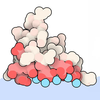
Mass: 25298.684 Da / Num. of mol.: 1 Source method: isolated from a genetically manipulated source Details: Fusion protein that was cleaved with precision protease leaving a GPLGS pentpeptide at the N-terminus corresponding to the cleavage and BamH1 sites. Source: (gene. exp.) Borreliella burgdorferi B31 (bacteria) / Strain: B31 / Gene: BB_0104 / Production host: Escherichia coli BL21(DE3) (bacteria) / References: UniProt: O51131
In the structure databanks used in Yorodumi, some data are registered as the other names, "COVID-19 virus" and "2019-nCoV". Here are the details of the virus and the list of structure data.
Jan 31, 2019. EMDB accession codes are about to change! (news from PDBe EMDB page)
EMDB accession codes are about to change! (news from PDBe EMDB page)
The allocation of 4 digits for EMDB accession codes will soon come to an end. Whilst these codes will remain in use, new EMDB accession codes will include an additional digit and will expand incrementally as the available range of codes is exhausted. The current 4-digit format prefixed with “EMD-” (i.e. EMD-XXXX) will advance to a 5-digit format (i.e. EMD-XXXXX), and so on. It is currently estimated that the 4-digit codes will be depleted around Spring 2019, at which point the 5-digit format will come into force.
The EM Navigator/Yorodumi systems omit the EMD- prefix.
Related info.:Q: What is EMD? / ID/Accession-code notation in Yorodumi/EM Navigator
Yorodumi is a browser for structure data from EMDB, PDB, SASBDB, etc.
This page is also the successor to EM Navigator detail page, and also detail information page/front-end page for Omokage search.
The word "yorodu" (or yorozu) is an old Japanese word meaning "ten thousand". "mi" (miru) is to see.
Related info.:EMDB / PDB / SASBDB / Comparison of 3 databanks / Yorodumi Search / Aug 31, 2016. New EM Navigator & Yorodumi / Yorodumi Papers / Jmol/JSmol / Function and homology information / Changes in new EM Navigator and Yorodumi
 Movie
Movie Controller


 Open data
 Basic information
 Components
 Keywords
 Function and homology information
 Borreliella burgdorferi B31 (bacteria)
 X-RAY DIFFRACTION /
  Authors
 United States, 1items
  Citation
 Structure visualization
 Downloads & links
 Other downloads


 PDBj
PDBj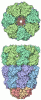
 Assembly

 Escherichia coli BL21(DE3) (bacteria) / References: UniProt: O51131
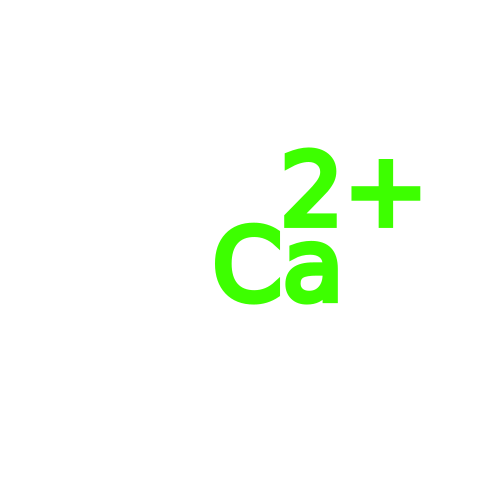 Mass: 40.078 Da / Num. of mol.: 1 / Source method: obtained synthetically / Formula: Ca / Feature type: SUBJECT OF INVESTIGATION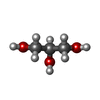
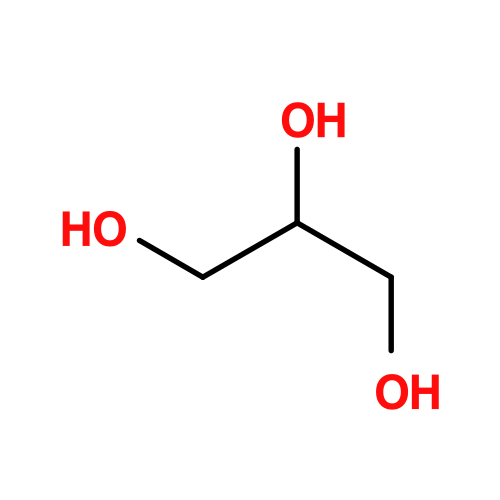 Mass: 92.094 Da / Num. of mol.: 2 / Source method: obtained synthetically / Formula: C3H8O3
 Mass: 18.015 Da / Num. of mol.: 71 / Source method: isolated from a natural source / Formula: H2O
 Sample preparation
 Processing