National Institutes of Health/National Institute of Neurological Disorders and Stroke (NIH/NINDS)
NS095892
United States
German Research Foundation (DFG)
556478029
Germany
Citation
Journal: Proc Natl Acad Sci U S A / Year: 2026 Title: Transthyretin can denature by an alternative pathway. Authors: Marcus Jäger / Jan-Hannes Schäfer / Gabriel C Lander / Evan T Powers / Martin Gruebele / Jeffery W Kelly / Abstract: Transthyretin (TTR) is a kinetically stable protein in the bloodstream, cerebrospinal fluid, and in the eye, whose aggregation causes a prominent human amyloid disease, TTR amyloidosis (ATTR). ...Transthyretin (TTR) is a kinetically stable protein in the bloodstream, cerebrospinal fluid, and in the eye, whose aggregation causes a prominent human amyloid disease, TTR amyloidosis (ATTR). Dissociation of the wild-type TTR tetramer into metastable dimers is rate-limiting for aggregation at acidic pH and unfolding in denaturant solutions at neutral pH. However, this "canonical dimer" pathway of denaturation is not the only one accessible under conditions possibly relevant to amyloid disease. At pH-values reached in the late endosome and lysosome (pH 4.0 to 5.0), as well as with perturbing mutations at neutral pH, a second denaturation pathway becomes accessible involving a more expanded transition state. This "alternative unfolding" pathway is evident via a characteristic switch to a steeper slope in the plot of the log-transformed unfolding rate constant vs. the urea concentration. Using mutations, we identify globally distributed locations in the protein that are sensitive to pathway-switching and correlate them with structural information. We show that flux along the alternative denaturation pathway becomes kinetically competitive in a subset of variants under mildly acidic conditions. A small-molecule kinetic stabilizer of TTR decreases flux along the canonical denaturation pathway, and exhibits reduced influence on denaturation by the alternative pathway. We present a "universal" plot allowing classification of TTR mutants to either pathway, and suggest a mechanism by which the two pathways operate. We speculate that the existence of an alternative unfolding pathway could allow for rapid protein degradation and turnover of kinetically stable TTR under acidic conditions in the autolysosome.
History
Deposition
Nov 26, 2025
Deposition site: RCSB / Processing site: RCSB
Revision 1.0
Sep 16, 2026
Provider: repository / Type: Initial release
Revision 1.0
Sep 16, 2026
Data content type: EM metadata / Data content type: EM metadata / Provider: repository / Type: Initial release
In the structure databanks used in Yorodumi, some data are registered as the other names, "COVID-19 virus" and "2019-nCoV". Here are the details of the virus and the list of structure data.
Jan 31, 2019. EMDB accession codes are about to change! (news from PDBe EMDB page)
EMDB accession codes are about to change! (news from PDBe EMDB page)
The allocation of 4 digits for EMDB accession codes will soon come to an end. Whilst these codes will remain in use, new EMDB accession codes will include an additional digit and will expand incrementally as the available range of codes is exhausted. The current 4-digit format prefixed with “EMD-” (i.e. EMD-XXXX) will advance to a 5-digit format (i.e. EMD-XXXXX), and so on. It is currently estimated that the 4-digit codes will be depleted around Spring 2019, at which point the 5-digit format will come into force.
The EM Navigator/Yorodumi systems omit the EMD- prefix.
Related info.:Q: What is EMD? / ID/Accession-code notation in Yorodumi/EM Navigator
Yorodumi is a browser for structure data from EMDB, PDB, SASBDB, etc.
This page is also the successor to EM Navigator detail page, and also detail information page/front-end page for Omokage search.
The word "yorodu" (or yorozu) is an old Japanese word meaning "ten thousand". "mi" (miru) is to see.
Related info.:EMDB / PDB / SASBDB / Comparison of 3 databanks / Yorodumi Search / Aug 31, 2016. New EM Navigator & Yorodumi / Yorodumi Papers / Jmol/JSmol / Function and homology information / Changes in new EM Navigator and Yorodumi
 Movie
Movie Controller


 Open data
 Basic information
 Components
 Keywords
 Function and homology information
 Homo sapiens (human)
 Authors
 United States,
  Germany, 2items
  Citation
 Structure visualization
 Downloads & links
 Other downloads
 PDBj
PDBj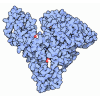
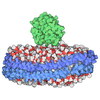
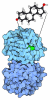
 Assembly

 Escherichia coli (E. coli) / References: UniProt: P02766
 Sample preparation
 Electron microscopy imaging
 FIELD EMISSION GUN / Accelerating voltage: 200 kV / Illumination mode: FLOOD BEAM
 Processing