 Movie
Movie Controller

[English] 日本語
 Yorodumi
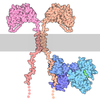
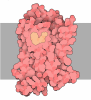
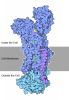
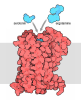
- PDB-9zd2: C1 local refinement of aquaporin 1 bound to endogenous human stomatin -
+ Open data

- Basic information
| Entry | Database: PDB / ID: 9zd2 | |||||||||||||||||||||||||||
|---|---|---|---|---|---|---|---|---|---|---|---|---|---|---|---|---|---|---|---|---|---|---|---|---|---|---|---|---|
| Title | C1 local refinement of aquaporin 1 bound to endogenous human stomatin | |||||||||||||||||||||||||||
 Components Components |
| |||||||||||||||||||||||||||
 Keywords Keywords | MEMBRANE PROTEIN / Oligomer / C8 symmetry / scaffold | |||||||||||||||||||||||||||
| Function / homology |  Function and homology information Function and homology informationmetanephric descending thin limb development / metanephric proximal straight tubule development / metanephric proximal convoluted tubule segment 2 development / metanephric glomerulus vasculature development / nitric oxide transmembrane transporter activity / hydrogen peroxide channel activity / renal water transport / cerebrospinal fluid secretion / cellular response to salt stress / positive regulation of viral process ...metanephric descending thin limb development / metanephric proximal straight tubule development / metanephric proximal convoluted tubule segment 2 development / metanephric glomerulus vasculature development / nitric oxide transmembrane transporter activity / hydrogen peroxide channel activity / renal water transport / cerebrospinal fluid secretion / cellular response to salt stress / positive regulation of viral process / carbon dioxide transmembrane transport / carbon dioxide transmembrane transporter activity / glycerol transmembrane transporter activity / cellular response to mercury ion / water transmembrane transporter activity / positive regulation of saliva secretion / Passive transport by Aquaporins / pancreatic juice secretion / establishment or maintenance of actin cytoskeleton polarity / lateral ventricle development / glycerol transmembrane transport / intracellular water homeostasis / intracellularly cGMP-activated cation channel activity / transepithelial water transport / water channel activity / potassium ion transmembrane transporter activity / ankyrin-1 complex / ammonium transmembrane transport / ammonium channel activity / host-mediated activation of viral genome replication / regulation of monoatomic ion transmembrane transport / multicellular organismal-level water homeostasis / water transport / hyperosmotic response / cellular homeostasis / cellular hyperosmotic response / cell volume homeostasis / odontogenesis / RNA polymerase binding / cellular response to dexamethasone stimulus / nitric oxide transport / azurophil granule membrane / RHOB GTPase cycle / RHOC GTPase cycle / RHOJ GTPase cycle / RHOQ GTPase cycle / ion channel inhibitor activity / CDC42 GTPase cycle / tertiary granule membrane / brush border / RHOH GTPase cycle / RHOA GTPase cycle / renal water homeostasis / positive regulation of protein targeting to membrane / potassium channel activity / potassium ion transport / cellular response to retinoic acid / specific granule membrane / ephrin receptor binding / transmembrane transporter activity / cellular response to nitric oxide / cellular response to cAMP / positive regulation of fibroblast proliferation / basal plasma membrane / cellular response to copper ion / Developmental Lineage of Pancreatic Ductal Cells / brush border membrane / carbon dioxide transport / Erythrocytes take up oxygen and release carbon dioxide / Erythrocytes take up carbon dioxide and release oxygen / cellular response to mechanical stimulus / sarcolemma / cellular response to hydrogen peroxide / Stimuli-sensing channels / positive regulation of angiogenesis / apical part of cell / cellular response to UV / melanosome / Vasopressin regulates renal water homeostasis via Aquaporins / nuclear membrane / blood microparticle / cellular response to hypoxia / defense response to Gram-negative bacterium / vesicle / basolateral plasma membrane / cytoskeleton / apical plasma membrane / membrane raft / axon / negative regulation of apoptotic process / Neutrophil degranulation / perinuclear region of cytoplasm / endoplasmic reticulum / protein homodimerization activity / mitochondrion / : / extracellular exosome / membrane / identical protein binding / nucleus Similarity search - Function | |||||||||||||||||||||||||||
| Biological species |  Homo sapiens (human) Homo sapiens (human) | |||||||||||||||||||||||||||
| Method | ELECTRON MICROSCOPY / single particle reconstruction / cryo EM / Resolution: 3.1 Å | |||||||||||||||||||||||||||
 Authors Authors | Vallese, F. / Clarke, O.B. | |||||||||||||||||||||||||||
| Funding support | 1items
| |||||||||||||||||||||||||||
 Citation Citation | Journal: Sci Adv / Year: 2026 Title: Stomatin encapsulates aquaporin-1 and urea transporter-B in the erythrocyte membrane. Authors: Francesca Vallese / Huan Li / Lucia Barazzuol / Tito Calì / Oliver B Clarke /   Abstract: Stomatin is a ubiquitous and highly expressed protein in erythrocytes, which associates with cholesterol-rich microdomains in the plasma membrane and is known to regulate the activity of multiple ion ...Stomatin is a ubiquitous and highly expressed protein in erythrocytes, which associates with cholesterol-rich microdomains in the plasma membrane and is known to regulate the activity of multiple ion channels and transporters, but the structural basis of association with stomatin targets remains unknown. Here, we describe high-resolution structures of multiple stomatin complexes with endogenous binding partners isolated from human erythrocyte membranes, revealing that stomatin specifically associates with two membrane proteins involved in water transport and cell volume regulation, aquaporin-1 and the urea transporter SLC14A1. Together, our results reveal the structural basis of stomatin oligomerization, membrane association, and target recruitment and identify a putative role for stomatin in the regulation of osmotic balance in the erythrocyte. | |||||||||||||||||||||||||||
| History |
|
- Structure visualization
| Structure viewer | Molecule: MolmilJmol/JSmol |
|---|
- Downloads & links
-Download
| PDBx/mmCIF format | 9zd2.cif.gz | 366.3 KB | Display | PDBx/mmCIF format |
|---|---|---|---|---|
| PDB format | pdb9zd2.ent.gz | 300.9 KB | Display | PDB format |
| PDBx/mmJSON format | 9zd2.json.gz | Tree view | PDBx/mmJSON format | |
| Others |  Other downloads Other downloads |
-Validation report
| Arichive directory | https://data.pdbj.org/pub/pdb/validation_reports/zd/9zd2ftp://data.pdbj.org/pub/pdb/validation_reports/zd/9zd2 | HTTPS FTP |
|---|
-Related structure data
| Related structure data |  74049MC  9z7uC  9zczC  9zd0C  9zd5C M: map data used to model this data C: citing same article ( |
|---|---|
| Similar structure data |


-Links
 PDBj
PDBj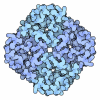
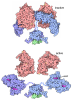
- Assembly
| Deposited unit | 
|
|---|---|
| 1 |
|
-Components
| #1: Protein | Mass: 25996.072 Da / Num. of mol.: 4 / Source method: isolated from a natural source / Details: Aquaporin-1 / Source: (natural) Homo sapiens (human) / References: UniProt: P29972#2: Protein | Mass: 21128.730 Da / Num. of mol.: 5 / Source method: isolated from a natural source Details: Stomatin region in contact with AQP-1,Stomatin region in contact with AQP-1 Source: (natural) Homo sapiens (human) / References: UniProt: P27105#3: Chemical | ChemComp-PLM /  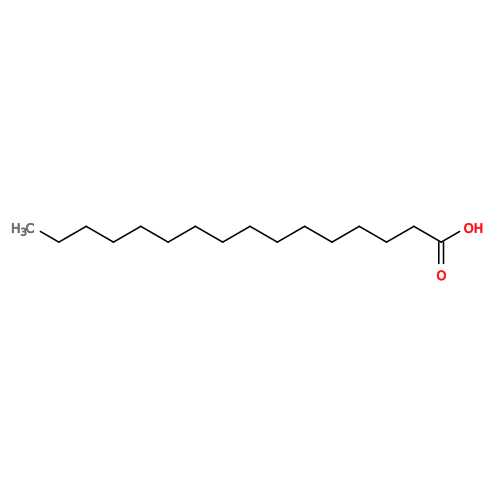 Mass: 256.424 Da / Num. of mol.: 4 / Source method: isolated from a natural source / Formula: C16H32O2 / Details: Aquaporin-1 / Feature type: SUBJECT OF INVESTIGATION Mass: 256.424 Da / Num. of mol.: 4 / Source method: isolated from a natural source / Formula: C16H32O2 / Details: Aquaporin-1 / Feature type: SUBJECT OF INVESTIGATION#4: Chemical | ChemComp-CLR /  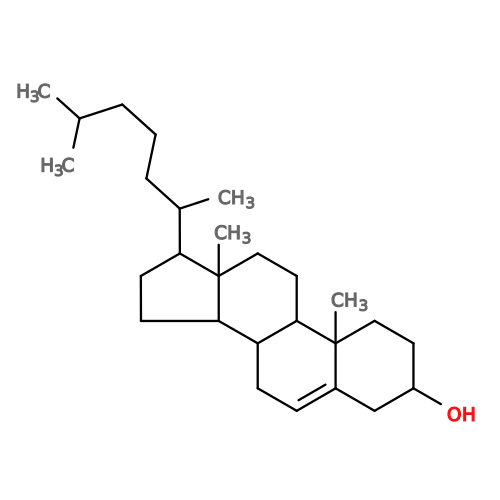 Mass: 386.654 Da / Num. of mol.: 4 / Source method: isolated from a natural source / Formula: C27H46O / Feature type: SUBJECT OF INVESTIGATION Mass: 386.654 Da / Num. of mol.: 4 / Source method: isolated from a natural source / Formula: C27H46O / Feature type: SUBJECT OF INVESTIGATIONHas ligand of interest | Y | Has protein modification | Y | |
|---|
-Experimental details
-Experiment
| Experiment | Method: ELECTRON MICROSCOPY |
|---|---|
| EM experiment | Aggregation state: PARTICLE / 3D reconstruction method: single particle reconstruction |
- Sample preparation
| Component | Name: The stomatin region in contact with two AQP-1 monomers Type: COMPLEX / Entity ID: #1-#2 / Source: NATURAL |
|---|---|
| Molecular weight | Experimental value: NO |
| Source (natural) | Organism: Homo sapiens (human) |
| Buffer solution | pH: 7.4 |
| Specimen | Embedding applied: NO / Shadowing applied: NO / Staining applied: NO / Vitrification applied: YES |
| Vitrification | Cryogen name: ETHANE |
- Electron microscopy imaging
| Experimental equipment |  Model: Titan Krios / Image courtesy: FEI Company |
|---|---|
| Microscopy | Model: TFS KRIOS |
| Electron gun | Electron source:  FIELD EMISSION GUN / Accelerating voltage: 300 kV / Illumination mode: FLOOD BEAM FIELD EMISSION GUN / Accelerating voltage: 300 kV / Illumination mode: FLOOD BEAM |
| Electron lens | Mode: BRIGHT FIELD / Nominal defocus max: 2000 nm / Nominal defocus min: 500 nm / Cs: 2.7 mm |
| Image recording | Electron dose: 58 e/Å2 / Film or detector model: GATAN K3 (6k x 4k) |
- Processing
| EM software |
| ||||||||||||||||||||||||
|---|---|---|---|---|---|---|---|---|---|---|---|---|---|---|---|---|---|---|---|---|---|---|---|---|---|
| CTF correction | Type: PHASE FLIPPING AND AMPLITUDE CORRECTION | ||||||||||||||||||||||||
| Symmetry | Point symmetry: C1 (asymmetric) | ||||||||||||||||||||||||
| 3D reconstruction | Resolution: 3.1 Å / Resolution method: FSC 0.143 CUT-OFF / Num. of particles: 135000 / Symmetry type: POINT | ||||||||||||||||||||||||
| Refine LS restraints |
|
