 Movie
Movie Controller

[English] 日本語
 Yorodumi
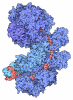
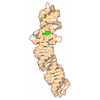
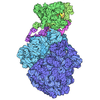
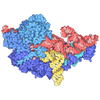
- PDB-9z7x: Cryo-EM Structure of the Type III-Bv CRISPR Complex from Dissulfu... -
+ Open data

- Basic information
| Entry | Database: PDB / ID: 9z7x | ||||||||||||||||||||||||||||||
|---|---|---|---|---|---|---|---|---|---|---|---|---|---|---|---|---|---|---|---|---|---|---|---|---|---|---|---|---|---|---|---|
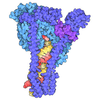
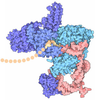
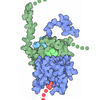
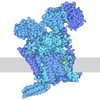
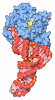
| Title | Cryo-EM Structure of the Type III-Bv CRISPR Complex from Dissulfurispira thermophila bound to target RNA with non-complementary PFS | ||||||||||||||||||||||||||||||
 Components Components |
| ||||||||||||||||||||||||||||||
 Keywords Keywords | IMMUNE SYSTEM/RNA / CRISPR / complex / target / RNA / IMMUNE SYSTEM / IMMUNE SYSTEM-RNA complex | ||||||||||||||||||||||||||||||
| Function / homology |  Function and homology information Function and homology informationdefense response to virus / nucleic acid binding / nucleotide binding / metal ion binding / cytosol / cytoplasm Similarity search - Function | ||||||||||||||||||||||||||||||
| Biological species |  Dissulfurispira thermophila (bacteria) Dissulfurispira thermophila (bacteria) Escherichia phage MS2 (virus) Escherichia phage MS2 (virus) | ||||||||||||||||||||||||||||||
| Method | ELECTRON MICROSCOPY / single particle reconstruction / cryo EM / Resolution: 2.9 Å | ||||||||||||||||||||||||||||||
 Authors Authors | Burman, N. / Pandey, S. / Wiedenheft, B. | ||||||||||||||||||||||||||||||
| Funding support |  United States, 2items United States, 2items
| ||||||||||||||||||||||||||||||
 Citation Citation | Journal: Structure / Year: 2026 Title: Identification and structure determination of a type III-Bv CRISPR complex that post-translationally modifies an associated toxin. Authors: Shishir Pandey / Nathaniel Burman / William S Henriques / Tanner Wiegand / Trevor Zahl / Hannah Nyquist / Tanner Spreeuw / Murat Buyukyoruk / Blake Wiedenheft / Abstract: Cas7-family proteins form the scaffolds of multi-subunit CRISPR RNA-guided surveillance complexes. To explore how Cas7 diversification expands CRISPR function, we identified Cas7 fusion proteins ...Cas7-family proteins form the scaffolds of multi-subunit CRISPR RNA-guided surveillance complexes. To explore how Cas7 diversification expands CRISPR function, we identified Cas7 fusion proteins linked to diverse accessory domains, including a type III-B variant (III-Bv) in which a Cas7 homolog (Cmr1) is fused to the MntA antitoxin and encoded adjacent to a HEPN-family toxin. Structures reveal that the core Cas proteins assemble into a stable surveillance complex in the absence of crRNA, whereas incorporation of the Cmr1-MntA fusion is crRNA-dependent. Target RNA recognition triggers conformational changes that expose the Cas10 cyclase active site and promote cyclic oligoadenylate synthesis. Biochemical analyses show that the CRISPR-associated MntA is enzymatically active and AMPylates the associated HEPN protein. Together, these findings establish the structural basis for assembly of a type III-Bv surveillance complex containing an enzymatically active toxin-antitoxin module. | ||||||||||||||||||||||||||||||
| History |
|
- Structure visualization
| Structure viewer | Molecule: MolmilJmol/JSmol |
|---|
- Downloads & links
-Download
| PDBx/mmCIF format | 9z7x.cif.gz | 593 KB | Display | PDBx/mmCIF format |
|---|---|---|---|---|
| PDB format | pdb9z7x.ent.gz | 466.1 KB | Display | PDB format |
| PDBx/mmJSON format | 9z7x.json.gz | Tree view | PDBx/mmJSON format | |
| Others |  Other downloads Other downloads |
-Validation report
| Arichive directory | https://data.pdbj.org/pub/pdb/validation_reports/z7/9z7xftp://data.pdbj.org/pub/pdb/validation_reports/z7/9z7x | HTTPS FTP |
|---|
-Related structure data
| Related structure data |  73883MC  9z7qC  9z7vC C: citing same article ( M: map data used to model this data |
|---|---|
| Similar structure data |


-Links
 PDBj
PDBj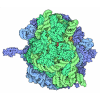
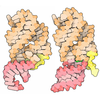
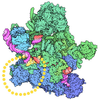
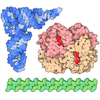
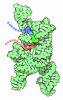
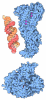
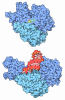
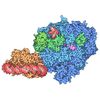
- Assembly
| Deposited unit | 
|
|---|---|
| 1 |
|
-Components
-Protein , 4 types, 5 molecules AFGHI
| #1: Protein | Mass: 70288.859 Da / Num. of mol.: 1 Source method: isolated from a genetically manipulated source Details: N-terminal 6x His affinity tag followed by HRV3C protease cleavage site. Source: (gene. exp.) Dissulfurispira thermophila (bacteria) / Gene: JZK55_14980 / Production host:  Escherichia coli (E. coli) / Strain (production host): BL-21 AI / References: UniProt: A0A7G1H3Q2 Escherichia coli (E. coli) / Strain (production host): BL-21 AI / References: UniProt: A0A7G1H3Q2 | ||||
|---|---|---|---|---|---|
| #4: Protein | Mass: 15953.378 Da / Num. of mol.: 2 Source method: isolated from a genetically manipulated source Source: (gene. exp.) Dissulfurispira thermophila (bacteria) / Gene: JZK55_14940 / Production host: Escherichia coli (E. coli) / Strain (production host): BL-21 AI / References: UniProt: A0A7G1H353#5: Protein | | Mass: 42396.605 Da / Num. of mol.: 1 Source method: isolated from a genetically manipulated source Source: (gene. exp.) Dissulfurispira thermophila (bacteria) / Gene: JZK55_14930 / Production host: Escherichia coli (E. coli) / Strain (production host): BL-21 AI / References: UniProt: A0A7G1H339#8: Protein | | Mass: 49646.605 Da / Num. of mol.: 1 Source method: isolated from a genetically manipulated source Source: (gene. exp.) Dissulfurispira thermophila (bacteria) / Gene: JZK55_15000 / Production host: Escherichia coli (E. coli) / Strain (production host): BL-21 AI / References: UniProt: A0A7G1H1S1 |
-Type III-B CRISPR ... , 2 types, 4 molecules BCDE
| #2: Protein | Mass: 40201.371 Da / Num. of mol.: 1 Source method: isolated from a genetically manipulated source Source: (gene. exp.) Dissulfurispira thermophila (bacteria) / Gene: JZK55_14970 / Production host: Escherichia coli (E. coli) / Strain (production host): BL-21 AI / References: UniProt: A0A7G1H1A4 |
|---|---|
| #3: Protein | Mass: 34966.660 Da / Num. of mol.: 3 Source method: isolated from a genetically manipulated source Source: (gene. exp.) Dissulfurispira thermophila (bacteria) / Gene: JZK55_14950 / Production host: Escherichia coli (E. coli) / Strain (production host): BL-21 AI / References: UniProt: A0A7G1H376 |
-RNA chain , 2 types, 2 molecules JN
| #6: RNA chain | Mass: 11346.689 Da / Num. of mol.: 1 Source method: isolated from a genetically manipulated source Source: (gene. exp.) Escherichia phage MS2 (virus) / Production host: Escherichia coli (E. coli) / Strain (production host): BL-21 AI |
|---|---|
| #7: RNA chain | Mass: 12342.476 Da / Num. of mol.: 1 / Source method: obtained synthetically / Source: (synth.) Escherichia phage MS2 (virus) |
-Non-polymers , 2 types, 21 molecules 

| #9: Chemical | ChemComp-ZN /  Mass: 65.409 Da / Num. of mol.: 1 / Source method: obtained synthetically / Formula: Zn Mass: 65.409 Da / Num. of mol.: 1 / Source method: obtained synthetically / Formula: Zn |
|---|---|
| #10: Water | ChemComp-HOH / Mass: 18.015 Da / Num. of mol.: 20 / Source method: isolated from a natural source / Formula: H2O |
-Details
| Has ligand of interest | N |
|---|---|
| Has protein modification | N |
-Experimental details
-Experiment
| Experiment | Method: ELECTRON MICROSCOPY |
|---|---|
| EM experiment | Aggregation state: PARTICLE / 3D reconstruction method: single particle reconstruction |
- Sample preparation
| Component | Name: Type III-Bv CRISPR complex from Dissulfurispira thermophila bound to target RNA with a non-complementary PFS Type: COMPLEX / Entity ID: #1-#8 / Source: MULTIPLE SOURCES |
|---|---|
| Molecular weight | Experimental value: NO |
| Source (natural) | Organism: Dissulfurispira thermophila (bacteria) |
| Source (recombinant) | Organism: Escherichia coli (E. coli) / Strain: BL-21 AI |
| Buffer solution | pH: 8 |
| Specimen | Embedding applied: NO / Shadowing applied: NO / Staining applied: NO / Vitrification applied: YES |
| Specimen support | Grid material: COPPER / Grid mesh size: 300 divisions/in. / Grid type: Quantifoil R1.2/1.3 |
| Vitrification | Instrument: FEI VITROBOT MARK IV / Cryogen name: ETHANE / Humidity: 100 % / Chamber temperature: 277.15 K |
- Electron microscopy imaging
| Experimental equipment | 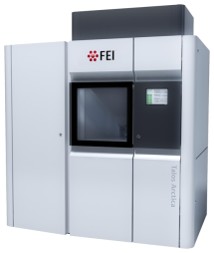 Model: Talos Arctica / Image courtesy: FEI Company |
|---|---|
| Microscopy | Model: FEI TALOS ARCTICA |
| Electron gun | Electron source:  FIELD EMISSION GUN / Accelerating voltage: 200 kV / Illumination mode: FLOOD BEAM FIELD EMISSION GUN / Accelerating voltage: 200 kV / Illumination mode: FLOOD BEAM |
| Electron lens | Mode: BRIGHT FIELD / Nominal magnification: 45000 X / Nominal defocus max: 2000 nm / Nominal defocus min: 500 nm / Cs: 2.7 mm / C2 aperture diameter: 50 µm / Alignment procedure: COMA FREE |
| Specimen holder | Cryogen: NITROGEN / Specimen holder model: FEI TITAN KRIOS AUTOGRID HOLDER |
| Image recording | Electron dose: 65 e/Å2 / Film or detector model: GATAN K3 (6k x 4k) / Num. of grids imaged: 1 / Num. of real images: 10358 |
- Processing
| EM software |
| ||||||||||||||||||||||||||||||||||||||||||||||||||
|---|---|---|---|---|---|---|---|---|---|---|---|---|---|---|---|---|---|---|---|---|---|---|---|---|---|---|---|---|---|---|---|---|---|---|---|---|---|---|---|---|---|---|---|---|---|---|---|---|---|---|---|
| CTF correction | Type: PHASE FLIPPING AND AMPLITUDE CORRECTION | ||||||||||||||||||||||||||||||||||||||||||||||||||
| Particle selection | Num. of particles selected: 3264182 Details: Particles picked using a de novo template generated in CryoSPARC live that contained 329559 particles. | ||||||||||||||||||||||||||||||||||||||||||||||||||
| Symmetry | Point symmetry: C1 (asymmetric) | ||||||||||||||||||||||||||||||||||||||||||||||||||
| 3D reconstruction | Resolution: 2.9 Å / Resolution method: FSC 0.143 CUT-OFF / Num. of particles: 358511 / Algorithm: FOURIER SPACE Details: Final reconstruction generated by non-uniform refinement with per particle CTF correction enabled. Num. of class averages: 4 / Symmetry type: POINT | ||||||||||||||||||||||||||||||||||||||||||||||||||
| Atomic model building | Protocol: RIGID BODY FIT / Space: REAL / Target criteria: Cross-correlation coefficient Details: ChimeraX's fit in map command was used to fit Alphafold predicted structure of individual subunits followed by refinement in PHENIX and manual editing in COOT. | ||||||||||||||||||||||||||||||||||||||||||||||||||
| Atomic model building | Details: Alphafold was used to generate starting molecules of protein subunits, RNA was built de novo using COOT. Source name: AlphaFold / Type: in silico model | ||||||||||||||||||||||||||||||||||||||||||||||||||
| Refinement | Highest resolution: 2.9 Å Stereochemistry target values: REAL-SPACE (WEIGHTED MAP SUM AT ATOM CENTERS) | ||||||||||||||||||||||||||||||||||||||||||||||||||
| Refine LS restraints |
|
