 Movie
Movie Controller

[English] 日本語
 Yorodumi
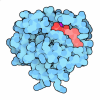
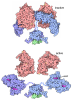
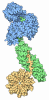
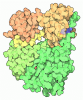
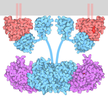
- PDB-9yrp: Full-length human VPS13C in complex with calmodulin from the Cryo... -
+ Open data

- Basic information
| Entry | Database: PDB / ID: 9yrp | |||||||||||||||
|---|---|---|---|---|---|---|---|---|---|---|---|---|---|---|---|---|
| Title | Full-length human VPS13C in complex with calmodulin from the CryoEM composite map | |||||||||||||||
 Components Components |
| |||||||||||||||
 Keywords Keywords | LIPID TRANSPORT / Lipid Transport protein / BLTP / lysosomal membrane repair / membrane homeostasis | |||||||||||||||
| Function / homology |  Function and homology information Function and homology informationdense core granule membrane / negative regulation of type 2 mitophagy / protein retention in Golgi apparatus / Golgi to endosome transport / protein targeting to vacuole / lipid transport / CaM pathway / Cam-PDE 1 activation / Sodium/Calcium exchangers / Calmodulin induced events ...dense core granule membrane / negative regulation of type 2 mitophagy / protein retention in Golgi apparatus / Golgi to endosome transport / protein targeting to vacuole / lipid transport / CaM pathway / Cam-PDE 1 activation / Sodium/Calcium exchangers / Calmodulin induced events / Reduction of cytosolic Ca++ levels / Activation of Ca-permeable Kainate Receptor / CREB1 phosphorylation through the activation of CaMKII/CaMKK/CaMKIV cascasde / Loss of phosphorylation of MECP2 at T308 / CREB1 phosphorylation through the activation of Adenylate Cyclase / PKA activation / CaMK IV-mediated phosphorylation of CREB / CASP4 inflammasome assembly / Glycogen breakdown (glycogenolysis) / negative regulation of ryanodine-sensitive calcium-release channel activity / Activation of RAC1 downstream of NMDARs / organelle localization by membrane tethering / CLEC7A (Dectin-1) induces NFAT activation / : / negative regulation of high voltage-gated calcium channel activity / autophagosome membrane docking / negative regulation of calcium ion export across plasma membrane / regulation of cardiac muscle cell action potential / presynaptic endocytosis / Synthesis of IP3 and IP4 in the cytosol / Phase 0 - rapid depolarisation / Negative regulation of NMDA receptor-mediated neuronal transmission / Unblocking of NMDA receptors, glutamate binding and activation / calcineurin-mediated signaling / RHO GTPases activate PAKs / regulation of cell communication by electrical coupling involved in cardiac conduction / Uptake and function of anthrax toxins / Ion transport by P-type ATPases / protein phosphatase activator activity / Long-term potentiation / Calcineurin activates NFAT / regulation of ryanodine-sensitive calcium-release channel activity / DARPP-32 events / Regulation of MECP2 expression and activity / Smooth Muscle Contraction / detection of calcium ion / regulation of cardiac muscle contraction / cellular response to interferon-beta / presynaptic cytosol / RHO GTPases activate IQGAPs / catalytic complex / calcium channel inhibitor activity / eNOS activation / regulation of release of sequestered calcium ion into cytosol by sarcoplasmic reticulum / Tetrahydrobiopterin (BH4) synthesis, recycling, salvage and regulation / Activation of AMPK downstream of NMDARs / Ion homeostasis / regulation of heart rate / Protein methylation / regulation of cardiac muscle contraction by regulation of the release of sequestered calcium ion / titin binding / calcium channel complex / voltage-gated potassium channel complex / FCERI mediated Ca+2 mobilization / substantia nigra development / FCGR3A-mediated IL10 synthesis / protein serine/threonine kinase activator activity / sperm midpiece / Antigen activates B Cell Receptor (BCR) leading to generation of second messengers / positive regulation of receptor signaling pathway via JAK-STAT / calyx of Held / Ras activation upon Ca2+ influx through NMDA receptor / adenylate cyclase activator activity / regulation of cytokinesis / lipid droplet / VEGFR2 mediated cell proliferation / mitochondrion organization / spindle microtubule / VEGFR2 mediated vascular permeability / sarcomere / calcium channel regulator activity / Translocation of SLC2A4 (GLUT4) to the plasma membrane / myelin sheath / cellular response to type II interferon / Transcriptional activation of mitochondrial biogenesis / long-term synaptic potentiation / Enterobacterial factors antagonize host defense / RAF activation / response to calcium ion / Stimuli-sensing channels / calcium-dependent protein binding / Signaling by RAF1 mutants / Signaling by moderate kinase activity BRAF mutants / Paradoxical activation of RAF signaling by kinase inactive BRAF / Signaling downstream of RAS mutants / RAS processing / Signaling by BRAF and RAF1 fusions / Platelet degranulation / late endosome / late endosome membrane Similarity search - Function | |||||||||||||||
| Biological species |  Homo sapiens (human) Homo sapiens (human) | |||||||||||||||
| Method | ELECTRON MICROSCOPY / single particle reconstruction / cryo EM / Resolution: 4.13 Å | |||||||||||||||
 Authors Authors | Li, D. / Reinisch, K.M. | |||||||||||||||
| Funding support |  United States, 1items United States, 1items
| |||||||||||||||
 Citation Citation | Journal: Mol Cell / Year: 2026 Title: Cryo-EM structure of soluble VPS13C suggests its regulation by a conformational switch and by calmodulin. Authors: Dazhi Li / Xinbo Wang / Hongyan Hao / Jessica Eden / Bodan Hu / Emma E Walsh / Matthew A H Parson / Stephanie Hamill / Yuting Li / Guochao Chen / John E Burke / Pietro De Camilli / Karin M Reinisch /  Abstract: Bridge-like lipid transfer proteins (BLTPs) play fundamental roles in cellular lipid redistribution between organellar membranes. They comprise bridge domains spanning organelles at contact sites ...Bridge-like lipid transfer proteins (BLTPs) play fundamental roles in cellular lipid redistribution between organellar membranes. They comprise bridge domains spanning organelles at contact sites that allow lipids to transit through the cytosol between adjacent membranes. The assembly of BLTPs into complexes with adaptor proteins enables lipid transfer. To address the mechanisms underlying the assembly and regulation of BLTP complexes, we used cryo-EM to resolve the structure of one such BLTP, the Parkinson's disease protein VPS13C, at near-atomic resolution. The structure identifies a lipid-transfer-nonpermissive conformation, in which the built-in C-terminal VAB adaptor module blocks the end of the lipid transfer bridge, interfering with lipid delivery. We also identify calmodulin (CaM), central to calcium signaling, as a constitutive VPS13C interactor. Calcium induces conformational changes in the VPS13C-CaM complex, suggesting calcium regulation of VPS13 function. Altogether, this structure of intact VPS13C serves as a starting point for understanding its regulation and that of other VPS13 proteins. | |||||||||||||||
| History |
|
- Structure visualization
| Structure viewer | Molecule: MolmilJmol/JSmol |
|---|
- Downloads & links
-Download
| PDBx/mmCIF format | 9yrp.cif.gz | 568.3 KB | Display | PDBx/mmCIF format |
|---|---|---|---|---|
| PDB format | pdb9yrp.ent.gz | Display | PDB format | |
| PDBx/mmJSON format | 9yrp.json.gz | Tree view | PDBx/mmJSON format | |
| Others |  Other downloads Other downloads |
-Validation report
| Arichive directory | https://data.pdbj.org/pub/pdb/validation_reports/yr/9yrpftp://data.pdbj.org/pub/pdb/validation_reports/yr/9yrp | HTTPS FTP |
|---|
-Related structure data
| Related structure data |  73373MC  9yqpC  9yqqC  9yrmC C: citing same article ( M: map data used to model this data |
|---|---|
| Similar structure data |


-Links
 PDBj
PDBj
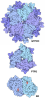
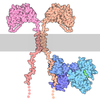
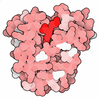
- Assembly
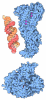
| Deposited unit | 
|
|---|---|
| 1 |
|
-Components
| #1: Protein | Mass: 16852.545 Da / Num. of mol.: 1 / Source method: isolated from a natural source / Source: (natural) Homo sapiens (human) / References: UniProt: P0DP23 |
|---|---|
| #2: Protein | Mass: 425875.438 Da / Num. of mol.: 1 Source method: isolated from a genetically manipulated source Source: (gene. exp.) Homo sapiens (human) / Gene: VPS13C, KIAA1421 / Production host: Homo sapiens (human) / References: UniProt: Q709C8 |
| Has protein modification | N |
-Experimental details
-Experiment
| Experiment | Method: ELECTRON MICROSCOPY |
|---|---|
| EM experiment | Aggregation state: PARTICLE / 3D reconstruction method: single particle reconstruction |
- Sample preparation
| Component |
| ||||||||||||||||||||||||||||
|---|---|---|---|---|---|---|---|---|---|---|---|---|---|---|---|---|---|---|---|---|---|---|---|---|---|---|---|---|---|
| Source (natural) |
| ||||||||||||||||||||||||||||
| Source (recombinant) | Organism: Homo sapiens (human) | ||||||||||||||||||||||||||||
| Buffer solution | pH: 7.2 | ||||||||||||||||||||||||||||
| Specimen | Embedding applied: NO / Shadowing applied: NO / Staining applied: NO / Vitrification applied: YES | ||||||||||||||||||||||||||||
| Vitrification | Cryogen name: ETHANE |
- Electron microscopy imaging
| Experimental equipment |  Model: Titan Krios / Image courtesy: FEI Company |
|---|---|
| Microscopy | Model: TFS KRIOS |
| Electron gun | Electron source:  FIELD EMISSION GUN / Accelerating voltage: 300 kV / Illumination mode: FLOOD BEAM FIELD EMISSION GUN / Accelerating voltage: 300 kV / Illumination mode: FLOOD BEAM |
| Electron lens | Mode: BRIGHT FIELD / Nominal defocus max: 2500 nm / Nominal defocus min: 2000 nm |
| Image recording | Electron dose: 43 e/Å2 / Film or detector model: GATAN K3 BIOQUANTUM (6k x 4k) |
- Processing
| EM software |
| |||||||||
|---|---|---|---|---|---|---|---|---|---|---|
| CTF correction | Type: PHASE FLIPPING AND AMPLITUDE CORRECTION | |||||||||
| 3D reconstruction | Resolution: 4.13 Å / Resolution method: FSC 0.143 CUT-OFF / Num. of particles: 392473 / Symmetry type: POINT |
