 Movie
Movie Controller


+ Open data

- Basic information
| Entry | Database: PDB / ID: 9yf5 | |||||||||||||||||||||||||||
|---|---|---|---|---|---|---|---|---|---|---|---|---|---|---|---|---|---|---|---|---|---|---|---|---|---|---|---|---|
| Title | N4 Empty Particle C6 Tail | |||||||||||||||||||||||||||
 Components Components |
| |||||||||||||||||||||||||||
 Keywords Keywords | VIRAL PROTEIN / dodecamer / bacteriophage portal | |||||||||||||||||||||||||||
| Function / homology |  Function and homology information Function and homology informationsymbiont genome ejection through host cell envelope, short tail mechanism / virus tail / adhesion receptor-mediated virion attachment to host cell / virion component / symbiont entry into host cell Similarity search - Function | |||||||||||||||||||||||||||
| Biological species |  Escherichia phage N4 (virus) Escherichia phage N4 (virus) | |||||||||||||||||||||||||||
| Method | ELECTRON MICROSCOPY / single particle reconstruction / cryo EM / Resolution: 3.65 Å | |||||||||||||||||||||||||||
 Authors Authors | Bellis, N.F. / Cingolani, G. | |||||||||||||||||||||||||||
| Funding support |  United States, 1items United States, 1items
| |||||||||||||||||||||||||||
 Citation Citation | Journal: Res Sq / Year: 2025 Title: Structure of the giant RNA polymerase ejected from coliphage N4. Authors: Nathan F Bellis / Ravi K Lokareddy / Mikhail Pavlenok / Stephanie L Cooper Horton / James L Kizziah / Francesca Forti / David A Schneider / Michael Niederweis / Federica Briani / Gino Cingolani /  Abstract: are widespread prokaryotic viruses that encapsidate a giant (~3,500-residue) virion-associated RNA polymerase (vRNAP). During infection, vRNAP is expelled into Gram-negative bacteria, along with two ... are widespread prokaryotic viruses that encapsidate a giant (~3,500-residue) virion-associated RNA polymerase (vRNAP). During infection, vRNAP is expelled into Gram-negative bacteria, along with two additional ejection proteins, to assemble a transient DNA-ejectosome that becomes transcriptionally active, initiating viral replication. Here, we present an integrative structural analysis of the coliphage N4 vRNAP (gp50). We find that this 383 kDa enzyme is a multi-domain, single-chain RNA polymerase, structurally distinct from both compact single-chain RNAPs and large multi-subunit holoenzymes. vRNAP is composed of loosely connected domains and exhibits an intramolecular mode of allosteric regulation through its C-terminal domain. Comparative analysis of intact and genome-released virions identified gp51, which forms an outer-membrane complex, and gp52, which assembles a periplasmic tunnel. These proteins generate heterogeneous pores that facilitate the release of vRNAP. We further uncover a signaling hub in the phage tail, composed of the receptor-binding protein, tail tube, and tail plug, that detects receptor engagement and orchestrates the release of ejection proteins. We propose that the beads-on-a-string architecture of vRNAP enables the translocation of megadalton-scale protein complexes through the ~35 Å channel formed by the tail and ejection proteins. These findings establish N4 as a distinctive model for protein translocation through biological channels. | |||||||||||||||||||||||||||
| History |
|
- Structure visualization
| Structure viewer | Molecule: MolmilJmol/JSmol |
|---|
- Downloads & links
-Download
| PDBx/mmCIF format | 9yf5.cif.gz | 5.1 MB | Display | PDBx/mmCIF format |
|---|---|---|---|---|
| PDB format | pdb9yf5.ent.gz | Display | PDB format | |
| PDBx/mmJSON format | 9yf5.json.gz | Tree view | PDBx/mmJSON format | |
| Others |  Other downloads Other downloads |
-Validation report
| Arichive directory | https://data.pdbj.org/pub/pdb/validation_reports/yf/9yf5ftp://data.pdbj.org/pub/pdb/validation_reports/yf/9yf5 | HTTPS FTP |
|---|
-Related structure data
| Related structure data |  72877MC  9pnqC  9pnrC  9pntC  9pnvC  9pnwC  9yf8C M: map data used to model this data C: citing same article ( |
|---|---|
| Similar structure data |


-Links
 PDBj
PDBj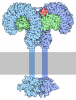

- Assembly
| Deposited unit | 
|
|---|---|
| 1 |
|
-Components
-Protein , 6 types, 84 molecules AAABACADAEAFAGAHAIAJAKALLALBLCLDLELFSASBSCSDSESFTATBTCTDTETF...
| #1: Protein | Mass: 27192.412 Da / Num. of mol.: 12 / Source method: isolated from a natural source / Source: (natural) Escherichia phage N4 (virus) / References: UniProt: A0MZE9#2: Protein | Mass: 154255.078 Da / Num. of mol.: 6 / Source method: isolated from a natural source / Source: (natural) Escherichia phage N4 (virus) / References: UniProt: A0MZE7#3: Protein | Mass: 48100.742 Da / Num. of mol.: 6 / Source method: isolated from a natural source / Source: (natural) Escherichia phage N4 (virus) / References: UniProt: A0MZE6#4: Protein | Mass: 32438.443 Da / Num. of mol.: 12 / Source method: isolated from a natural source / Source: (natural) Escherichia phage N4 (virus) / References: UniProt: Q859Q3#5: Protein | Mass: 58943.914 Da / Num. of mol.: 36 / Source method: isolated from a natural source / Source: (natural) Escherichia phage N4 (virus) / References: UniProt: A0MZE8#6: Protein | Mass: 85642.523 Da / Num. of mol.: 12 / Source method: isolated from a natural source / Source: (natural) Escherichia phage N4 (virus) / References: UniProt: A0MZE1 |
|---|
-Details
| Has protein modification | Y |
|---|
-Experimental details
-Experiment
| Experiment | Method: ELECTRON MICROSCOPY |
|---|---|
| EM experiment | Aggregation state: PARTICLE / 3D reconstruction method: single particle reconstruction |
- Sample preparation
| Component | Name: Escherichia phage N4 / Type: VIRUS / Entity ID: #1 / Source: NATURAL |
|---|---|
| Source (natural) | Organism: Escherichia phage N4 (virus) |
| Details of virus | Empty: YES / Enveloped: NO / Isolate: SPECIES / Type: VIRION |
| Natural host | Organism: Escherichia coli str. K-12 substr. MG1655 |
| Buffer solution | pH: 7 |
| Specimen | Embedding applied: NO / Shadowing applied: NO / Staining applied: NO / Vitrification applied: YES |
| Specimen support | Grid material: COPPER / Grid type: C-flat-2/1 |
| Vitrification | Cryogen name: ETHANE |
- Electron microscopy imaging
| Microscopy | Model: TFS GLACIOS |
|---|---|
| Electron gun | Electron source:  FIELD EMISSION GUN / Accelerating voltage: 200 kV / Illumination mode: FLOOD BEAM FIELD EMISSION GUN / Accelerating voltage: 200 kV / Illumination mode: FLOOD BEAM |
| Electron lens | Mode: BRIGHT FIELD / Nominal defocus max: 2500 nm / Nominal defocus min: 500 nm |
| Image recording | Electron dose: 40 e/Å2 / Film or detector model: TFS FALCON 4i (4k x 4k) |
- Processing
| EM software |
| ||||||||||||||||||||||||
|---|---|---|---|---|---|---|---|---|---|---|---|---|---|---|---|---|---|---|---|---|---|---|---|---|---|
| CTF correction | Type: PHASE FLIPPING AND AMPLITUDE CORRECTION | ||||||||||||||||||||||||
| Symmetry | Point symmetry: C6 (6 fold cyclic) | ||||||||||||||||||||||||
| 3D reconstruction | Resolution: 3.65 Å / Resolution method: FSC 0.143 CUT-OFF / Num. of particles: 10265 / Symmetry type: POINT | ||||||||||||||||||||||||
| Refine LS restraints |
|
