 Movie
Movie Controller


+ Open data

- Basic information
| Entry | Database: PDB / ID: 9y66 | ||||||||||||||||||||||||||||||||||||
|---|---|---|---|---|---|---|---|---|---|---|---|---|---|---|---|---|---|---|---|---|---|---|---|---|---|---|---|---|---|---|---|---|---|---|---|---|---|
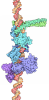
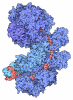
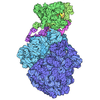
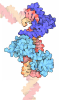
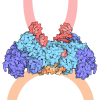
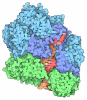
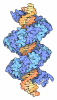
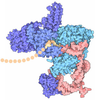
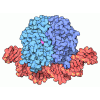
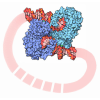
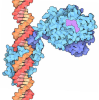
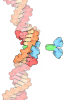
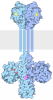
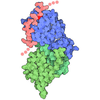
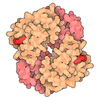
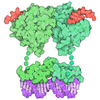
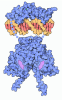
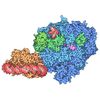
| Title | attLsym bound serine integrase complex in the dimeric state | ||||||||||||||||||||||||||||||||||||
 Components Components |
| ||||||||||||||||||||||||||||||||||||
 Keywords Keywords | RECOMBINATION / Site-specific DNA Recombinase / Large serine integrase / DNA binding domains / Recombinase / Resolvase / Zinc ribbon recombinase | ||||||||||||||||||||||||||||||||||||
| Function / homology |  Function and homology information Function and homology information | ||||||||||||||||||||||||||||||||||||
| Biological species |  Spbetavirus SPbeta Spbetavirus SPbeta | ||||||||||||||||||||||||||||||||||||
| Method | ELECTRON MICROSCOPY / single particle reconstruction / cryo EM / Resolution: 3.31 Å | ||||||||||||||||||||||||||||||||||||
 Authors Authors | Shin, H. / Pigli, Y. / Pena Reyes, T. / Fuller, J.R. / Olorunniji, F.J. / Rice, P.A. | ||||||||||||||||||||||||||||||||||||
| Funding support |  United States, United States,  United Kingdom, 3items United Kingdom, 3items
| ||||||||||||||||||||||||||||||||||||
 Citation Citation | Journal: bioRxiv / Year: 2025 Title: Structural basis of directionality control in large serine integrases. Authors: Heewhan Shin / Ying Pigli / Tania Peña Reyes / James R Fuller / Femi J Olorunniji / Phoebe A Rice / Abstract: Large serine integrases (LSIs) catalyze unidirectional site-specific DNA recombination reactions, yet those reactions are reversed by the presence of a cognate recombination directionality factor ...Large serine integrases (LSIs) catalyze unidirectional site-specific DNA recombination reactions, yet those reactions are reversed by the presence of a cognate recombination directionality factor (RDF). Mechanistic understanding of directionality control has been hampered by a lack of structural information. Here, we use cryo-electron microscopy (cryo-EM) to determine the structures of six SPbeta integrase-DNA complexes along the integrative (-RDF) and excisive (+RDF) reaction pathways, at 4.16-7.18Å resolution. Our findings reveal how RDF-mediated repositioning of an integrase subdomain (1) dictates which pairs of DNA sites can be assembled into a synaptic complex to initiate recombination and (2) dictates which product complexes will be conformationally locked, preventing the back reaction. These mechanistic insights provide a conceptual framework for engineering efficient and versatile genome editing tools. | ||||||||||||||||||||||||||||||||||||
| History |
|
- Structure visualization
| Structure viewer | Molecule: MolmilJmol/JSmol |
|---|
- Downloads & links
-Download
| PDBx/mmCIF format | 9y66.cif.gz | 521.2 KB | Display | PDBx/mmCIF format |
|---|---|---|---|---|
| PDB format | pdb9y66.ent.gz | 427.2 KB | Display | PDB format |
| PDBx/mmJSON format | 9y66.json.gz | Tree view | PDBx/mmJSON format | |
| Others |  Other downloads Other downloads |
-Validation report
| Arichive directory | https://data.pdbj.org/pub/pdb/validation_reports/y6/9y66ftp://data.pdbj.org/pub/pdb/validation_reports/y6/9y66 | HTTPS FTP |
|---|
-Related structure data
| Related structure data |  72552MC  9y6vC M: map data used to model this data C: citing same article ( |
|---|---|
| Similar structure data |


-Links
 PDBj
PDBj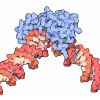

- Assembly
| Deposited unit | 
|
|---|---|
| 1 |
|
-Components
| #1: Protein | Mass: 63232.066 Da / Num. of mol.: 2 Source method: isolated from a genetically manipulated source Source: (gene. exp.) Spbetavirus SPbeta / Gene: yokAProduction host:   Escherichia coli 'BL21-Gold(DE3)pLysS AG' (bacteria) Escherichia coli 'BL21-Gold(DE3)pLysS AG' (bacteria)References: UniProt: O64015 #2: DNA chain | | Mass: 19436.590 Da / Num. of mol.: 1 / Source method: obtained synthetically / Source: (synth.) Spbetavirus SPbeta#3: DNA chain | | Mass: 19386.469 Da / Num. of mol.: 1 / Source method: obtained synthetically / Source: (synth.) Spbetavirus SPbeta#4: Chemical |   Mass: 65.409 Da / Num. of mol.: 2 / Source method: obtained synthetically / Formula: Zn / Feature type: SUBJECT OF INVESTIGATION Mass: 65.409 Da / Num. of mol.: 2 / Source method: obtained synthetically / Formula: Zn / Feature type: SUBJECT OF INVESTIGATIONHas ligand of interest | Y | Has protein modification | N | |
|---|
-Experimental details
-Experiment
| Experiment | Method: ELECTRON MICROSCOPY |
|---|---|
| EM experiment | Aggregation state: PARTICLE / 3D reconstruction method: single particle reconstruction |
- Sample preparation
| Component | Name: Dimeric complex of attLsym bound large serine integrases Type: COMPLEX Details: DNAs synthesized from Integrated DNA Technologies (IDT) Entity ID: #1-#3 / Source: RECOMBINANT | |||||||||||||||
|---|---|---|---|---|---|---|---|---|---|---|---|---|---|---|---|---|
| Molecular weight | Experimental value: NO | |||||||||||||||
| Source (natural) | Organism: Spbetavirus SPbeta | |||||||||||||||
| Source (recombinant) | Organism: Escherichia coli 'BL21-Gold(DE3)pLysS AG' (bacteria) | |||||||||||||||
| Buffer solution | pH: 8 / Details: 20mM Tris-HCL pH 8, 100mM NaCl | |||||||||||||||
| Buffer component |
| |||||||||||||||
| Specimen | Conc.: 8 mg/ml / Embedding applied: NO / Shadowing applied: NO / Staining applied: NO / Vitrification applied: YES | |||||||||||||||
| Specimen support | Grid material: COPPER / Grid mesh size: 400 divisions/in. / Grid type: Quantifoil R1.2/1.3 | |||||||||||||||
| Vitrification | Instrument: FEI VITROBOT MARK II / Cryogen name: ETHANE / Humidity: 100 % / Chamber temperature: 291.15 K |
- Electron microscopy imaging
| Experimental equipment |  Model: Titan Krios / Image courtesy: FEI Company |
|---|---|
| Microscopy | Model: TFS KRIOS |
| Electron gun | Electron source:  FIELD EMISSION GUN / Accelerating voltage: 300 kV / Illumination mode: FLOOD BEAM FIELD EMISSION GUN / Accelerating voltage: 300 kV / Illumination mode: FLOOD BEAM |
| Electron lens | Mode: BRIGHT FIELD / Nominal defocus max: 1900 nm / Nominal defocus min: 900 nm |
| Image recording | Electron dose: 65 e/Å2 / Film or detector model: GATAN K3 BIOQUANTUM (6k x 4k) |
- Processing
| EM software |
| ||||||||||||||||||||||||
|---|---|---|---|---|---|---|---|---|---|---|---|---|---|---|---|---|---|---|---|---|---|---|---|---|---|
| CTF correction | Type: PHASE FLIPPING ONLY | ||||||||||||||||||||||||
| 3D reconstruction | Resolution: 3.31 Å / Resolution method: FSC 0.143 CUT-OFF / Num. of particles: 263209 / Symmetry type: POINT | ||||||||||||||||||||||||
| Refine LS restraints |
|
