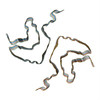
Movie
Movie Controller


+ Open data

- Basic information
| Entry | Database: PDB / ID: 9y0s | |||||||||
|---|---|---|---|---|---|---|---|---|---|---|
| Title | CryoEM structure of alpha-synuclein fibril induced by psychosine | |||||||||
 Components Components | Alpha-synuclein | |||||||||
 Keywords Keywords | PROTEIN FIBRIL / alpha-synuclein / amyloid / lipid | |||||||||
| Function / homology |  Function and homology information Function and homology informationnegative regulation of mitochondrial electron transport, NADH to ubiquinone / response to desipramine / negative regulation of dopamine uptake involved in synaptic transmission / negative regulation of norepinephrine uptake / positive regulation of SNARE complex assembly / positive regulation of hydrogen peroxide catabolic process / supramolecular fiber / negative regulation of chaperone-mediated autophagy / regulation of synaptic vesicle recycling / regulation of reactive oxygen species biosynthetic process ...negative regulation of mitochondrial electron transport, NADH to ubiquinone / response to desipramine / negative regulation of dopamine uptake involved in synaptic transmission / negative regulation of norepinephrine uptake / positive regulation of SNARE complex assembly / positive regulation of hydrogen peroxide catabolic process / supramolecular fiber / negative regulation of chaperone-mediated autophagy / regulation of synaptic vesicle recycling / regulation of reactive oxygen species biosynthetic process / positive regulation of protein localization to cell periphery / negative regulation of exocytosis / dopamine biosynthetic process / dopamine uptake involved in synaptic transmission / negative regulation of dopamine metabolic process / response to iron(II) ion / negative regulation of platelet-derived growth factor receptor signaling pathway / SNARE complex assembly / negative regulation of microtubule polymerization / negative regulation of thrombin-activated receptor signaling pathway / synaptic vesicle priming / Lewy body / synaptic vesicle transport / regulation of norepinephrine uptake / synaptic vesicle exocytosis / transporter regulator activity / protein kinase inhibitor activity / positive regulation of inositol phosphate biosynthetic process / positive regulation of receptor recycling / cuprous ion binding / positive regulation of exocytosis / nuclear outer membrane / dynein complex binding / synaptic transmission, dopaminergic / regulation of dopamine secretion / positive regulation of endocytosis / response to magnesium ion / negative regulation of serotonin uptake / kinesin binding / cysteine-type endopeptidase inhibitor activity / regulation of presynapse assembly / synaptic vesicle endocytosis / alpha-tubulin binding / beta-tubulin binding / phospholipase binding / behavioral response to cocaine / cellular response to fibroblast growth factor stimulus / supramolecular fiber organization / response to type II interferon / cellular response to epinephrine stimulus / inclusion body / response to interleukin-1 / Hsp70 protein binding / axon terminus / cellular response to copper ion / positive regulation of release of sequestered calcium ion into cytosol / enzyme inhibitor activity / glutathione metabolic process / SNARE binding / protein tetramerization / regulation of microtubule cytoskeleton organization / phosphoprotein binding / receptor internalization / protein destabilization / microglial cell activation / tubulin binding / ferrous iron binding / protein sequestering activity / phospholipid binding / synapse organization / PKR-mediated signaling / tau protein binding / enzyme activator activity / positive regulation of inflammatory response / actin cytoskeleton / terminal bouton / synaptic vesicle membrane / negative regulation of neuron apoptotic process / histone binding / actin binding / response to lipopolysaccharide / growth cone / cellular response to oxidative stress / cell cortex / oxidoreductase activity / microtubule binding / amyloid fibril formation / mitochondrial outer membrane / lysosome / transcription cis-regulatory region binding / mitochondrial inner membrane / positive regulation of apoptotic process / ribosome / mitochondrial matrix / Amyloid fiber formation / copper ion binding / protein domain specific binding / axon / lipid binding / neuronal cell body Similarity search - Function | |||||||||
| Biological species |  Homo sapiens (human) Homo sapiens (human) | |||||||||
| Method | ELECTRON MICROSCOPY / helical reconstruction / cryo EM / Resolution: 2.72 Å | |||||||||
 Authors Authors | Jenkins, R.A. / Sun, C.Q. / Sawaya, M.R. / Rodriguez, J.A. | |||||||||
| Funding support |  United States, 2items United States, 2items
| |||||||||
 Citation Citation | Journal: bioRxiv / Year: 2025 Title: Leveraging bioorthogonal conjugation for alpha synuclein fibril surveillance. Authors: Rebecca A Jenkins / Samantha Wu / Gretchen Fujimura / Andrés Heredia / Cameron W Flowers / Chuanqi Sun / Michael R Sawaya / Joseph A Loo / Jose A Rodriguez / Abstract: Alpha synuclein (α-syn) amyloid fibrils are associated with various neurodegenerative diseases. To better understand the molecular and cellular basis for α-syn fibril persistence and spread, we ...Alpha synuclein (α-syn) amyloid fibrils are associated with various neurodegenerative diseases. To better understand the molecular and cellular basis for α-syn fibril persistence and spread, we implemented a fluorophore labeling strategy to surveil pre-formed α-syn fibrils in solution and in cells. We leveraged amber codon mediated incorporation of a tetrazine-based artificial amino acid (TetV2.0) to install a cyclooctene-conjugated Janeliaflour, JF549, at four sites on human α-syn: residues 4, 60, 96 and 136. Fast coupling occurred under mild buffer conditions and in the presence of the disease-associated cofactor and cytotoxic lipid, psychosine. Labeled fibrils retained their polymorphic features, seeded the growth of new fibrils , and induced the seeding of positive puncta in α-syn FRET biosensor HEK293T cells. This allowed simultaneous tracking of exogenous and endogenous α-syn aggregates in biosensor cells, and their localization within the cells. In doing so, our approach facilitates more detailed mechanistic investigation of α-syn aggregates. | |||||||||
| History |
|
- Structure visualization
| Structure viewer | Molecule: MolmilJmol/JSmol |
|---|
- Downloads & links
-Download
| PDBx/mmCIF format | 9y0s.cif.gz | 100.8 KB | Display | PDBx/mmCIF format |
|---|---|---|---|---|
| PDB format | pdb9y0s.ent.gz | 75.4 KB | Display | PDB format |
| PDBx/mmJSON format | 9y0s.json.gz | Tree view | PDBx/mmJSON format | |
| Others |  Other downloads Other downloads |
-Validation report
| Arichive directory | https://data.pdbj.org/pub/pdb/validation_reports/y0/9y0sftp://data.pdbj.org/pub/pdb/validation_reports/y0/9y0s | HTTPS FTP |
|---|
-Related structure data
| Related structure data |  72396MC M: map data used to model this data C: citing same article ( |
|---|---|
| Similar structure data |
-Links
 PDBj
PDBj
- Assembly
| Deposited unit | 
|
|---|---|
| 1 |
|
-Components
| #1: Protein | Mass: 14476.108 Da / Num. of mol.: 10 Source method: isolated from a genetically manipulated source Source: (gene. exp.) Homo sapiens (human) / Gene: SNCA, NACP, PARK1 / Production host:   Escherichia coli (E. coli) / References: UniProt: P37840 Escherichia coli (E. coli) / References: UniProt: P37840Has protein modification | N | |
|---|
-Experimental details
-Experiment
| Experiment | Method: ELECTRON MICROSCOPY |
|---|---|
| EM experiment | Aggregation state: FILAMENT / 3D reconstruction method: helical reconstruction |
- Sample preparation
| Component | Name: alpha-synuclein fibril with psychosine / Type: COMPLEX / Entity ID: all / Source: RECOMBINANT |
|---|---|
| Molecular weight | Value: 14.4 kDa/nm / Experimental value: NO |
| Source (natural) | Organism: Homo sapiens (human) |
| Source (recombinant) | Organism: Escherichia coli (E. coli) |
| Buffer solution | pH: 8 / Details: 20 mM Tris-HCl, 150 mM NaCl |
| Specimen | Conc.: 2.5 mg/ml / Embedding applied: NO / Shadowing applied: NO / Staining applied: NO / Vitrification applied: YES Details: Monomer agitated to form fibrils in the presence of psychosine. |
| Specimen support | Grid material: COPPER / Grid mesh size: 300 divisions/in. / Grid type: Quantifoil R1.2/1.3 |
| Vitrification | Instrument: FEI VITROBOT MARK IV / Cryogen name: ETHANE / Humidity: 100 % / Chamber temperature: 277.15 K |
- Electron microscopy imaging
| Experimental equipment |  Model: Titan Krios / Image courtesy: FEI Company |
|---|---|
| Microscopy | Model: TFS KRIOS |
| Electron gun | Electron source:  FIELD EMISSION GUN / Accelerating voltage: 300 kV / Illumination mode: FLOOD BEAM FIELD EMISSION GUN / Accelerating voltage: 300 kV / Illumination mode: FLOOD BEAM |
| Electron lens | Mode: BRIGHT FIELD / Nominal magnification: 130000 X / Nominal defocus max: 2500 nm / Nominal defocus min: 1500 nm |
| Specimen holder | Cryogen: NITROGEN / Specimen holder model: FEI TITAN KRIOS AUTOGRID HOLDER |
| Image recording | Electron dose: 40 e/Å2 / Film or detector model: TFS FALCON 4i (4k x 4k) / Num. of grids imaged: 1 / Num. of real images: 1641 |
- Processing
| EM software |
| ||||||||||||||||||||||||
|---|---|---|---|---|---|---|---|---|---|---|---|---|---|---|---|---|---|---|---|---|---|---|---|---|---|
| CTF correction | Type: NONE | ||||||||||||||||||||||||
| Helical symmerty | Angular rotation/subunit: 179.41 ° / Axial rise/subunit: 2.5 Å / Axial symmetry: C1 | ||||||||||||||||||||||||
| Particle selection | Num. of particles selected: 116649 | ||||||||||||||||||||||||
| 3D reconstruction | Resolution: 2.72 Å / Resolution method: FSC 0.143 CUT-OFF / Num. of particles: 18458 / Symmetry type: HELICAL | ||||||||||||||||||||||||
| Atomic model building | Protocol: OTHER | ||||||||||||||||||||||||
| Atomic model building | PDB-ID: 6h6b Accession code: 6h6b / Source name: PDB / Type: experimental model | ||||||||||||||||||||||||
| Refinement | Highest resolution: 2.72 Å / Cross valid method: NONE Stereochemistry target values: REAL-SPACE (WEIGHTED MAP SUM AT ATOM CENTERS) | ||||||||||||||||||||||||
| Refine LS restraints |
|