- PDB-9xpl: Crystal structure of the pufferfish taste receptor Tas1r1-Tas1r3 ... -
+
Open data
ID or keywords:
Loading...
-
Basic information
Entry
Database: PDB / ID: 9xpl
Title
Crystal structure of the pufferfish taste receptor Tas1r1-Tas1r3 ligand binding domains in complex with D-phenylalanine
Components
Taste receptor type 1 member 3
Taste receptor, type 1, member 1
Keywords
SIGNALING PROTEIN / Taste receptor
Function / homology
Function and homology information
sensory perception of umami taste / sensory perception of sweet taste / sensory perception of taste / G protein-coupled receptor activity / plasma membrane Similarity search - Function
GPCR, family 3, extracellular calcium-sensing receptor-related / G-protein coupled receptors family 3 signature 3. / G-protein coupled receptors family 3 signature 2. / GPCR, family 3, nine cysteines domain / GPCR, family 3, nine cysteines domain superfamily / Nine Cysteines Domain of family 3 GPCR / GPCR, family 3, conserved site / GPCR, family 3 / G-protein coupled receptors family 3 profile. / GPCR family 3, C-terminal ...GPCR, family 3, extracellular calcium-sensing receptor-related / G-protein coupled receptors family 3 signature 3. / G-protein coupled receptors family 3 signature 2. / GPCR, family 3, nine cysteines domain / GPCR, family 3, nine cysteines domain superfamily / Nine Cysteines Domain of family 3 GPCR / GPCR, family 3, conserved site / GPCR, family 3 / G-protein coupled receptors family 3 profile. / GPCR family 3, C-terminal / 7 transmembrane sweet-taste receptor of 3 GCPR / Receptor, ligand binding region / Receptor family ligand binding region / Periplasmic binding protein-like I Similarity search - Domain/homology
In the structure databanks used in Yorodumi, some data are registered as the other names, "COVID-19 virus" and "2019-nCoV". Here are the details of the virus and the list of structure data.
Jan 31, 2019. EMDB accession codes are about to change! (news from PDBe EMDB page)
EMDB accession codes are about to change! (news from PDBe EMDB page)
The allocation of 4 digits for EMDB accession codes will soon come to an end. Whilst these codes will remain in use, new EMDB accession codes will include an additional digit and will expand incrementally as the available range of codes is exhausted. The current 4-digit format prefixed with “EMD-” (i.e. EMD-XXXX) will advance to a 5-digit format (i.e. EMD-XXXXX), and so on. It is currently estimated that the 4-digit codes will be depleted around Spring 2019, at which point the 5-digit format will come into force.
The EM Navigator/Yorodumi systems omit the EMD- prefix.
Related info.:Q: What is EMD? / ID/Accession-code notation in Yorodumi/EM Navigator
Yorodumi is a browser for structure data from EMDB, PDB, SASBDB, etc.
This page is also the successor to EM Navigator detail page, and also detail information page/front-end page for Omokage search.
The word "yorodu" (or yorozu) is an old Japanese word meaning "ten thousand". "mi" (miru) is to see.
Related info.:EMDB / PDB / SASBDB / Comparison of 3 databanks / Yorodumi Search / Aug 31, 2016. New EM Navigator & Yorodumi / Yorodumi Papers / Jmol/JSmol / Function and homology information / Changes in new EM Navigator and Yorodumi
 Movie
Movie Controller

 Yorodumi
 Open data
 Basic information
 Components
 Keywords
 Function and homology information
 Takifugu rubripes (torafugu)
 X-RAY DIFFRACTION /
  Authors
 Japan, 4items
  Citation
 Structure visualization
 Downloads & links
 Other downloads

 PDBj
PDBj
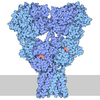
 Assembly

 Drosophila melanogaster (fruit fly) / References: UniProt: Q2MHK1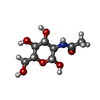
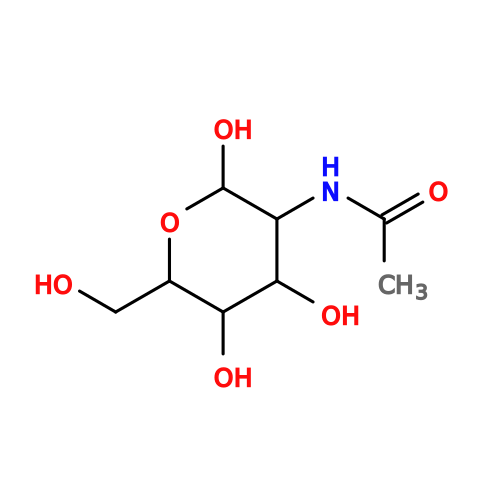 Type: D-saccharide, beta linking / Mass: 221.208 Da / Num. of mol.: 5 / Source method: obtained synthetically / Formula: C8H15NO6 / Feature type: SUBJECT OF INVESTIGATION


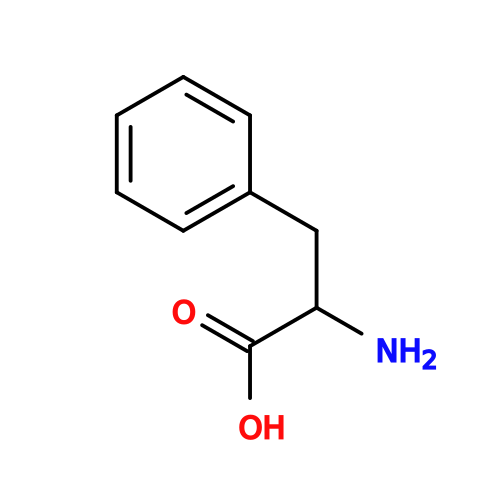 Type: D-peptide linking / Mass: 165.189 Da / Num. of mol.: 2 / Source method: obtained synthetically / Formula: C9H11NO2 / Feature type: SUBJECT OF INVESTIGATION / Comment: medication, antidepressant, inhibitor*YM
 Mass: 22.990 Da / Num. of mol.: 1 / Source method: obtained synthetically / Formula: Na / Feature type: SUBJECT OF INVESTIGATION
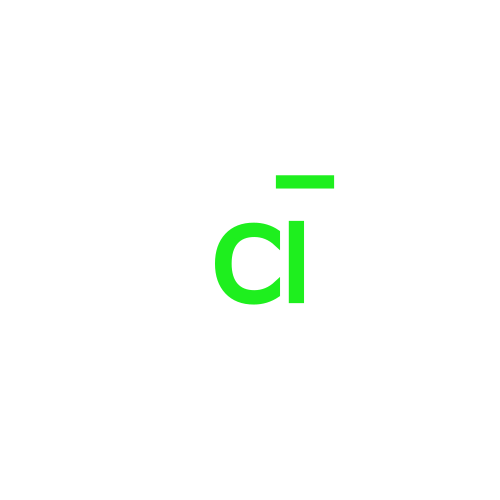 Mass: 35.453 Da / Num. of mol.: 1 / Source method: obtained synthetically / Formula: Cl / Feature type: SUBJECT OF INVESTIGATION
 Sample preparation
 Processing