 Movie
Movie Controller


+ Open data

- Basic information
| Entry | Database: PDB / ID: 9x4x | ||||||||||||
|---|---|---|---|---|---|---|---|---|---|---|---|---|---|
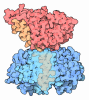
| Title | Cryo-EM structure of HSP90-CDC37-PINK1 complex | ||||||||||||
 Components Components |
| ||||||||||||
 Keywords Keywords | PROTEIN BINDING / chaperone / kinase / protein complex | ||||||||||||
| Function / homology |  Function and homology information Function and homology informationpositive regulation of cristae formation / positive regulation of free ubiquitin chain polymerization / regulation of type II interferon-mediated signaling pathway / regulation of protein localization to mitochondrion / mitochondrion to lysosome vesicle-mediated transport / maintenance of protein location in mitochondrion / protein kinase B binding / cellular response to hydrogen sulfide / negative regulation of proteasomal protein catabolic process / Aryl hydrocarbon receptor signalling ...positive regulation of cristae formation / positive regulation of free ubiquitin chain polymerization / regulation of type II interferon-mediated signaling pathway / regulation of protein localization to mitochondrion / mitochondrion to lysosome vesicle-mediated transport / maintenance of protein location in mitochondrion / protein kinase B binding / cellular response to hydrogen sulfide / negative regulation of proteasomal protein catabolic process / Aryl hydrocarbon receptor signalling / regulation of autophagy of mitochondrion / positive regulation of mitochondrial electron transport, NADH to ubiquinone / regulation of oxidative phosphorylation / C3HC4-type RING finger domain binding / negative regulation of hypoxia-induced intrinsic apoptotic signaling pathway / regulation of synaptic vesicle transport / aryl hydrocarbon receptor complex / negative regulation of hydrogen peroxide-induced neuron intrinsic apoptotic signaling pathway / negative regulation of autophagosome assembly / regulation of hydrogen peroxide metabolic process / regulation of cellular response to oxidative stress / histone methyltransferase binding / positive regulation of type 2 mitophagy / dynein axonemal particle / positive regulation of protein localization to cell surface / autophagy of mitochondrion / receptor ligand inhibitor activity / protein kinase regulator activity / negative regulation of mitophagy / cellular response to toxic substance / regulation of cyclin-dependent protein serine/threonine kinase activity / regulation of mitochondrion organization / negative regulation of oxidative stress-induced neuron intrinsic apoptotic signaling pathway / ATP-dependent protein binding / TORC2 signaling / negative regulation of JNK cascade / negative regulation of reactive oxygen species metabolic process / regulation of reactive oxygen species metabolic process / peptidase activator activity / positive regulation of mitochondrial fission / post-transcriptional regulation of gene expression / HSP90-CDC37 chaperone complex / telomerase holoenzyme complex assembly / positive regulation of protein localization to mitochondrion / Respiratory syncytial virus genome replication / negative regulation of intrinsic apoptotic signaling pathway / FOXO-mediated transcription of cell death genes / astrocyte projection / negative regulation of intrinsic apoptotic signaling pathway in response to hydrogen peroxide / Drug-mediated inhibition of ERBB2 signaling / Resistance of ERBB2 KD mutants to trastuzumab / Resistance of ERBB2 KD mutants to sapitinib / Resistance of ERBB2 KD mutants to tesevatinib / Resistance of ERBB2 KD mutants to neratinib / Resistance of ERBB2 KD mutants to osimertinib / Resistance of ERBB2 KD mutants to afatinib / Resistance of ERBB2 KD mutants to AEE788 / Resistance of ERBB2 KD mutants to lapatinib / Drug resistance in ERBB2 TMD/JMD mutants / Uptake and function of diphtheria toxin / regulation of type I interferon-mediated signaling pathway / positive regulation of transforming growth factor beta receptor signaling pathway / hemopoiesis / dendritic growth cone / TPR domain binding / positive regulation of release of cytochrome c from mitochondria / Assembly and release of respiratory syncytial virus (RSV) virions / Lewy body / positive regulation of macroautophagy / positive regulation of ATP biosynthetic process / Sema3A PAK dependent Axon repulsion / regulation of protein ubiquitination / The NLRP3 inflammasome / response to unfolded protein / protein phosphatase activator activity / HSF1-dependent transactivation / protein localization to mitochondrion / regulation of protein-containing complex assembly / Attenuation phase / protein folding chaperone complex / HSF1 activation / protein targeting / negative regulation of macroautophagy / chaperone-mediated protein complex assembly / mitophagy / axonal growth cone / response to ischemia / telomere maintenance via telomerase / negative regulation of mitochondrial fission / RHOBTB2 GTPase cycle / Purinergic signaling in leishmaniasis infection / Dengue virus activates/modulates innate and adaptive immune responses / heat shock protein binding / Signaling by ERBB2 / DNA polymerase binding / peptide binding / supramolecular fiber organization / protein folding chaperone / ESR-mediated signaling / negative regulation of proteasomal ubiquitin-dependent protein catabolic process Similarity search - Function | ||||||||||||
| Biological species |  Homo sapiens (human) Homo sapiens (human) | ||||||||||||
| Method | ELECTRON MICROSCOPY / single particle reconstruction / cryo EM / Resolution: 3.08 Å | ||||||||||||
 Authors Authors | Okatsu, K. / Fukai, S. | ||||||||||||
| Funding support |  Japan, 3items Japan, 3items
| ||||||||||||
 Citation Citation | Journal: To Be Published Title: Structural basis for the folding of PINK1 by the HSP90-CDC37 chaperone complex Authors: Okatsu, K. / Yamamoto, H. / Okamoto, A. / Nishimoto, Y. / Fukai, S. | ||||||||||||
| History |
|
- Structure visualization
| Structure viewer | Molecule: MolmilJmol/JSmol |
|---|
- Downloads & links
-Download
| PDBx/mmCIF format | 9x4x.cif.gz | 329.8 KB | Display | PDBx/mmCIF format |
|---|---|---|---|---|
| PDB format | pdb9x4x.ent.gz | 258.6 KB | Display | PDB format |
| PDBx/mmJSON format | 9x4x.json.gz | Tree view | PDBx/mmJSON format | |
| Others |  Other downloads Other downloads |
-Validation report
| Arichive directory | https://data.pdbj.org/pub/pdb/validation_reports/x4/9x4xftp://data.pdbj.org/pub/pdb/validation_reports/x4/9x4x | HTTPS FTP |
|---|
-Related structure data
| Related structure data |  66567MC M: map data used to model this data C: citing same article ( |
|---|---|
| Similar structure data |
-Links
 PDBj
PDBj

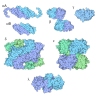
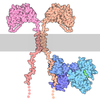
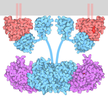
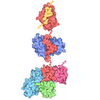
- Assembly
| Deposited unit | 
|
|---|---|
| 1 |
|
-Components
| #1: Protein | Mass: 44622.363 Da / Num. of mol.: 1 Source method: isolated from a genetically manipulated source Source: (gene. exp.) Homo sapiens (human) / Gene: CDC37, CDC37A / Production host:   Spodoptera frugiperda (fall armyworm) / References: UniProt: Q16543 Spodoptera frugiperda (fall armyworm) / References: UniProt: Q16543 | ||||||||
|---|---|---|---|---|---|---|---|---|---|
| #2: Protein | Mass: 53054.270 Da / Num. of mol.: 1 / Fragment: residues 104-581 / Mutation: F104M Source method: isolated from a genetically manipulated source Details: C-terminal His8-tag / Source: (gene. exp.) Homo sapiens (human) / Gene: PINK1 / Production host: Spodoptera frugiperda (fall armyworm)References: UniProt: Q9BXM7, non-specific serine/threonine protein kinase | ||||||||
| #3: Protein | Mass: 83384.250 Da / Num. of mol.: 2 Source method: isolated from a genetically manipulated source Source: (gene. exp.) Homo sapiens (human) / Gene: HSP90AB1, HSP90B, HSPC2, HSPC3, HSPCB / Production host: Spodoptera frugiperda (fall armyworm) / References: UniProt: P08238#4: Chemical | 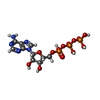 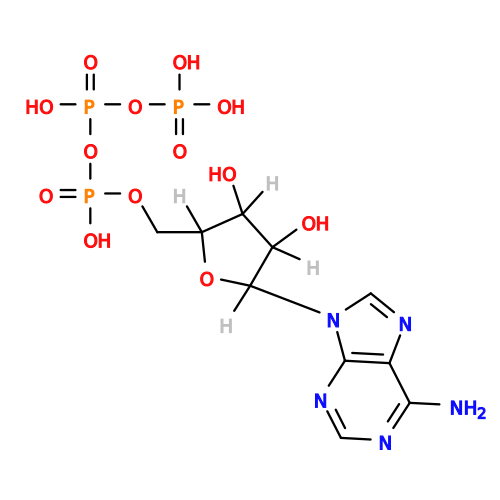 Mass: 507.181 Da / Num. of mol.: 2 / Source method: obtained synthetically / Formula: C10H16N5O13P3 / Feature type: SUBJECT OF INVESTIGATION / Comment: ATP, energy-carrying molecule*YM Mass: 507.181 Da / Num. of mol.: 2 / Source method: obtained synthetically / Formula: C10H16N5O13P3 / Feature type: SUBJECT OF INVESTIGATION / Comment: ATP, energy-carrying molecule*YM#5: Chemical |   Mass: 24.305 Da / Num. of mol.: 2 / Source method: obtained synthetically / Formula: Mg / Feature type: SUBJECT OF INVESTIGATION Mass: 24.305 Da / Num. of mol.: 2 / Source method: obtained synthetically / Formula: Mg / Feature type: SUBJECT OF INVESTIGATIONHas ligand of interest | Y | Has protein modification | Y | |
-Experimental details
-Experiment
| Experiment | Method: ELECTRON MICROSCOPY |
|---|---|
| EM experiment | Aggregation state: PARTICLE / 3D reconstruction method: single particle reconstruction |
- Sample preparation
| Component | Name: tetrameric complex of PINK1 with an HSP90 dimer and CDC37 Type: COMPLEX / Entity ID: #1-#3 / Source: RECOMBINANT |
|---|---|
| Molecular weight | Experimental value: NO |
| Source (natural) | Organism: Homo sapiens (human) |
| Source (recombinant) | Organism: Spodoptera frugiperda (fall armyworm) |
| Buffer solution | pH: 8 Details: 50mM Tris-HCl pH 8.0, 150mM NaCl, 10mM MgCl2, 10mM KCl, 20mM Na2MoO4 |
| Specimen | Conc.: 0.67 mg/ml / Embedding applied: NO / Shadowing applied: NO / Staining applied: NO / Vitrification applied: YES |
| Specimen support | Grid material: COPPER / Grid mesh size: 300 divisions/in. / Grid type: Quantifoil R1.2/1.3 |
| Vitrification | Instrument: FEI VITROBOT MARK IV / Cryogen name: ETHANE / Humidity: 100 % |
- Electron microscopy imaging
| Microscopy | Model: TFS GLACIOS |
|---|---|
| Electron gun | Electron source:  FIELD EMISSION GUN / Accelerating voltage: 200 kV / Illumination mode: OTHER FIELD EMISSION GUN / Accelerating voltage: 200 kV / Illumination mode: OTHER |
| Electron lens | Mode: BRIGHT FIELD / Nominal magnification: 190000 X / Nominal defocus max: 1600 nm / Nominal defocus min: 800 nm / Cs: 2.7 mm |
| Image recording | Electron dose: 50 e/Å2 / Film or detector model: FEI FALCON IV (4k x 4k) |
- Processing
| EM software |
| ||||||||||||||||||||||||
|---|---|---|---|---|---|---|---|---|---|---|---|---|---|---|---|---|---|---|---|---|---|---|---|---|---|
| CTF correction | Type: PHASE FLIPPING ONLY | ||||||||||||||||||||||||
| 3D reconstruction | Resolution: 3.08 Å / Resolution method: FSC 0.143 CUT-OFF / Num. of particles: 454727 / Symmetry type: POINT | ||||||||||||||||||||||||
| Refinement | Highest resolution: 3.08 Å Stereochemistry target values: REAL-SPACE (WEIGHTED MAP SUM AT ATOM CENTERS) | ||||||||||||||||||||||||
| Refine LS restraints |
|
