 Movie
Movie Controller


+ Open data

- Basic information
| Entry | Database: PDB / ID: 9x4h | |||||||||||||||||||||||||||
|---|---|---|---|---|---|---|---|---|---|---|---|---|---|---|---|---|---|---|---|---|---|---|---|---|---|---|---|---|
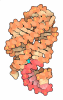
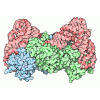
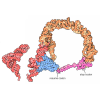
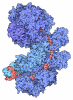
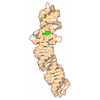
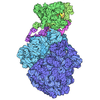
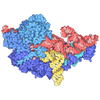
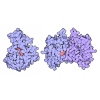
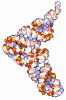
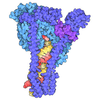
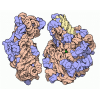
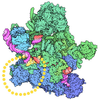
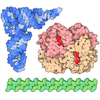
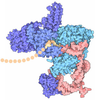
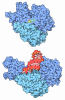
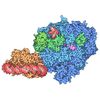
| Title | Structure Of the KEOPS-tRNA | |||||||||||||||||||||||||||
 Components Components |
| |||||||||||||||||||||||||||
 Keywords Keywords | TRANSFERASE/RNA / tRNA modification / t6A / KEOPS-tRNA complex / cryo-EM structure / substrate recognition / catalytic mechanism / regulation principle / TRANSFERASE-RNA complex | |||||||||||||||||||||||||||
| Function / homology |  Function and homology information Function and homology informationN6-L-threonylcarbamoyladenine synthase / tRNA N(6)-L-threonylcarbamoyladenine synthase activity / EKC/KEOPS complex / tRNA threonylcarbamoyladenosine metabolic process / tRNA threonylcarbamoyladenosine modification / tRNA processing / non-specific serine/threonine protein kinase / protein serine/threonine kinase activity / ATP binding / metal ion binding ...N6-L-threonylcarbamoyladenine synthase / tRNA N(6)-L-threonylcarbamoyladenine synthase activity / EKC/KEOPS complex / tRNA threonylcarbamoyladenosine metabolic process / tRNA threonylcarbamoyladenosine modification / tRNA processing / non-specific serine/threonine protein kinase / protein serine/threonine kinase activity / ATP binding / metal ion binding / nucleus / cytosol / cytoplasm Similarity search - Function | |||||||||||||||||||||||||||
| Biological species |   Caenorhabditis elegans (invertebrata) Caenorhabditis elegans (invertebrata) | |||||||||||||||||||||||||||
| Method | ELECTRON MICROSCOPY / single particle reconstruction / cryo EM / Resolution: 3.36 Å | |||||||||||||||||||||||||||
 Authors Authors | Zhang, Z.L. / Zhou, L. / Jin, M.Q. / Lei, D.S. / Zhang, W.H. | |||||||||||||||||||||||||||
| Funding support |  China, 1items China, 1items
| |||||||||||||||||||||||||||
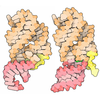
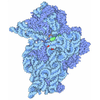
 Citation Citation | Journal: Nat Commun / Year: 2026 Title: Catalytic and regulatory basis of tRNA tA modification by the KEOPS complex. Authors: Li Zhou / Zelin Zhang / Mengqi Jin / Dengmiao Xie / Han Wen / Eric Westhof / Dongsheng Lei / Wenhua Zhang /  Abstract: N-threonylcarbamoyladenosine (tA) at tRNA position 37 is essential for translational fidelity and cellular homeostasis. The multi-subunit KEOPS complex catalyzes tA formation in Archaea and Eukarya. ...N-threonylcarbamoyladenosine (tA) at tRNA position 37 is essential for translational fidelity and cellular homeostasis. The multi-subunit KEOPS complex catalyzes tA formation in Archaea and Eukarya. Here we present cryo-EM structures of C. elegans KEOPS in its apo and tRNA-bound states. tRNA binding induces concerted conformational rearrangements, distorting the anticodon loop to project A37 into the Kae1 active site. Kae1 recognizes the conserved G10-C25 pair and 36-UAA-38 motif. Bud32 directly contacts the anticodon and acceptor arms, coupling ATP hydrolysis to tA catalysis in the distant Kae1 active site through long-range conformational changes. Cgi121 enhances catalytic efficiency through cooperative binding with Bud32 and the tRNA 3' CCA. Pcc1 stabilizes the anticodon loop and mediates KEOPS dimerization, enhancing tRNA binding and tA activity. GAMOS-associated mutations cluster at functional hotspots within the KEOPS-tRNA complex. This study provides a structural framework for understanding KEOPS mechanism and its cellular roles. | |||||||||||||||||||||||||||
| History |
|
- Structure visualization
| Structure viewer | Molecule: MolmilJmol/JSmol |
|---|
- Downloads & links
-Download
| PDBx/mmCIF format | 9x4h.cif.gz | 268.1 KB | Display | PDBx/mmCIF format |
|---|---|---|---|---|
| PDB format | pdb9x4h.ent.gz | 206.7 KB | Display | PDB format |
| PDBx/mmJSON format | 9x4h.json.gz | Tree view | PDBx/mmJSON format | |
| Others |  Other downloads Other downloads |
-Validation report
| Arichive directory | https://data.pdbj.org/pub/pdb/validation_reports/x4/9x4hftp://data.pdbj.org/pub/pdb/validation_reports/x4/9x4h | HTTPS FTP |
|---|
-Related structure data
| Related structure data |  66545MC  9x4gC M: map data used to model this data C: citing same article ( |
|---|---|
| Similar structure data | |
| Other databases |


-Links
 PDBj
PDBj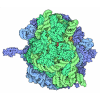
- Assembly
| Deposited unit | 
|
|---|---|
| 1 |
|
-Components
-Protein , 4 types, 6 molecules AFBCDE
| #1: Protein | Mass: 36859.742 Da / Num. of mol.: 2 Source method: isolated from a genetically manipulated source Source: (gene. exp.) Caenorhabditis elegans (invertebrata) / Gene: CELE_Y71H2AM.1, Y71H2AM.1 / Production host:   Escherichia coli (E. coli) Escherichia coli (E. coli)References: UniProt: Q9BL28, N6-L-threonylcarbamoyladenine synthase #2: Protein | | Mass: 27544.473 Da / Num. of mol.: 1 Source method: isolated from a genetically manipulated source Source: (gene. exp.) Caenorhabditis elegans (invertebrata) / Gene: CELE_F52C12.6, F52C12.6 / Production host: Escherichia coli (E. coli)References: UniProt: B5WWL2, non-specific serine/threonine protein kinase #3: Protein | | Mass: 20215.439 Da / Num. of mol.: 1 Source method: isolated from a genetically manipulated source Source: (gene. exp.) Caenorhabditis elegans (invertebrata) / Gene: CELE_W03F8.4, W03F8.4 / Production host: Escherichia coli (E. coli) / References: UniProt: O44566#4: Protein | Mass: 13223.827 Da / Num. of mol.: 2 Source method: isolated from a genetically manipulated source Source: (gene. exp.) Caenorhabditis elegans (invertebrata) / Gene: CELE_F59A2.5, F59A2.5 / Production host: Escherichia coli (E. coli) / References: UniProt: Q21019 |
|---|
-RNA chain / Non-polymers , 2 types, 3 molecules T
| #5: RNA chain | Mass: 24555.592 Da / Num. of mol.: 1 Source method: isolated from a genetically manipulated source Source: (gene. exp.) Caenorhabditis elegans (invertebrata) / Production host: Escherichia coli (E. coli) |
|---|---|
| #6: Chemical |  Mass: 39.098 Da / Num. of mol.: 2 / Source method: obtained synthetically / Formula: K / Feature type: SUBJECT OF INVESTIGATION Mass: 39.098 Da / Num. of mol.: 2 / Source method: obtained synthetically / Formula: K / Feature type: SUBJECT OF INVESTIGATION |
-Details
| Has ligand of interest | Y |
|---|---|
| Has protein modification | N |
-Experimental details
-Experiment
| Experiment | Method: ELECTRON MICROSCOPY |
|---|---|
| EM experiment | Aggregation state: PARTICLE / 3D reconstruction method: single particle reconstruction |
- Sample preparation
| Component | Name: CeKEOPS-tRNA / Type: COMPLEX / Entity ID: #1-#5 / Source: RECOMBINANT |
|---|---|
| Molecular weight | Experimental value: NO |
| Source (natural) | Organism: Caenorhabditis elegans (invertebrata) |
| Source (recombinant) | Organism: Escherichia coli (E. coli) |
| Buffer solution | pH: 7.5 |
| Specimen | Embedding applied: NO / Shadowing applied: NO / Staining applied: NO / Vitrification applied: YES |
| Vitrification | Instrument: FEI VITROBOT MARK IV / Cryogen name: ETHANE |
- Electron microscopy imaging
| Experimental equipment |  Model: Titan Krios / Image courtesy: FEI Company |
|---|---|
| Microscopy | Model: TFS KRIOS |
| Electron gun | Electron source:  FIELD EMISSION GUN / Accelerating voltage: 300 kV / Illumination mode: FLOOD BEAM FIELD EMISSION GUN / Accelerating voltage: 300 kV / Illumination mode: FLOOD BEAM |
| Electron lens | Mode: BRIGHT FIELD / Nominal magnification: 105000 X / Nominal defocus max: 2200 nm / Nominal defocus min: 800 nm / Cs: 2.7 mm |
| Image recording | Electron dose: 60 e/Å2 / Film or detector model: GATAN K3 BIOQUANTUM (6k x 4k) |
- Processing
| EM software |
| |||||||||||||||||||||||||||||||||
|---|---|---|---|---|---|---|---|---|---|---|---|---|---|---|---|---|---|---|---|---|---|---|---|---|---|---|---|---|---|---|---|---|---|---|
| CTF correction | Type: PHASE FLIPPING AND AMPLITUDE CORRECTION | |||||||||||||||||||||||||||||||||
| 3D reconstruction | Resolution: 3.36 Å / Resolution method: FSC 0.143 CUT-OFF / Num. of particles: 123388 / Symmetry type: POINT | |||||||||||||||||||||||||||||||||
| Refinement | Highest resolution: 3.36 Å Stereochemistry target values: REAL-SPACE (WEIGHTED MAP SUM AT ATOM CENTERS) | |||||||||||||||||||||||||||||||||
| Refine LS restraints |
|
