 Movie
Movie Controller


+ Open data

- Basic information
| Entry | Database: PDB / ID: 9wqv | |||||||||||||||||||||||||||
|---|---|---|---|---|---|---|---|---|---|---|---|---|---|---|---|---|---|---|---|---|---|---|---|---|---|---|---|---|
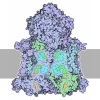
| Title | Cryo-EM structure of LH1-RC from Rhodovulum sulfidophilum | |||||||||||||||||||||||||||
 Components Components |
| |||||||||||||||||||||||||||
 Keywords Keywords | PHOTOSYNTHESIS / light harvesting complex 1 / Rhodovulum sulfidophilum | |||||||||||||||||||||||||||
| Function / homology |  Function and homology information Function and homology informationorganelle inner membrane / plasma membrane-derived chromatophore membrane / plasma membrane light-harvesting complex / bacteriochlorophyll binding / photosynthetic electron transport in photosystem II / photosynthesis, light reaction / electron transfer activity / iron ion binding / heme binding / metal ion binding / plasma membrane Similarity search - Function | |||||||||||||||||||||||||||
| Biological species |  Rhodovulum sulfidophilum DSM 1374 (bacteria) Rhodovulum sulfidophilum DSM 1374 (bacteria) | |||||||||||||||||||||||||||
| Method | ELECTRON MICROSCOPY / single particle reconstruction / cryo EM / Resolution: 1.81 Å | |||||||||||||||||||||||||||
 Authors Authors | Yue, X.-Y. / Wang, G.-L. / Yu, L.-J. | |||||||||||||||||||||||||||
| Funding support |  China, 3items China, 3items
| |||||||||||||||||||||||||||
 Citation Citation | Journal: Commun Biol / Year: 2026 Title: Structural insights into the photochemistry of the LH1-RC complex from the marine purple phototrophic bacterium Rhodovulum sulfidophilum. Authors: Xing-Yu Yue / Guang-Lei Wang / Shinya Kosaki / Kenji V P Nagashima / Yu-Lu Wu / Yuki Kobayashi / Tomoya Sugiyama / Ryo Kanno / Endang R Purba / Shinichi Takaichi / Toshiaki Mochizuki / Akira ...Authors: Xing-Yu Yue / Guang-Lei Wang / Shinya Kosaki / Kenji V P Nagashima / Yu-Lu Wu / Yuki Kobayashi / Tomoya Sugiyama / Ryo Kanno / Endang R Purba / Shinichi Takaichi / Toshiaki Mochizuki / Akira Mizoguchi / Bruno M Humbel / Michael T Madigan / Hiroyuki Mino / Kazutoshi Tani / Yukihiro Kimura / Zheng-Yu Wang-Otomo / Long-Jiang Yu /   Abstract: The marine purple nonsulfur phototrophic bacterium Rhodovulum (Rdv.) sulfidophilum (Alphaproteobacteria) has been a model organism for bacterial photosynthesis research because of its unusual ability ...The marine purple nonsulfur phototrophic bacterium Rhodovulum (Rdv.) sulfidophilum (Alphaproteobacteria) has been a model organism for bacterial photosynthesis research because of its unusual ability to grow phototrophically (anoxic/light) using high concentrations of inorganic or organic sulfur compounds as electron donors or by respiration under fully oxic conditions. Here we present a 1.81 Å-resolution cryo-EM structure of the light-harvesting 1-reaction center (LH1-RC) photocomplex from the Rdv. sulfidophilum type strain W4 with a focus on RC structure and function. The Rdv. sulfidophilum RC is characterized by its cytochrome (Cyt) subunit that contains three heme groups and is anchored by its intact N-terminal domain in the membrane. In contrast to a methionine as the 6th axial ligand to the heme-2 in other bacterial RC-bound triheme and tetraheme Cyt subunits, the outmost heme-2 in the Rdv. sulfidophilum Cyt subunit is ligated by a cysteine residue, resulting in a significant downshift of reduction potential of 470 mV compared to that of a methionine-ligated heme-2. A nonheme Fe ligated by a histidine of the Cyt subunit and five water molecules was identified in close proximity to heme-2, implying a potential role in electron transport from soluble electron donors to heme-2. The Rdv. sulfidophilum LH1 complex forms an open ring structure consisting of 16 αβ-subunits with a gap formed where the N-terminal transmembrane domain of the RC Cyt subunit and a newly identified protein with three helical domains (designated as protein-3h) are located. Protein-3h corresponds to the truncated N-terminal fragment of a gene product encoded by the pseudo-gene urf1 in the NADH:ubiquinone oxidoreductase (complex I) nuo operon in the genome of Rdv. sulfidophilum W4. Genes urf1 are also found in other purple nonsulfur bacteria and in aerobic anoxygenic phototrophic bacteria, and their putative products all share a common structural motif of N-terminal transmembrane U-shaped tandem helices. Based on structural and spectroscopic data, possible electron transfer pathways between the Rdv. sulfidophilum RC Cyt subunit and soluble electron donors and potential roles of protein-3h in the structural integrity of LH1-RC are discussed. | |||||||||||||||||||||||||||
| History |
|
- Structure visualization
| Structure viewer | Molecule: MolmilJmol/JSmol |
|---|
- Downloads & links
-Download
| PDBx/mmCIF format | 9wqv.cif.gz | 726 KB | Display | PDBx/mmCIF format |
|---|---|---|---|---|
| PDB format | pdb9wqv.ent.gz | Display | PDB format | |
| PDBx/mmJSON format | 9wqv.json.gz | Tree view | PDBx/mmJSON format | |
| Others |  Other downloads Other downloads |
-Validation report
| Arichive directory | https://data.pdbj.org/pub/pdb/validation_reports/wq/9wqvftp://data.pdbj.org/pub/pdb/validation_reports/wq/9wqv | HTTPS FTP |
|---|
-Related structure data
| Related structure data |  66181MC M: map data used to model this data C: citing same article ( |
|---|---|
| Similar structure data |
-Links
 PDBj
PDBj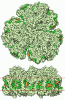
- Assembly
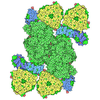
| Deposited unit | 
|
|---|---|
| 1 |
|
-Components
-Antenna pigment protein ... , 2 types, 32 molecules 02468BEGJNPRTVXZ13579ADFIKOQSUWY
| #1: Protein/peptide | Mass: 5427.191 Da / Num. of mol.: 16 / Source method: isolated from a natural source Details: The sequence of organism Rhodovulum sulfidophilum DSM 1374 is not available during the biocuration, replaced by Q9WXD9 temporarily. Source: (natural) Rhodovulum sulfidophilum DSM 1374 (bacteria)References: UniProt: Q9WXD9 #2: Protein | Mass: 6238.516 Da / Num. of mol.: 16 / Source method: isolated from a natural source Details: The sequence of organism Rhodovulum sulfidophilum DSM 1374 is not available during the biocuration, replaced by Q9WXE0 temporarily. Source: (natural) Rhodovulum sulfidophilum DSM 1374 (bacteria)References: UniProt: Q9WXE0 |
|---|
-Protein , 3 types, 3 molecules CHa
| #3: Protein | Mass: 39176.539 Da / Num. of mol.: 1 / Source method: isolated from a natural source Source: (natural) Rhodovulum sulfidophilum DSM 1374 (bacteria)References: UniProt: Q9WXE3 |
|---|---|
| #4: Protein | Mass: 28762.891 Da / Num. of mol.: 1 / Source method: isolated from a natural source Source: (natural) Rhodovulum sulfidophilum DSM 1374 (bacteria) |
| #7: Protein | Mass: 24079.639 Da / Num. of mol.: 1 / Source method: isolated from a natural source Source: (natural) Rhodovulum sulfidophilum DSM 1374 (bacteria) |
-Reaction center protein ... , 2 types, 2 molecules LM
| #5: Protein | Mass: 31674.777 Da / Num. of mol.: 1 / Source method: isolated from a natural source Details: The sequence of organism Rhodovulum sulfidophilum DSM 1374 is not available during the biocuration, replaced by Q9WXE1 temporarily. Source: (natural) Rhodovulum sulfidophilum DSM 1374 (bacteria)References: UniProt: Q9WXE1 |
|---|---|
| #6: Protein | Mass: 36508.949 Da / Num. of mol.: 1 / Source method: isolated from a natural source Details: The sequence of organism Rhodovulum sulfidophilum DSM 1374 is not available during the biocuration, replaced by Q9WXE2 temporarily. Source: (natural) Rhodovulum sulfidophilum DSM 1374 (bacteria)References: UniProt: Q9WXE2 |
-Sugars , 1 types, 10 molecules 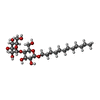
| #12: Sugar | ChemComp-LMT / 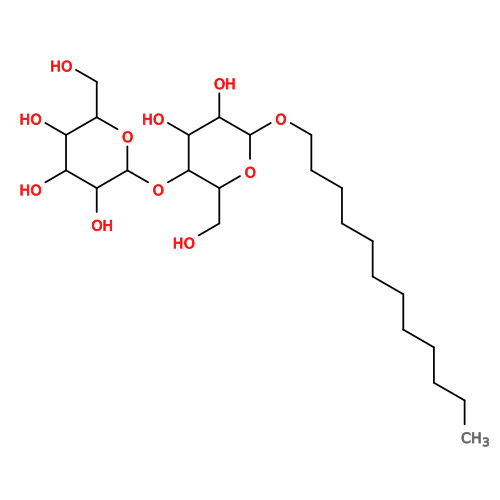 Type: D-saccharide / Mass: 510.615 Da / Num. of mol.: 10 / Source method: obtained synthetically / Formula: C24H46O11 / Comment: detergent*YM Type: D-saccharide / Mass: 510.615 Da / Num. of mol.: 10 / Source method: obtained synthetically / Formula: C24H46O11 / Comment: detergent*YM |
|---|
-Non-polymers , 11 types, 609 molecules 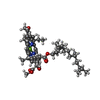
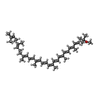
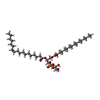
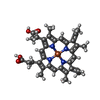



| #8: Chemical | ChemComp-BCL / 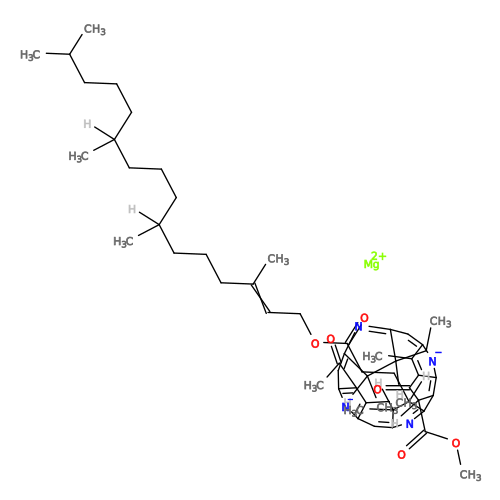 Mass: 911.504 Da / Num. of mol.: 36 / Source method: obtained synthetically / Formula: C55H74MgN4O6 / Feature type: SUBJECT OF INVESTIGATION Mass: 911.504 Da / Num. of mol.: 36 / Source method: obtained synthetically / Formula: C55H74MgN4O6 / Feature type: SUBJECT OF INVESTIGATION#9: Chemical | ChemComp-UNL / Mass: 254.494 Da / Num. of mol.: 13 / Source method: obtained synthetically #10: Chemical | ChemComp-SPO /  Mass: 568.914 Da / Num. of mol.: 16 / Source method: obtained synthetically / Formula: C41H60O / Feature type: SUBJECT OF INVESTIGATION Mass: 568.914 Da / Num. of mol.: 16 / Source method: obtained synthetically / Formula: C41H60O / Feature type: SUBJECT OF INVESTIGATION#11: Chemical | ChemComp-A1EYK / ( Mass: 554.888 Da / Num. of mol.: 14 / Source method: obtained synthetically / Formula: C40H58O / Feature type: SUBJECT OF INVESTIGATION #13: Chemical | ChemComp-PGV / ( 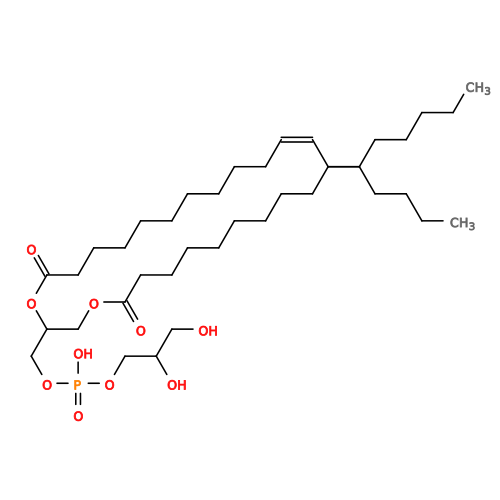 Mass: 749.007 Da / Num. of mol.: 13 / Source method: obtained synthetically / Formula: C40H77O10P / Comment: phospholipid*YM Mass: 749.007 Da / Num. of mol.: 13 / Source method: obtained synthetically / Formula: C40H77O10P / Comment: phospholipid*YM#14: Chemical |  Mass: 620.519 Da / Num. of mol.: 3 / Source method: obtained synthetically / Formula: C34H36FeN4O4 / Feature type: SUBJECT OF INVESTIGATION Mass: 620.519 Da / Num. of mol.: 3 / Source method: obtained synthetically / Formula: C34H36FeN4O4 / Feature type: SUBJECT OF INVESTIGATION#15: Chemical | ChemComp-MG /  Mass: 24.305 Da / Num. of mol.: 4 / Source method: obtained synthetically / Formula: Mg Mass: 24.305 Da / Num. of mol.: 4 / Source method: obtained synthetically / Formula: Mg#16: Chemical | 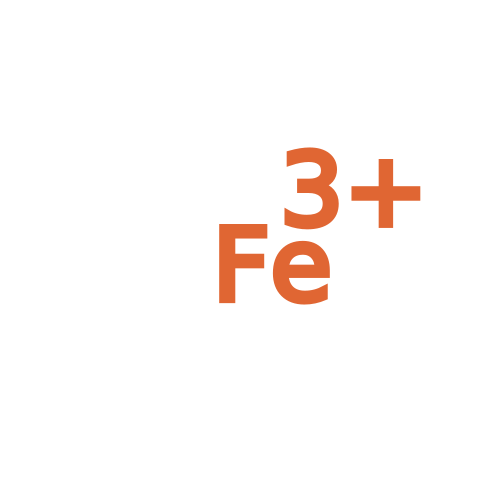 Mass: 55.845 Da / Num. of mol.: 2 / Source method: obtained synthetically / Formula: Fe Mass: 55.845 Da / Num. of mol.: 2 / Source method: obtained synthetically / Formula: Fe#17: Chemical | 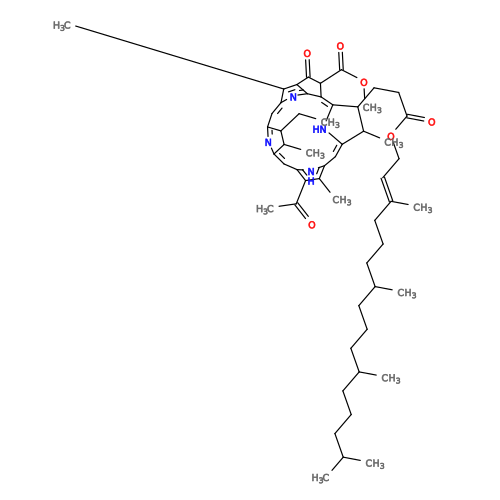 Mass: 889.215 Da / Num. of mol.: 2 / Source method: obtained synthetically / Formula: C55H76N4O6 / Feature type: SUBJECT OF INVESTIGATION Mass: 889.215 Da / Num. of mol.: 2 / Source method: obtained synthetically / Formula: C55H76N4O6 / Feature type: SUBJECT OF INVESTIGATION#18: Chemical | ChemComp-U10 / 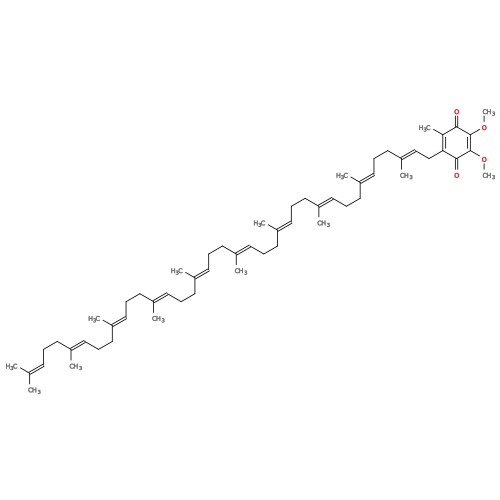 Mass: 863.343 Da / Num. of mol.: 4 / Source method: obtained synthetically / Formula: C59H90O4 / Feature type: SUBJECT OF INVESTIGATION Mass: 863.343 Da / Num. of mol.: 4 / Source method: obtained synthetically / Formula: C59H90O4 / Feature type: SUBJECT OF INVESTIGATION#19: Water | ChemComp-HOH / | Mass: 18.015 Da / Num. of mol.: 502 / Source method: isolated from a natural source / Formula: H2O |
|---|
-Details
| Has ligand of interest | Y |
|---|---|
| Has protein modification | Y |
-Experimental details
-Experiment
| Experiment | Method: ELECTRON MICROSCOPY |
|---|---|
| EM experiment | Aggregation state: PARTICLE / 3D reconstruction method: single particle reconstruction |
- Sample preparation
| Component | Name: LH1-RC / Type: COMPLEX / Entity ID: #3, #5-#6, #4, #2, #1, #7 / Source: NATURAL |
|---|---|
| Molecular weight | Experimental value: NO |
| Source (natural) | Organism: Rhodovulum sulfidophilum DSM 1374 (bacteria) |
| Buffer solution | pH: 8 |
| Specimen | Embedding applied: NO / Shadowing applied: NO / Staining applied: NO / Vitrification applied: YES |
| Vitrification | Cryogen name: ETHANE |
- Electron microscopy imaging
| Experimental equipment |  Model: Titan Krios / Image courtesy: FEI Company |
|---|---|
| Microscopy | Model: TFS KRIOS |
| Electron gun | Electron source:  FIELD EMISSION GUN / Accelerating voltage: 300 kV / Illumination mode: FLOOD BEAM FIELD EMISSION GUN / Accelerating voltage: 300 kV / Illumination mode: FLOOD BEAM |
| Electron lens | Mode: BRIGHT FIELD / Nominal defocus max: 3000 nm / Nominal defocus min: 500 nm |
| Image recording | Electron dose: 50 e/Å2 / Film or detector model: FEI FALCON IV (4k x 4k) |
- Processing
| EM software |
| ||||||||||||||||
|---|---|---|---|---|---|---|---|---|---|---|---|---|---|---|---|---|---|
| CTF correction | Type: PHASE FLIPPING ONLY | ||||||||||||||||
| 3D reconstruction | Resolution: 1.81 Å / Resolution method: FSC 0.143 CUT-OFF / Num. of particles: 108964 / Symmetry type: POINT |
